


Story and Photos by Terry W. Sheely
The Jig ‘n Bobber Technique that nails salmon & steelhead where other anglers can’t reach
At its techie heart is a precision, free-spinning specialty reel that whirls in constant confounding free-spool, that is packed with buoyant line as thin as daydreams and is married to a dozen feet of odd and lanky fast-tip rod.
It’s a system called center-pinning and when you see it at work I guarantee you’ll stop and stare. Fourteen years ago that’s exactly what happened to Bruce Belles, owner of Clackacraft Boats.
[emember_protected custom_msg=’This content is available for subscribers only.’]
On the snowy banks of Michigan’s Grand River the Oregon angler watched winter steelheaders rack up improbable catches with center-pin rigs that wiped the resentful green eyes of conventional tackle purists.
He picked up one of the curious rod and reel setups, tried it, grinned and almost immediately morphed into a center-pin loyalist. Belles fishes hard and often through Alaska and the Lower 48 and although he sidesteps the expert label he is indisputably one of the few center-pinning authorities in this part of the world.
The system is a Eurocentric hybridization of fly and spin tackle. It’s wildly, if not slightly uppity, popular on Atlantic salmon and brown trout rivers in northern Europe but surprisingly unknown on our hard-running local salmon and steelhead waters. That such an unbelievably productive system could hide on the edge of Alaska salmon and steelhead popularity may be explained by the cost of gear-($200 to $300 for the reel)-and there’s a complexity of finger dexterity required to cast that can be intimidating.
Watching Belles organize a web of line loops into his off hand, then deftly loft a cast 50 feet to a current seam while lightly palming the whirling spool, preventing overrun and controlling line spill while meticulously gliding his sliding bobber and jig precisely down 120 yards of current is both humbling and motivating.
The offsetting factor, the justification that makes this technique worth the cost and bother is that it allows anglers to snake steelhead and salmon out of overgrown hidey holes that conventional tackle would never reach.
With center-pin rigs, and a lot of practice, stream fishermen are able to free-float bobbers and jigs through a hundred yards or so of promising water, ducking around logs, dipping into pools, plunging down tunnels of alder and devil’s club, finding fish that no one else can reach.
My introduction, more of a shock than a handshake, came on a muddy, cold March river. Our guide/instructor insists that we float our ultra-light bobber-jig rigs through the flowing mocha on a current seam that wheezes a good 135 yards, much of it overhung with brush and limbs. After a few dozen traumatic falls from the learning curve, I’m assured that we’ll “get the feel.’
“Don’t worry about the cold water or the color,” my guide says, “center-pinning is made for cold water.”
I have doubts, big hulking doubts.
Which vanish a long 90 yards below the drift boat when a steelhead unloads on my partner Manuel Torrez, a Petersburg lodge guide enjoying an experimental off-season weekend. Before its abrupt sinking, Torrez’ foam bobber is just a fluorescent chartreuse dot drifting on cold mud into a tunnel of overhanging bank brush. With no help from Manuel, who is stuck in the boat almost a football field away upriver, the little number 2 bronze wire hook digs in, solidly pinning the miniscule 1/16-ounce jig to 10 wild pounds of twisting trout.
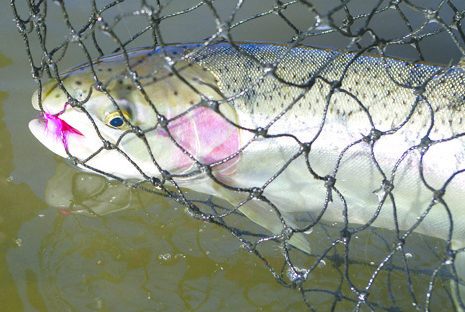 Our boatman grins. Sweet vindication!
Center-pinning, as I can best describe the technique, is a highly evolved hybrid that shares the mechanics of spinning, fly fishing, noodle-rodding jig-and-bobber drifting and a dab of side-drifting.
It can be worked from bank or boat, will cover a football field or more of water without requiring the angler to reposition and reaches deep under overhangs and dripping brush to ferret out secluded fish that other techniques can’t reach.
It’s mechanically simple if not somewhat techie, produces when water conditions are cold, muddy and nearly impossible for conventional tackle, employs thin, fine lines (10-pound-test is good, 8- is better), and will effectively deliver those high-action mini jigs that cause lethargic coldwater steelhead to come unglued.
A basic rig and rudimentary casting style will throw jigs as light as 1/32-ounce for considerable distances, and 1/16-ounce jigs easily soar 60 feet. I’m convinced that a center-pin outfit is more efficient and productive than conventional steelhead tackle when steelhead and salmon conditions are at their ugliest.
Reels
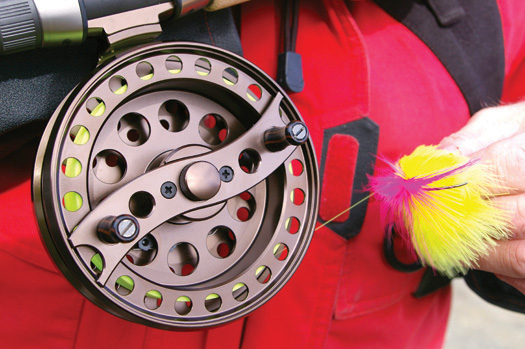
The free-spooling reel is the heart of the center-pin system.
The frightening heart. A British writer described them as “the Rolls Royce of reels. A delight to look at, wonderful to hold, and just a nightmare to use.”
Center-pin reels resemble thin (typically less than an inch wide) fly reels that will hold 300 yards of 8-pound-test on a 4H-inch diameter spool. These reels are essentially single-action precision-crafted line-arbors that revolve freely on embedded micro bearings around a polished spindle-the nearly friction-free namesake “center-pin.”
Prominent reel manufacturers are Raven, Ross, Islander and Okuma. Because of the nearly friction-free zero-drag and infinite free-spool, the reels will smoothly self-feed line downstream, a plus for classic bobber drifting. The constant free-spool (some models offer clicker resistance), while ideal for long drifts, takes practice when looking to develop the coordinated touch that will stop the spinning spool with delicate finger pressure short of disastrous line overruns and tangles, yet never impeding the drift. There is also a tendency for loose coils to jump the spool and wrap-up on the rod handles. During a mindless retrieve it’s possible-believe me-to wrap 20 yards of line around the reel handles instead of onto the spool. Belles’ solution is remove one of the handles.
Rods
Center-pinning rods resemble stiff renditions of the wimpy noodle rods that were in vogue in the 1970s. CPs are 11 to 14 feet long, built with medium backbones, fast tips, and 6- to 9-inch butts with under-slung reel seats. The extreme length and closely-spaced row of 10 to 14 line guides help loft the bantam lures and control the fine lines inherent to center-pinning. The length, which allows a lot of slack to be lifted off the water in a hurry, can be a plus-factor when fighting a hard-charging steelhead with the maddeningly slow, single-action center-pin reel.
John Posey, an executive at Lamiglas Rods, sees enough new interest to jump into the market with the X113MC-P model designed with a moderate action. The Lamiglas center-pin rod is 11 feet 3 inches long, two pieces, and rated for 8- to 15-pound line and 3/8- to 3/4-ounce lures, Posey said.
Raven Tackle, a Canadian manufacturer based in Ontario, is one of the longest-established makers of center-pin rods and reels, marketing a line of rods from 11 feet, 6 inches to 14 feet. The lanky rods provide line control when float fishing, long drifts and passable hook sets. Accordingto Raven, 13-foot 6-inch float rods handle most river conditions, and the 14-footer is for large rivers. Raven manufactures an 11-foot 6-inch model, comparable to the Lamiglas introduction, specifically for steelheading.
Lines
Center-pin steelheading lines are typically light monofilament, thin diameter and buoyant to float on the surface during the drift.
For his Northwest steelheading Belles has settled on Raven mainline, 8-pound-test, .010 diameter. “This line is supple and it’s amazingly buoyant,” Belles said; “I’ve tried most of the lines out there and for me this is the best for center-pin steelheading.”
The Cast
The standard center-pin cast involves a convoluted casting style that is beautiful to watch and intimidating to master. Casting requires mastering a two-handed technique with a monster learning curve and no shortcuts-pat-your-head, rub-your-belly coordination.
I’m fascinated watching Belles crunch across ice heaves while pulling line off the reel.
He strips out 18 inches of green line and holds it at a 90-degree angle away from the spool, forming a V between reel spool and first guide.
With finger pressure on his rod hand he secures the free-spinning spool. Holding the line 90 degrees out, he draws back the rod and flips it toward the targeted current seam, simultaneously releasing the line. Holding the line at a 90-degree angle is critical to presentation and smooth line feed.
The cast is so smooth, effortless and controlled that I fully expect a boat-ramp hook-up. But it doesn’t happen and we push off downstream.
There are several casting styles, most prominently the Wallis, Nottingham and side cast, which is the basic 90-degree system.
For drift fishermen there are several large advantages to center-pinning. Ultra-light jigs (down to 1/32-ounce), single eggs or even flies can be presented without adding supplemental sinkers, Slinkies, or pencil leads, which enhances lure action. Free-swinging lure action is especially critical for provoking strikes when water temperatures are just short of ice and when visibility is measured in inches. Stout winter flows, however, sometimes may require a split or two of shot to be positioned above the very light lures to prevent them from kiting back to the surface, and will be needed to pull line through drift floats designed to slide on the line.
Bobber and jig rigs can be finessed from pocket to pocket along current seams that run well over 100 yards, which means that every cast covers a lot of holding water, including reaching into areas protected by shielding overhangs. The ability to reach fish that conventional fishermen can’t is a huge bonus.
When all the pieces fit, though, center-pinning is a deadly combination that lifts bobber and jig drifting into an evenmore productive art form, and produces steelhead and salmon when it shouldn’t. After 14 years of center-pin devotion, Belles doesn’t see the technique ever displacing open-faced spinning reels or fixed-spool casting systems, no matter how productive it is. “It’s a challenge to learn. A little upscale. It probably has more in common with fly fishing than conventional steelhead techniques,” he says.
But then again, there’s good reason this long-time western steelheader evolved into a center-pin loyalist. He fishes the tough lies.
###
Terry Sheely is a contributing editor for Fish Alaska magazine. [/emember_protected] [emember_protected scope=”not_logged_in_users_only”]
- Need to subscribe? Now’s a good time! Check out our current subscription specials!
- Already a subscriber? Login below to access all of our online articles and content!