


Approach a new lake with confidence and know-how
By George Krumm
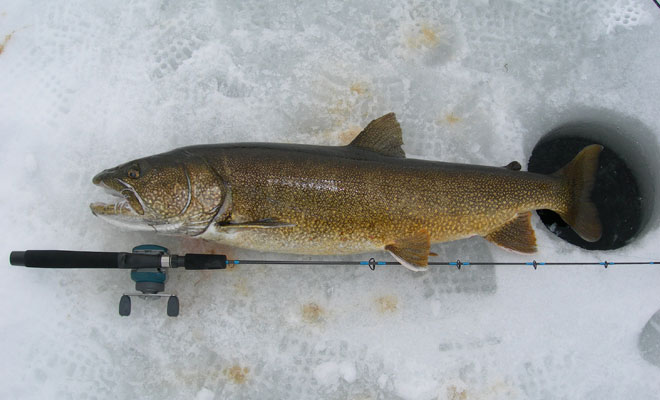
You’ve all seen the pictures. Mammoth lake trout; stunning Arctic char, perhaps large northern pike or a limit of stocked rainbow trout; all of these caught through the ice. Yet ice fishing seems so foreign. You can’t see into the lake; all you see is an expanse of white and the geography around the lake. So, how do you approach a new lake?
Putting yourself into one of the pictures referred to above can happen by sheer luck; however, ice anglers who do it consistently do their homework. Successfully tackling a new lake is best done in phases: Research, developing a game plan, executing the game plan, and recording results. [emember_protected custom_msg=’This content is available for subscribers only.’]
Research is probably the most important of these phases, for without it, you’re shooting in the dark. There are several elements of researching a lake to ice fish, including talking to other anglers, reading forum boards and literature, map study and visiting the lake during open-water periods. To really be prepared you should accomplish each of them. Most other anglers like to talk about their fishing, especially when they catch large fish or large numbers of fish. These days, many of these people post reports online. This can be a good source of information. Other anglers you encounter while at the lake will also sometimes share helpful information. One caveat—not everything you read online or hear through conversation is guaranteed to be true or accurate. You can, however, at least find out names of promising lakes. Once you have the name of the lake or lakes you’re interested in, you should look for a map of the lake.
ADF&G has bathymetric maps of most stocked lakes and non-stocked lakes on their website. These maps will give you a general idea of the depths and features of the lakes. It’ll show deep spots, drop-offs, large flats, inlets, outlets and the like. However, these maps are not extremely detailed. Another source are the bathymetric maps put out by Todd Communications, called Road and Recreation Maps. There are several in this series including the Matanuska-Susitna Valley map, the Kenai Peninsula map and the Big Lake and Point McKenzie map, to name a few.
Maps themselves are extremely useful to help you home in on areas of the maps that may be productive. However, the lake maps lack information on bottom type, weed beds and other structure. You can’t scroll over electronic versions of these maps and get GPS coordinates or mark waypoints on them. Additionally, due to scale, many structural items are not accurately represented, and in some cases, structural items that could be hot spots are not shown on the maps at all.
The point is that the study of these maps alone will not prepare you for success on the ice. The maps are just a starting point.
The most important thing you can do in the research phase of approaching a new lake is to actually go there during open water. Using a boat, sonar and GPS unit, you can verify the structural makeup of the general areas you identified during map study. Being on the water allows you to start filling in the blanks—to build a more complete picture of the areas you’re interested in fishing. You can see weed beds on the sonar and/or with your eyes. Your sonar will give you accurate information on how steep the drop-offs actually are. You’ll see sub-structures that are not on any of the maps such as bottom type (mud, gravel, carpeted with chara weeds, or perhaps tall-growing potamogeton weeds). You can then use your GPS to precisely mark places so that you can come back when the lake is frozen and drill on these spots. This enables you to fish these prime areas very efficiently, with little time or energy wasted trying to find good spots by drilling massive numbers of holes looking for structure.
When you do your open-water scouting trips, be sure to evaluate several different types of structure; some days the fish are going to be relating to steep drop-offs; other days they are going to be in relatively shallow bays patrolling weed lines or weed beds. I typically run my boat over the area I’m interested in with more or less a grid pattern. I’ll stop the boat to mark things like weed lines, drop-offs, etc. on my GPS. In some instances, your eyes will tell you where structural items like weed lines are; in other situations, your sonar may be what gives you the information you need. It may be helpful to use marker buoys, too.
It’s also helpful to take the map of the lake with you, and to write notes on it regarding what you found. For instance, at a spot you named Gilligan’s Island, you might note that you marked the beginning of the drop-off as waypoint Gilligan 1 and that it is 12 feet deep, with a rocky bottom. You might have a second waypoint in the same location called Gilligan 2 that shows where the drop-off ends and the lake bottom flattens out. Your notes for this waypoint might say that it flattens out at 60 feet, and that the bottom is mud. Sometimes it’s helpful to blow up your map at a print shop so that you have more room to make notes right on the page. Additionally, once your open-water scouting is finished, you can laminate the blown-up version of the map. This will protect it when you take it with you ice fishing. When you’re done doing your open-water scouting, you should have several different spots marked on your map and GPS, sometimes with multiple waypoints at each spot.
Once your open-water scouting is done, it might be a month or even six months before you actually put the information touse. However, with this information you can create an effective game plan to tackle your new lake, knowing you’ve got great, detailed information—not just hearsay or generalities. The items that make up my game plan are: Locations, time of day, amount of time to spend at each location, amount of time to fish each hole and lure selection. I typically create a game plan with at least two spots, and more likely, four spots picked out. Usually I’ll pick two steep and deep spots and two shallower, flat spots. In any event, one of these spots will be my primary spot, and the others will be alternatives. I pick the primary spot very scientifically—by which I mean using my gut. Some other factors play into it, though. I look at the weather forecast and the time of day I plan to fish. Typically, I plan to fish shallow spots first on overcast days and deeper spots on bright days. I also consider time of day into my planning. I may fish shallow during early morning, moving to a steep and deep spot during midday and back to shallow again in the evening.
Regardless of what type of spot I’m fishing, I typically drill several holes in a grid fashion to cover the majority of the good structure at that particular spot. I usually fish all the holes, spending a pre-planned amount of time on each hole—usually 15 minutes. I’ll often plan on trying a couple different lures in each hole, for instance a tube jig or jerkbait followed by a spoon. Sometimes I’ll fish each hole twice. If I’m catching fish I stay, repeatedly fishing the holes again. I don’t leave fish to find fish. However, if I fish through all the holes according to plan and I don’t hook any fish or see any show up on sonar, I’ll move to an alternate spot and repeat the process. Ice fishing can be a relaxing experience, though your willingness to move to a new area and drill more holes will cause you to catch more fish than the other guy in the long run. At the end of an ice- fishing day, I’m physically done.
Another part of your game plan should be lure selection. It should be based upon the fish you’re after, their preferred prey and the depth of the water you’re fishing. To put this in perspective, I often use soft plastics 3- to 5 inches long for lake trout. However, I’ll use different weights of lead-head jigs depending on the depth of the water I’m fishing. An eighth-ounce lead-head might be the ticket in water from 6- to 15 feet deep; however such a light lead-head will not work well in 60 feet of water. At that depth, I may use a lead-head as heavy as ¾-ounce. I’ll rig up my rods the night before with what I think will be the appropriate size and weight of lure for my primary spot. If I move during the day from steep and deep to shallow, I’ll either re-rig with lighter lures, or I’ll rig additional rods the night before so that I don’t have to waste time changing over during the fishing day. It’s not uncommon for me to take six rigged rods with me when I head out on the ice.
Executing your game plan is crucial to developing in-depth knowledge of the lake you’re fishing. If you don’t execute as planned, it’s difficult to know if your success or failure is attributable to your plan. Accordingly, it will be difficult to consistently reproduce or avoid the experience in the future. Fishing the spots you planned to fish is difficult to do if you don’t have your gear pre-rigged as part of the plan, and if you don’t stick to some sort of timeline regarding how long you’ll spend at each spot, and how long you’re going to fish each hole. If you stick to the plan, you’ll be maximizing your chances for success, and you will be accelerating your learning curve. You will learn the lake faster and better than the casual anglers sitting in a shanty all day, or those who spend all day at one location regardless of whether they’re catching fish. Stick to your plan.
As important as sticking to your game plan is recording the results. Memories fade over time. Put down your results, good and bad, in writing. You canrecord information in a spiral notebook, an Excel file or Word document; anything will work. There are a number of things you can record that will be helpful at some point in the future. What was the game plan and did you stick to it? What were the weather conditions? At what spots did you catch fish? What depths? What kind of structure produced fish (weed line, drop-off, shallow rock flat, deep flat, etc.)? What lures worked? How many fish did you catch? What size were they? Were the fish oriented to the bottom, or were they suspended? What time of day did you catch fish? What kind of presentation (one-foot jigging strokes or very subtle twitches of the lure, etc.)? Trust me; you will not be able to remember all the details a year or even a couple weeks from the date of the trip. Record them that night! With the technology we have available today, you could even record them on the water by use of a voice memo on your smart phone as things happen and put them in writing later.
I remember a day early in my ice-fishing career when I experienced great success on a lake trout lake. I had snowmachined into a secluded bay on a large lake and without having done any planning I ended up drilling right on the edge of a weed line. I caught both lake trout and burbot at this location. I didn’t enter any information into a GPS and I didn’t take any notes that night, but I remember I caught some beautiful fish. The weed line was actually quite a ways off shore—like 60 yards—in a large, featureless bay with no prominent landmarks. I went back a few weeks later. Snow had covered all of my previous holes. I couldn’t remember the depth the weed line was at, and I couldn’t accurately visualize where along the shoreline the weed bed was located, or how far from shore it was. I ended up drilling 15 holes through two and a half feet of ice looking for that weed line. At each hole I had to shovel off about a foot and a half of snow to get down to the ice. I burned a lot of energy and fishing time in the process, and never did find the exact spot I was looking for. The result was disappointing but enlightening.
This experience was the driving force for the relatively systematic process I follow today. By the time you read this, the lakes should still be open. Do yourself a favor and go research some of these lakes before they freeze. If you do, and if you follow the suggestions above, you’ll be setting yourself up for successful and memorable ice fishing experiences later this winter.
###
George Krumm has been ice fishing Alaska since 1994. He’s a contributing editor for Fish Alaska magazine and he writes the Fish Alaska Stillwater column. He can be reached at george@fishalaskamagazine.com. [/emember_protected] [emember_protected scope=”not_logged_in_users_only”]
- Need to subscribe? Now’s a good time! Check out our current subscription specials!
- Already a subscriber? Login below to access all of our online articles and content!