


Tackling One of Alaska’s Premier Sockeye Rivers
By Lance Irving and Charlie Summerville
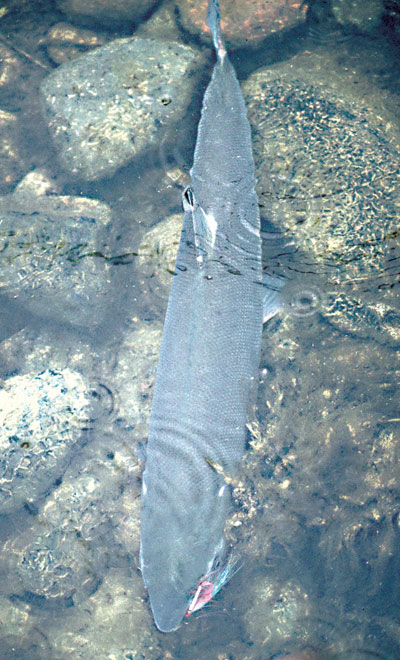
Alaska’s salmon are known for spectacular aerial acrobatics, knuckle-busting runs, and fine table fare. And none of the Pacific salmon exemplify this stereotype more than the sockeye, or red, salmon (Oncorhynchus nerka). In the month of July, over 600,000 reds will return to the Alagnak River in southwest Alaska and migrate upriver into the headwater lakes and streams of Katmai country. During the migration this multitude of sockeye are accessible to anglers in huge numbers. The chrome coloration of the salmon in the ocean is retained throughout the first part of their upstream migration, as is the fine dining quality of their flesh. And this is precisely when the discerning angler wants to catch them.
Catching a fresh sockeye salmon on a fly rod is always an experience of the more memorable variety, and usually one that borders on the breathtaking. The techniques used to catch chrome-bright sockeye on a fly rod are simple in nature, and with a bit of practice or instruction, they can be mastered quickly. However, as in real estate, location is everything. [emember_protected custom_msg=’This content is available for subscribers only.’]
Winding along approximately 300 miles southwest of Anchorage, the upper Alagnak River provides not only a huge number of salmon for the angler to target, but ideal locations in which to fish for them. Truly a world-class angling destination, the Wild & Scenic Alagnak flows from twin lake sources, Nonvianuk and Kukaklek, in the Katmai National Park and Preserve and travels some 65 miles until it empties into the Kvichak. The upper river is characterized by brilliantly clear, swift waters that provide ideal flyfishing conditions for the prolific sockeye run.
As the salmon migrate upriver, they will travel close to the banks of the river and are often nose-to-tail, two or three fish across in less than three feet of clear water. The multitude of channels in the famous upper braids section of the river and the area 10 or 12 miles upstream of the braids provide water where the sockeye are forced to slow and bunch together. Small channels between islands and the shore are some of the best places on the river to fish. As the reds move upstream to their spawning grounds, they move at a fairly constant rate. Diversions, such as a small gravel shelf, can force the fish to concentrate and pause, providing a better opportunity for the angler.
One of the best ways to access the prime fishing on the upper river is by raft, putting in at either headwater location. The nature of the upper river lends itself to this option, as the lack of gravel bars make the area nearly perfect for camping and spending four to six days on the water.
The Alagnak runs mostly at a class I, with some class II whitewater and one class III rapid about 12 miles below Kukaklek Lake. Perhaps more of a worry than the river itself is the abundant population of Katmai bruins lurking the banks in search of these same fish. During the peak of the sockeye run, the entire length of the upper river literally comes alive with Alaskan browns, and although serious run-ins are rare, the wise angler is always vigilant, whether the native foragers are prowling the river right next to the raft or not. For novice floaters, though, the Alagnak presents little in the way of technical challenge, and it comes highly recommended as a float for beginners looking to land themselves among July’s phenomenal return of reds.
To fully appreciate the sockeye, a little background is necessary. As the salmon enter freshwater, they stop feeding and have to rely on food stores in their body to provide energy for gonad development and the stresses of spawning. One of the most interesting and visible developments that a sockeye undergoes is its change in color and shape. What were chrome-bright salmon in the ocean turn bright red after two to three weeks in freshwater. The males often get a sharply contrasting green head in addition to their red bodies. Fusiform shape gives way to a massive humped back and hooked jaw on the males. The females undergo a similar change in appearance, though not nearly as severe.
Sockeye salmon traditionally spawn in shoreline areas of lakes or the smaller streams that feed them in the late summer/early autumn period. Digging a redd (nest) with her anal fin and tail, a female will remove the silt from the gravel to create a depression in which to lay her eggs. After the redd is prepared, one or more males will join her for fertilization. The female then moves slightly forward of the redd containing fertilized eggs and begins to dig another, both to deposit more eggs and also to cover those already fertilized.
The eggs develop throughout the winter and emergence ensues as water temperatures begin to increase. After the yolk sac is completely consumed, the juvenile fish must swim to the water surface and “gulp” air to inflate their swim bladder in order to achieve neutral buoyancy. The juvenile sockeye typically spend one or more years in the freshwater environment, feeding and growing on dipteran insects and pelagic zooplankton. In the early fry stage of sockeye, the body markings and coloration are quite distinct. Oval parr marks are spaced vertically along the sides of the fish. At the time of smoltification, the fish become more streamlined and silvery, and the parr marks begin to become obscured.
After smoltification and the leaving of natal systems, young sockeye enter the marine environment for one to four years. When the juvenile fish migrate towards the ocean in the early spring, they must overcome changes in the number and kind of predators to be avoided, changes to the physiological processes, and significant alterations in both their feeding patterns and social interactions. Feeding on zooplankton, crustaceans, and larval fish, they can grow to a size of up to 14 pounds; however, the typical mature sockeye weighs 6 to 10 pounds. top of page
The migration back to the watershed of their birth is one of nature’s great wonders. With feeding patterns alone, a sockeye in the ocean can travel in excess of 3,700 kilometers in a single year. As it approaches time for the sockeye to spawn, they return to their place of birth by (most likely) a combination of highly developed olfactory glands and some sort of magnetic imprinting. Returning to the system of their birth, they begin the spawning process and thus complete the life cycle of the sockeye.
The presence of sockeye salmon in freshwater systems is of great importance to those systems. Marine-derived nutrients are delivered to the system as the salmon start to die after spawning. The eggs provide a major food source for the resident fish (rainbow trout, Arctic grayling, whitefish, etc.). The juvenile salmon provide important forage for avian and aquatic predators-both in lake and river systems. Mature returning salmon provide a huge food source for the many brown bears and eagles present in the area. Even the flesh of dead salmon provides an important food source for a multitude of creatures, including those of avian, terrestrial, and aquatic varieties. Arguably the most important of the Pacific salmon, the sockeye do far more for both the aquatic and terrestrial ecosystems than simply provide ample sport fishing opportunities.
It is a cycle of vital importance to many organisms in the surrounding area. Just to be on a river such as the Alagnak when the sockeye return is a memorable event. The sights to behold seem to have no end. There are bears diving in the water after fish, eagles waiting to eat the bears’ scraps, and literally thousands of salmon swimming right past you every day. Seeing thousands of fish swim little more than a rod length away is exciting, as is knowing that each fish is another opportunity to hookup.
Fresh sockeye salmon are thought by some to be a fish that can only be snagged. Despite being less than ethical, the statement is also (thankfully) completely untrue. With the proper setup and in the right location, these fish can be legally and ethically pursued in a manner that is very similar to deepwater nymphing for trout. Depth control and providing an easy opportunity for the fish to take the fly are the keys. As sockeye turn red and morphidite in shape, they are willing to chase flies to a greater extent, but not so when the fish are fresh from salt, chrome bright and full of energy. That’s when this nymphing technique is deadly.
To catch these amazing fish, a simple setup is needed. The preferred combination is an 8-foot, 6-inch through 9-foot rod, with a matching reel and weight forward floating line, lots of backing, and a reliable drag system. Either a 7 or 8-weight rod is recommended, especially in the heavier current where reds like to congregate. In some rivers, a sink-tip line might be needed or preferable, but on the Alagnak River, it’s just not necessary.
The leader is somewhat unusual but very simple. Abrasion-resistant leader material (a 6-foot length of 15-pound test) is connected from the butt section to a small barrel swivel. A 4-inch dropper is tied off the barrel swivel, and an abrasion-resistant tippet (a 4-foot length of 10-pound test) is tied to the other end.
Maxima is one of the preferred lines for leaders because of its strength and durability. Split-shot (1 or 2 bb or 3/0) are placed on the dropper line and a Trapper fly is connected to the tippet. The most important component of this rig is the weight. Depending on the water velocity and depth, the weight should be enough to quickly make contact with the bottom, but not so much as to slow the drift of the fly. An angler’s best bet is to experiment with the weight at each location until the proper drift is achieved.
The purpose of the dropper rig is for the weight to barely tap along the bottom, 4 to 6 inches below the fly. Since the sockeye are swimming along the bottom, this presentation ensures your fly is at eye level with the fish. The easier it is for the passing fish to take your fly, the more hookups will result. The fly mentioned, the Trapper fly, developed by Nelson “Trapper” Young, is a simple red nymph tied on a Mustad 37132 #10 or #12 hook and tied with thin estez or yarn. Personally, we fish a few variables-flies in blood red, salmon-egg orange, or rust brown, which resemble very small shrimp.
The fly is beautifully uncomplicated; the principle it works on is location and opportunity. Sockeye are not piscavorous like other Pacific salmon, and in addition (as with all Pacific salmon), they stop actively feeding once in freshwater. The fly is presented at such a precise depth and in such an unobtrusive manner that the fish simply open their mouths and accept the offering. The fact that sockeye are not actively chasing the fly makes location so much more important. This is like the scenario when after a big dinner, a small piece of chocolate is put on your plate. You may be full, but the chocolate is right there, and you can probably make room for it. top of page
On the Alagnak, sockeye anglers will literally have thousands of fish swim right by them in a typical day. With precise depth control and an abundance of fish-and the crystal clear water of the upper Alagnak-anglers have the opportunity to watch their prey open their mouths and take the fly. Then, a good, hard hook-set is needed for the salmon’s hard mouths and the often-long battles that ensue.
A fresh sockeye fights much like a steelhead, spending plenty of time in the air. In fast current, it is not uncommon for an angler to be taken to his backing on the first run of the fish. A reliable drag system is a must here; within seconds, a fresh sockeye will make several jumps and strip dozens of feet of line off the reel. Slowing these fish down is necessary to increase the odds of them coming to hand.
With at least 600,000 fish returning to the river every July, anglers can expect to hook anywhere from 60 to 80 fish a day during peak times and to land as many as their arms and tackle will allow. A typical day for clients at Alaska Trophy Adventures on the upper Alagnak this past July was 60 to 80 fish hooked and 20 to 30 landed per person. The average size for a sockeye caught in the Alagnak system is 6 to 10 pounds with a few larger fish taken every week. A five fish limit per day is enforced on the Alagnak for those anglers wishing to take some table fare home. Rich, deep red flesh-often noted as the best of the salmon species-awaits those wishing to keep a few fish.
Often overlooked, sockeye salmon should never be underestimated in their strength and willingness to take a properly presented fly. The waters of the upper Alagnak provide both ample and ideal opportunities for the angler wishing to pursue these fish. The jet boats used by Alaska Trophy Adventures and the absence of any other fishing operation within 30 miles of river ensure our anglers get to the ideal spots. These waters are home to some of the finest sockeye fishing in the world. If you’re tired of the crowds and looking for a true wilderness fishing experience, then don’t miss out on this truly world-class sockeye salmon fishery. Chances are, you’ll love it. [/emember_protected] [emember_protected scope=”not_logged_in_users_only”]
- Need to subscribe? Now’s a good time! Check out our current subscription specials!
- Already a subscriber? Login below to access all of our online articles and content!