

On an Alaska steelhead adventure, one never knows what else to expect.
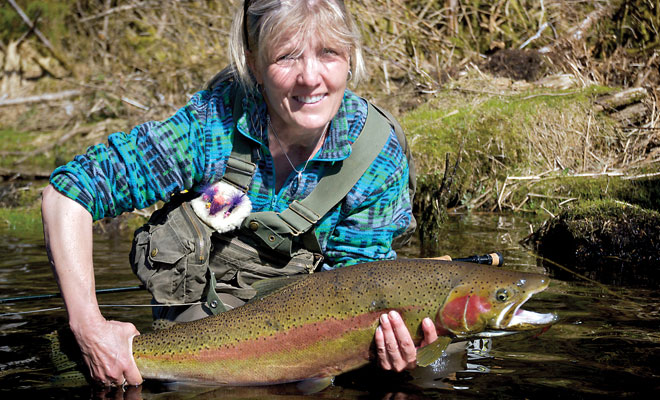
Rites of Spring: Good Company & Wild Places

Story by E. Donnall Thomas, Jr.
Photos by Don & Lori Thomas

T.S. Eliot claimed that April is the cruelest month, but what did he know? In Alaska, that’s when you start to enjoy more daylight than your friends and relatives Outside (a milestone that officially begins with the vernal equinox in late March). Airplanes come off of skis and onto wheels, bears emerge from their dens, and skunk cabbages begin to erupt. And for true steelhead fanatics that’s when the greatest gamefish in the world finally return to Alaska’s streams after their long, mysterious voyages about the North Pacific. [emember_protected custom_msg=’This content is available for subscribers only.’]

While the Alaska steelhead mystique could fuel an essay all its own (as I’ve proven myself a number of times), the conduct of most steelhead adventures proves every bit as intriguing as the fish. For there’s no such thing as a typical steelhead fishing trip; there are just too many variables at play to allow predictability, from the weather to the timing of the runs to the makeup of each fishing party. With nearly 50 years of steelhead experience under my belt, I ought to know. Last year’s expedition to our home in southeast Alaska proved that point once again.

Alaska Steelhead on . . . Snowshoes?

It was the latest spring in memory. We arrived at our place on Prince of Wales Island to find layers of corn-snow set up three feet deep to the consistency of concrete, not just in the alpine but right down to the tide line. After hitting the ordinarily reliable stream near the house for two days without touching a fish, we decided to explore new water. Unfortunately, the consensus around town was that you couldn’t get where we wanted to go because of the snow blocking the roads.

But to serious steelhead anglers, impossibility is relative. We finally loaded the truck with chains and scoop shovels and headed north toward one of my favorite streams on the island. The good news was that we made it farther than I expected in the truck. The bad news was that we still had a long way to go.

The only way to get there was to set off down the road on top of the snow. By coincidence, we’d had a discussion about snowshoes around the dinner table the night before. As anyone who has read Jack London knows, snowshoes are a time-honored tradition up north, but I’ve always considered that tradition better honored in the breach than the observance. I spend a lot of time hunting in the mountains during long Montana winters and always carry a pair strapped to my pack, but only as a means of extricating myself from disaster. I’ve long considered the concept of recreational snowshoeing an oxymoron, and decided many winters ago that if I really needed snowshoes to get someplace I was probably better off staying at home.

Fortunately, the snow had set up so hard that we stayed on top almost all the way to the creek wearing nothing on our feet but hip waders. When we finally reached the water, the clean-tracking snow in front of us confirmed the upside of its inaccessibility: no one had fished it ahead of us all year. If the fish had found their way to the stream, we had found our way to virgin fish.

And had we ever. The current was running high from melting snow, but it was clear and stuffed with steelhead. Some had been in freshwater for a while, but others were bright as a newly polished chrome fender. For the rest of the morning we enjoyed the kind of fishing that justifies all those long days steelhead anglers sometimes spend casting to fish that aren’t even there.

We were congratulating ourselves on our luck and perseverance by the time we finally set off back down the road toward the truck. Unfortunately, we’d underestimated the thermal power of the sunshine beating down upon those miles of snow. I certainly should have known better, but my contrition wasn’t doing us any good. The sun’s rays had rotted the crust we’d hiked in upon so easily, and we broke through and sank to the tops of our waders with every other step.

“I’d pay a thousand dollars for a pair of snowshoes!” I whined to Lori after an hour of hopeless floundering.

“You’d still have to fight me for them,” she replied.

Of course we made it in the end; I’m not trying to turn this into a blood-and-guts survival story. But by the time we finally reached home we were too tired to do much more than shuck off our waders and collapse into bed. I’d certainly faced tougher situations outdoors in Alaska, but most of them took place during the course of more predictably challenging missions, like bowhunting sheep or floating long wilderness rivers. Walking down a road to go fishing? You’ve got to be kidding.

I guess there’s a first time for everything—especially in Alaska.

The Man Who Knew Too Much

Our houseguests last spring included a trio of old friends from Texas. Dick is a well-traveled outdoorsman with plenty of steelhead and salmon experience. Cindy is a novice fly-rod angler who earned the highest possible marks for determination. Marshall is, well . . . Marshall.

In fact he’s an experienced and capable angler, but he’d never been to Alaska before and had never fished for steelhead. A thoughtful, analytical individual  whose keen mind has served him well as an independent businessman, Marshall has always been one to do his homework before embarking on any new venture. So I wasn’t surprised when the e-mails questioning me about tackle choices started to arrive months before the trip. I did my best to adhere to the KISS principle (Keep It Simple, Stupid): a single-handed 7-weight rod, intermediate sink-tip line, plenty of backing. On the subject of flies, I told him he could make the whole trip with three patterns: Glo-bugs, Egg-sucking Leeches and Green-butt Skunks.

I should have known I wasn’t going to get off that easily. The Internet is a powerful informational tool that lacks one important feature: a filter. (The same principle applies to online publishing, which has done more than anything in my lifetime to establish through its too frequent absence the value of a good editor.) Marshall soon established running electronic relationships with everyone on the planet who knew, or thought they knew, anything about steelhead flies. He wrote me several times a week to inquire about the likely value of all the suggestions he’d received, and I always replied with the same monotonous mantra: Glo-bugs, Egg-sucking Leeches, Green-butt Skunks.

I should have known better than to imagine that my consistency was going to do any good. When Lori and I met our friends at the floatplane dock, Marshall was carrying enough tackle to stock his own fly shop. His reel bag must have weighed 50 pounds, and I’m still not sure how he got all those rod tubes in the Beaver. And when we finally carried everything up to the house and spread his fly boxes out on the kitchen table, I almost collapsed from sensory overload. He had brought along hundreds of different flies suitable for everything from spring-creek brown trout to billfish. The only thing missing? You guessed it: Glo-bugs, Egg-sucking Leeches and Green-butt Skunks.

I explained at the beginning of their visit that steelhead are a graduate-school fly-rod quarry, a principle that made the two fish Cindy hooked (on flies I gave her) all the more gratifying on our third day out. Of course I also offered Marshall his choice of the output from my own tying bench, but he stuck to his guns, unsuccessfully fishing saltwater shrimp patterns because he’d learned that steelhead eat shrimp, huge nymphs because a steelhead expert from Arkansas (?) had assured him they were killer patterns, and so on. Since everyone was having fun, I kept my mouth shut and tried not to feel guilty whenever I caught a fish.

Marshall’s refusal to listen to my advice about fly patterns finally paid off one afternoon, however. Living off the sea is an essential part of our time in southeast Alaska, but after several days of cracked crab and clam chowder everyone was ready for something different. Although Alaska allows anglers to keep two steelhead over 36 inches in length per year (though there are regulated catch-and-release-only streams), I haven’t killed one in decades. They’re just too valuable in the river, no matter how good they might taste. But one afternoon, calm water on the bay led to inspiration.

“The bottom out there is crawling with flounder,” I explained. “With a little luck, I think we can catch enough for dinner…on flies.”

Marshall’s oddball selection of “steelhead” patterns proved just the ticket. Armed with a redfish fly and a fast-sinking shooting head, he was into fish in no time, and some tedious work with the fillet knife on my part eventually led to an Alaska version of sole meuniere for dinner.

The lesson is twofold. First, don’t guide the guide. Second, if you are the guide, don’t be afraid to think outside the box.

Birthday Steelhead

I go back a long way with my old friend Mike Hedricks. We started our original careers (mine in medicine, his with the USFWS) in the same small town in Montana. He moved north a year or two after I did, and we eventually wound up living near each other again on the Kenai Peninsula when he became Refuge Manager at the Moose Range. Some years later we were both back in Montana where  we started (by this time, Mike was managing the Charles M. Russell National Wildlife Refuge) and this long series of coincidences concluded when Mike and his wife Nancy bought a house across the bay from our place in Southeast.

Mike was always more a hunter than an angler, and most of the time we spent together in the field involved bows and bird dogs. The move to Southeast finally triggered his dormant interest in the fly rod, and he quickly became a regular fishing partner on fall silver salmon expeditions. However, he had yet to catch a steelhead, and last year the occasion of his birthday in early May seemed like an ideal time to address that shortfall.

After powering our way through the last of the receding snow to another out-of-the-way stream, I donned my polarized glasses, climbed out on a log, and took advantage of another uncharacteristically sunny day to study a favorite run. When I identified several bright fish holding in the tailout of the pool, courtesy demanded that I give the water to our visitors from Texas and I did. Once I had the three of them fishing in the right places (don’t even ask me what Marshall had on the end of his tippet), Mike and I girded up our loins and headed upstream to an obscure lie my friends and I call the Frog Pond.

The Frog Pond is difficult water: a long, slow slick near the outlet of the lake that feeds the stream, where steelhead sometimes hold before scooting through the lake to spawn in its headwaters. Four times out of five, the short but nasty hike leads to nothing but empty water. It’s the fifth time that makes all the rest worthwhile . . . if you can get the fish to cooperate in a setting that looks more like a freestone spring creek than a classical Alaska steelhead run.

Given the bright sunlight overhead, I knew the fish would be wary as big Dall rams . . . assuming any were there in the first place. After leading a careful, quiet approach to a flooded bar that affords a bit of a vantage, I rose cautiously to study the water ahead. The good news: a bright fish was holding 40 feet upstream. The bad news: as soon as I stood high enough to be able to see the fish, it rocketed off toward the lake never to be seen again.

The skinny water called for careful, accurate sight casting, but I quickly concluded that the person doing the casting wasn’t going to be able to see the fish without spooking them. After leaving Mike on the open side of the pool, I circled back downstream and climbed out on the high, timbered bank across from him. Then I began to stalk the water as if I were bowhunting whitetails.

Thirty yards farther up the edge of the Frog Pond, I spotted a trio of fresh fish and cautiously directed Mike into casting position. Then I began my best rendition of a Keys flats guide directing a client’s casts toward a big bonefish. In fact, our mission was even more difficult: in addition to getting the fly in the right place, Mike had to lead the fish upstream just far enough to get his single egg pattern down to steelhead depth as it drifted past . . . and no farther. After a couple of attempts fell just short he finally let a beauty unfold, and when the largest of the fish moved a foot sideways as the fly tumbled by, I yelled: “ Strike!”

The whole pool seemed to erupt in response to his strip-set, as steelhead exploded in all directions and his bright hen went airborne. At first I thought Mike’s fish was going to make it to the rapids below the Frog Pond and disappear from our lives forever, but he successfully turned her at the last moment. Ten minutes later, his steelhead jinx lay defeated at the streamside as we gently released the fish.

Happy birthday, Mike. It couldn’t have happened to a nicer guy.

Consistency can be an elusive goal in the outdoors, as last year’s spring steelhead season proved. The runs were late throughout the region, likely as a consequence of frigid water temperatures due to late melting snow. We caught fish in unexpected places while several reliable standby streams failed to produce a single strike. We needed suntan lotion more than we needed our raincoats and we produced an unexpected gourmet meal from the bottom of a bay using flies designed for different fish in different water thousands of miles away. Go figure.

Regrets? There weren’t many. I do wish that Cindy, who fished her heart out from dawn until dark, hand landed at least one of the pair of fish she hooked. She deserved an Alaska steelhead as much as any fishing partner I’ve ever known. But I’m sure even Cindy will agree that we were all having way too much fun to worry about fish she didn’t catch.

For as much as I love catching steelhead—and even after a lifetime spent chasing various gamefish around the planet I can’t think of one I’d rather have on the end of my line—the fish themselves are optional in the end. If you can’t deal with that bitter truth, you should probably forget about angling for anadromous fish that may not even occupy the water you’re fishing.

Good company and wild places are all you really need to ensure a good Alaska steelhead expedition. Consider anything the water decides to give you a bonus, and let the stream leave you happy. That’s the best advice I can give.

A former Kenai Peninsula resident, Don Thomas and his wife Lori now divide their time between homes in rural Montana and coastal Alaska. Don his just finished his 16th book on outdoor subjects, a review of sportsmen’s contributions to the conservation movement. His books are available through his website. [/emember_protected] [emember_protected scope=”not_logged_in_users_only”]

[/emember_protected] [emember_protected scope=”not_logged_in_users_only”]
[wp_eMember_login]
[/emember_protected]

SaveSave

SaveSave