


Rockfish get little respect, except perhaps as fish and chips. Commonly encountered by Alaskan anglers while salmon or halibut fishing, they are frequently caught on heavy tackle, making fishermen think they are pulling up a rubber boot. If this is your perception, I hope the following words will change those thoughts and introduce an exciting fishery that is overlooked and overly abused at the same time.
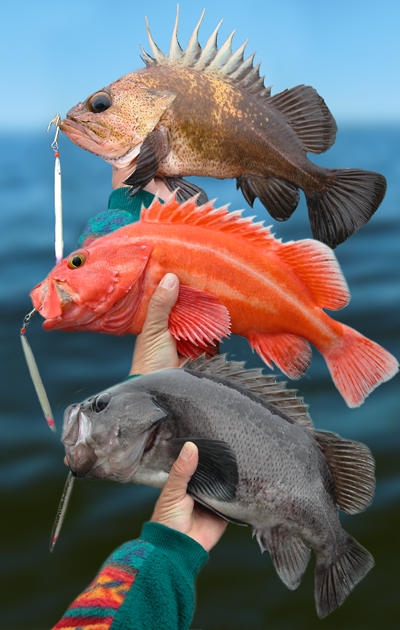
An Under-Appreciated Saltwater Fish Found All Across Alaska
by Doug Wilson
According to the Alaska Department of Fish and Game sport fishing regulations, there are approximately 32 rockfish species in the Gulf of Alaska, but only about 15 are commonly found in nearshore shelf areas of 100 fathoms or less. [emember_protected custom_msg=’This content is available for subscribers only.’]
Of these there are a half dozen or so that most anglers will regularly encounter. Black rockfish, (Sebastes melanops), frequently referred to as sea bass or black bass, are probably the most commonly caught of the surface feeding, pelagic (open water) rockfish. Yellowtail, dusky, and blue rockfish make up the rest of the pelagic rockfish commonly found. Yellowtail and dusky rockfish are frequently referred to as brown bombers.
All of these species may be caught high in the water column. In fact, it is not unusual to see schools of black rockfish flopping all over the surface as they feed. Yellowtail and dusky rockfish are usually in the top thirty feet of water as well and can be recognized by their light tapping bite to your lure as it falls in the water column. They can be an outright nuisance to salmon anglers, or an absolute joy to the light-tackle rockfish enthusiast.
Copper, quillback, and China rockfish are the most common bottom-dwelling rockfish in shallow Alaskan waters. They are frequently taken from 30 to 60 feet and deeper. Going deeper than 60 feet brings anglers in reach of canary, Boccacio, silvergray, and yelloweye rockfish. Yelloweye, commonly called red snapper, are the most sought-after and best known of the deepwater rockfish in Alaska. They are easily recognized by their bright orange color and yellow eyes. Immature yelloweye have two light-colored banks on their sides. Canary rockfish are pale orange on the back, mottled with gray on the sides, and are smaller than adult yelloweye.
Rockfish are extremely slow growing. Depending on the species, they reach maturity anywhere from seven to 20 years and have life spans from 40 to 114 years. According to ADF&G, yelloweye may live for up to 140 years. However, being largely territorial species, rockfish are subject to over-fishing and one’s take should be limited. Once a bottom-living rockfish sets up shop in a piece of territory, it will be its permanent home, although it may move to deeper water in the winter.
Rockfish have swim bladders that allow them to hold in the water column off the bottom. This physiological feature creates a severe problem in regards to releasing rockfish taken deeper than 60 feet. Basically, it is like a diver ascending too quickly—rockfish get the Bends. The gas in the fish’s system expands. This expansion in the bladder causes the stomach to be forced out its mouth, and particularly in deepwater, the eyes to bulge. This gas expansion also prevents the fish from being able to return to the depths.
The single best answer to maintaining a healthy rockfish population is to fish for the shallow water species that can be safely released. Rather than target rockfish deeper than 60 feet, I would urge anglers to learn shallow-water fishing techniques with tackle balanced to the fish you are targeting. While it is possible to puncture the bladder with the proper equipment and knowledge, and safely release rockfish taken from waters deeper than 60 feet, most fishermen are best to retain these fish as part of their daily limit.
Having fished rockfish for over 40 years, I’m deeply entrenched in the joyful side of light tackle, shallow water rockfishing. Rockfish taken from shallow water on light tackle are tough-fighting adversaries that can be easily released with no harm to the fish, creating a sport fishing opportunity that can be sustained and enjoyed by many.
Locating Rockfish
Pelagic rockfish tend to congregate over rock piles and pinnacles but may be found in open water as well. Rockfish are also somewhat migratory. However, anglers can follow some simple procedures to find productive rockfish habitant.
For starters, rockfish gravitate to the best habitat. In the open ocean along the Alaska coastline, kelp beds and wash rocks are likely places to begin searching for schools of rockfish. Find a pinnacle that comes up from a couple hundred feet to 30 or 40 feet below the surface, and you will almost certainly find a rockfish bonanza. Black rockfish in particular will school around the top of these pinnacles. You may also encounter blue rockfish, which are very similar in appearance to black rockfish, although they do have a smaller mouth. Coppers and quillbacks will be slightly deeper and hugging the bottom structure.
Kelp bed edges along a shoreline are also prospective sites. The water in these areas should run shallow (15 to 30 feet) and then fall off to 60 feet or deeper. This offers ideal habitat, shallow water with both kelp and rocky bottom-structure to support the sea life that rockfish feed upon. Another key to finding a good rockfish location is to look for areas adjacent to a deep-water escape route, as rockfish need to constantly remain wary of predators such as larger fish and seals. Thus, in inland areas of Alaska’s coastal waters, rockfish populations may vary. Habitat that looks ideal may not hold decent populations, as there is a definite correlation to the number of rockfish found and the area’s proximity to the open ocean. That is not to say that good rockfish cannot be found in inside waters, but here you may have to look more carefully to find good rockfish populations.
A NOAA chart of an area can be a major help in selecting potential rockfish habitat. A depth sounder and portable GPS system makes staying on the honey hole that much easier. Personally, I like to use a marker buoy to mark a location once I hook a rockfish. This makes for an easy return to the spot if I drift off with a running tide or am blown off by wind and wave action. It is simple to make one yourself using a yellow or white detergent bottle or quart oil bottle that has been thoroughly cleaned. Wrap about 60 feet of Dacron line weighted with a six-ounce sinker. Keep two or three in a bucket in your boat and toss one overboard at your line when you hook a rockfish. In choppy water, the line may unwrap to the knot, but it will get you close to the starting point.
Fishing for Rockfish
It is best to fish for rockfish during slow moving tides, as fast currents make it difficult to hold on a location. Fish from shallow to deep, which will help prevent hanging up on the bottom. My preferred equipment is a six to seven-foot popping rod and Ambassador 5000 or similar level-wind reel, with 17-pound test line used for tossing a one-ounce leadhead jig with a six-inch curl-tail worm. Medium spinning tackle with 14-pound test line is a good choice for spin casters. Lighter lines are not recommended since it is common to hang up when fishing the edge of a kelp bed, and you’ll need a line strong enough to pull the jig free. If you are a fly fisherman, a 6 to 8-weight rod with a sink-tip line and a minnow style fly will put you into more rockfish than your wrist can stand.
While bait is always an alternative for rockfish, artificial lures are more efficient for the light tackle fisherman. For instance, leadhead jigs with a six-inch curl-tail plastic worm are surefire rockfish lures. Casting these along the edges of kelp beds and letting them sink until you get a strike or the lure reaches the bottom is a simple and effective technique. When a rockfish inhales a sinking jig, you will feel a slight tick. Set the hook quickly before the fish spits the artificial lure.
If the jig reaches the bottom before getting a strike, jig the lure slowly back to the surface by raising your rod tip and then dropping it, reeling the slack as you drop the lure to the bottom. Here, a steady retrieve is highly effective, and you will most often feel several sharp taps as a rockfish mouths the lure. Set the hook sharply. It is also quite common to suddenly feel a weight at the other end of your line, as a rockfish will have grabbed the lure and turned to run back to the safety of structure, securely hooking itself. Reel down and set the hook with a snap of your wrist.
A one-half to one-ounce leadhead is perfect for fishing up to 30 feet deep. My preference is a one-ounce leadhead, which can be cast a great distance, sinks quickly, and can be fished to about 45 feet. Leadheads weighing one and a half to two ounces work well in fast moving tides or deeper water up to sixty feet. Leadheads are manufactured up to 24 ounces for deepwater halibut and lingcod fishing.
My overall preference is to fish rockfish no deeper than 60 feet, seldom using leadhead jigs heavier than two ounces. If I am fishing in areas where I might catch salmon as well as rockfish, my choice of lures switches to lead minnow-styled jigs like the Point Wilson Dart, Stinger, Spinnow, or Crippled Herring. The metal jigs are dynamite producers for all bottomfish and highly effective salmon lures. Basically you can catch just about any fish that swims in the North Pacific and feeds on small baitfish.
In all cases it is recommended that you pinch the barb down on all hooks, whether single or treble. I have a strong preference for single Siwash hooks over trebles on my metal minnow-style jigs. Some lures come with trebles on a welded ring, which makes them difficult to exchange with a single Siwash. You can embed two points of the treble in a block of wood and saw through the eye with a hacksaw, then replace with a barbless single hook, or one with a pinched-down barb. If you don’t replace the hook, be sure to pinch the barbs down on the treble with a pair of pliers. Barbless hooks allow you to release a fish easier and more efficiently unhook those fish to be retained.
Rockfish as Table Fare
While the fun is in the catching, rockfish are high on the list as table fare. For the best quality-eating fish, proper care is a necessity. A well-equipped fisherman needs a fish club to stun a landed fish, a knife or kitchen shears to cut a gill arch, and an ice chest or fish box to store the catch.
A sharp rap on the head with the fish club will stun the fish. Cutting a gill arch will allow the fish to bleed most of the blood in the body cavity and flesh as the heart continues to pump after the fish is stunned. This bleeding process assures the fish will stay fresh longer and be milder tasting. Never allow your catch to float in melted ice water in a fish box or ice chest. An extremely sharp filet knife and a good non-porous cutting board are necessary for properly filleting your catch. A Kevlar glove used on the hand holding the fish is great for gripping spine-studded rockfish and a handy safety device to prevent cuts from a slipped filet knife.
Fried for fish and chips is probably the favored use for rockfish, but they may be prepared in many delicious ways including steaming, baking, broiling, or barbecuing. If your choice is deep fat frying, be sure to cut the filet in thin slices at a diagonal. Thinner slices will cook easier than thick ones. A tempura batter is an excellent covering for deep fat frying.
Steamed rockfish is the perfect way to make rockfish sandwiches. Place filets in a frying pan with water reaching halfway up the filet. Cook at a high heat until the fish is flaky. This only takes a few minutes. Do not overcook or allow the water to completely boil away. Use toasted bread or a Kaiser roll with a slice of cheddar cheese and tarter sauce to complete the sandwich. Wrap it in a paper towel or napkin and enjoy the best breakfast or lunch sandwich you may ever encounter.
For the barbecue, I like to marinate black rockfish in a mixture of one-cup soy sauce, one-cup brown sugar, and three cups water. Marinate in the refrigerator for three hours before barbecuing or broiling. Cook until the filets flake with the touch of a fork. However, it should be mentioned that black rockfish are extremely fatty and do not last well in the freezer. Thus, it is best to consume them fresh or freeze in water or vacuum pack. Either way, they should not be kept frozen more than a couple of months before use.
And perhaps, after all, tasting one may be the best way to make rockfish advocates out of all of us. Learn to catch them on light tackle in shallow water, avoid deepwater rockfishing, limit your catch to what you can use, and enjoy this wonderful saltwater resource.
Alaska’s Rockfish
Common Pelagic (open water) Rockfish of the Gulf of Alaska
Black Rockfish
(Sebastes melanops); up to 25 inches
Yellowtail Rockfish
(Sebastes flavidus); up to 26 inches
Dusky Rockfish
(Sebastes ciliatus); up to 22 inches
Blue Rockfish
(Sebastes mystinus); up to 21 inches
Common Non-Pelagic or Demersal
(bottom dwelling) Rockfish
of the Gulf of Alaska
Copper Rockfish
(Sebastes caurinus); up to 22 inches
Quillback Rockfish
(Sebastes malinger); up to 24 inches
China Rockfish
(Sebastes nebulosus); up to 17 inches
Canary Rockfish
(Sebastes pinniger); up to 30 inches
Boccacio
(Sebastes paucispinis); up to 35 inches
Silvergray Rockfish
(Sebastes brevispinis); up to 28 inches
Yelloweye Rockfish
(Sebastes rubberrimus); up to 36 inches
An excellent rockfish identification site is available at: www.afsc.noaa.gov/groundfish/RockfishGuide/rockfish.htm
Preserving Yelloweye
Possession limits on yelloweye rockfish are restricted in most Pacific coast waters, as fisheries managers attempt to protect a valuable and vulnerable resource. If your goal is halibut or lingcod in deep waters and you catch yelloweye, the best thing you can do is move to another location. To avoid these deepwater rockfish that may attain 30 pounds, it is best to avoid rocky pinnacles or others areas with a rapidly deepening structure. If they are your targets, limit your catch to less than the allowed possession limit. [/emember_protected] [emember_protected scope=”not_logged_in_users_only”]
- Need to subscribe? Now’s a good time! Check out our current subscription specials!
- Already a subscriber? Login below to access all of our online articles and content!