


A flurry of fishing in Ketchikan
By Marcus Weiner
Eagles wheel overhead and dive for fish scraps. Seaplanes taxi and take off, while cruise ships and their bounty of tourists tour the Inside Passage. Turn one way and watch the blue and gold Alaska Marine Highway ferry depart; turn the other and marvel as a kayaker strokes toward Pennock Island.
These waters teem with life. Throughout a season you will see five species of Pacific salmon, not to mention the halibut, rockfish, lingcod, Alaska spot shrimp, and Dungeness crab that make the area a notoriously bountiful angling destination. Move to the freshwater and catch a seemingly unlimited number of Dolly Varden, as well as plump and plentiful rainbow, cutthroat, and steelhead trout. Welcome to Ketchikan—a crown jewel of Alaska’s southeast coast. [emember_protected custom_msg=’This content is available for subscribers only.’]
I arrived on June 21, 2001, with my good friend Greg and some high hopes for chinook salmon. We would be fishing with Captain Kevin Beck on the Frieda Mae II, a 28-foot twin diesel catamaran owned by Ray Chaikin of Advanced Charters and Eagle Creek Lodge. Kevin has been fishing in Ketchikan for 16 years and it shows—he knows the hotspots and the killer techniques, both of which tell me that visions of catching kings with regularity are not unfounded. In fact, Kevin immediately let us know they had been landing dime-bright Ketchikan chinook for the last three weeks, and since it was late June, we’d likely find some early season silvers prowling the tides as well.
At 5:45 the following morning we began by trolling near Mountain Point. Three lines connected to downriggers at 50 feet presented a tantalizing trail of herring, flasher, and hoochie to the king and silver salmon in the depthsof the blue-green saltwater. We got our first strike 45 minutes later, before we even had the chance to develop a team strategy for manning the lines. Consequently, no one got to the bending rod fast enough to set the hook.
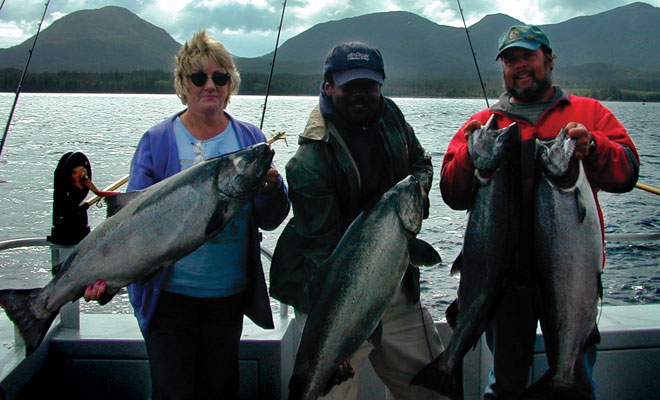
It only took 20 minutes, though, before the starboard rod bowed again, revealing the telltale strike and run of a nice king. I ripped the rod from its holder and set the hook so hard I almost fell over. I knew my exuberance stemmed from the adrenaline rush of nabbing the first chinook of the season, and looking back, I realize I was lucky the hook wasn’t dislodged. The king came to the surface and ran directly at the boat while I reeled feverishly. Five minutes later, a 30.5-pound fish was in the net—the first of many Ketchikan kings.
The Frieda Mae is equipped with four Penn Fathom Master 625 downriggers, which allow the fishermen to consistently access productive spots in the water column. We were using Lamiglas 8-foot, 6-inch Inshore Classics, 15 to 30-pound class, with Shimano TR 200 reels. The reels were loaded with 25-pound Maxima, and riggings were made with 40-pound leader. We used two types of terminal riggings in these waters: a flasher, hoochie, and double hook (4/0 or 5/0) with cut plug herring and a flasher combined with a Luhr-Jensen #5 Superior, half brass-half chrome spoon. Kevin insists on very sharp hooks for all riggings and is constantly checking to make sure none have dulled while in use.
All told, the setups produced. In the first morning of fishing, we boated five chinook and one coho—with all the kings on the hoochie/herring setup and the silver on the Superior. All were caught 25 to 60 feet down.
We fished for two days in the waters around the city, particularly around the productive Mountain Point and Herring Cove, spots that generate a fair amount of traffic from both sport and commercial boats. The waters surrounding Ketchikan are accessible, navigable, and usually calm by Alaskan standards. Our success led Kevin to think it might be worth trying a spot north of Ketchikan, so we brought in the riggings and went to get Ray at the lodge.
In my opinion, Ray’s lodge is a culmination of hard work, innovation, and vision. It is both physically and aesthetically impressive. Completely off the power grid and far from any other modern utility, Ray has created a self-sufficient lodge that produces its own power from solar panels and a generator backup and offers all the modern luxuries. The stonework in the main lodge was designed as a heat bank—to trap and release heat slowly—and the two 20-foot tall fireplaces are spectacular.
The 6,000 square foot building is accompanied by a two-bedroom cabin, another building with shop space, a room for Kevin, and its own private dock and boardwalk. How would you like to drive your boat to your own dock, moor up, and walk 200 feet to your front door? Did I mention that they have an oyster bed in the front yard, and a never-ending supply of shrimp and crab just minutes from the dock?
After picking up Ray at the lodge, we headed for an adamantly undisclosed location. Kevin and Ray thought that we might intercept the chinook heading south. “It is uncommon to get a double hookup when fishing for kings,” Ray warned as we made our way to the new fishing grounds. I knew he was right, of course, but nothing on this trip so far had led me to believe anything but fantastic fishing was possible in Ketchikan. And once again, the right combination of timing, lure presentation, and fishing experience combined to buck the odds.
By 6:20 p.m., we had four lines on downriggers ranging from 30 to 60 feet, two with herring and two with Superiors. A few ticks of the clock later, I was fighting a king when the rod next to me went down. We had experienced our first double of the trip.
Over the next hour and a half, we had six double hookups and caught and released 23 total kings ranging from a two or three-pound “shaker” to a nice 32.5-pound buck landed by Ray. This was not normal king fishing, not even in Alaska.
Shortly after catching the first two chinook on Luhr-Jensen Superiors, we switched out the herring/hoochie rigs. I found that with the Superiors the fish fought much more fiercely, perhaps because of the four-inch spoon slapping them in the head throughout the battle. Greg had a 30-pounder repeatedly jumping and tail-dancing 100 feet from the boat. It fought him for 15 minutes before he landed it, and the look on his face when it was over told of a man in heaven. In 25 years of living in Alaska, he had never experienced king salmon fishing like this. It made us both want to come back in mid-summer to see how they did with halibut.
For two days in Ketchikan, we rarely left the water, stopping only to pull the shrimp pots for Ray’s mouth-watering seafood creations or for a few hours of coma-like sleep. As I stepped onto the plane for the short flight to Anchorage, complete with aching muscles and a sunburned face, all I could think was, “Next year I bring a fly rod.”
###
Marcus Weiner is the publisher of Fish Alaska. He can be reached at info@fishalaskamagazine.com. [/emember_protected] [emember_protected scope=”not_logged_in_users_only”]
- Need to subscribe? Now’s a good time! Check out our current subscription specials!
- Already a subscriber? Login below to access all of our online articles and content!