

Sockeye Salmon
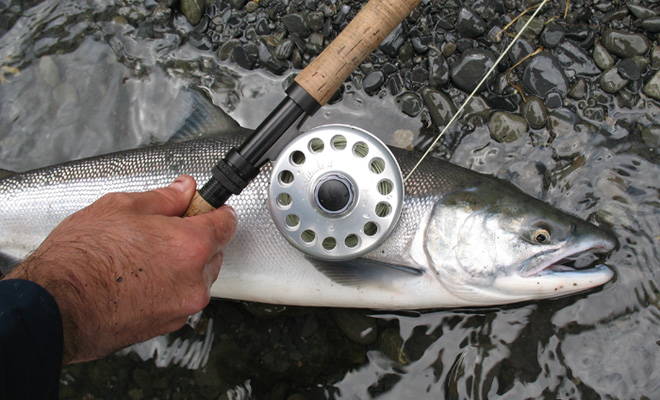
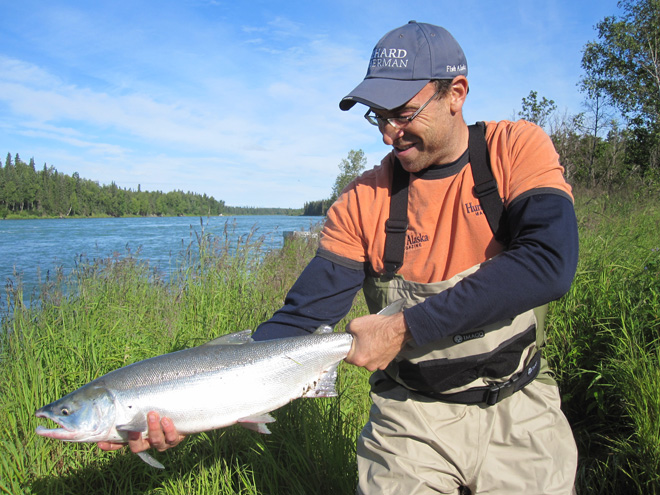
Until one actually hooks their first sockeye salmon, it is hard to imagine such strength and speed is possible from such a compact fish. Likewise, it is unlikely that anyone can imagine how delicious these fish are until they sample that deep, firm flesh. These two factors, combined with their abundant numbers, liberal three fish limit and do-it-yourself nature, make the Kenai River sockeye (red) one of the most popular fisheries in the state!
Not unlike their larger cousin, the Kenai king, there are two distinct runs of sockeye salmon in the Kenai River. The early run, primarily Russian River bound fish, begin arriving in mid/late May and continue through June. The late run, which typically begins entering the mouth of the Kenai in early July, historically peaks the third week of the month.
 It is important to understand the two main differences between early and late run sockeye in the Kenai River. First, and foremost, is the fact that the early run is much smaller of a return in terms of sheer number of fish. In addition, early run fish (Russian River bound reds) are screaming up river at such a frantic pace that effectively fishing them in the lower river becomes very challenging. Conversely, in July, huge pushes of steady moving late run fish enter the river. The combination of more fish and slower traveling fish works to the angler’s benefit in July and (in recent years) early August as almost anywhere on the lower or middle river becomes a “good spot,” provided fresh fish are traveling through. Early run reds are best fished where they slow down and concentrate, specifically the upper Kenai near the Russian River confluence.
“How to fish for Kenai River sockeye” is an easy subject; perhaps this is another large factor that contributes to their immense popularity. Anyone can do it, and the tackle and gear needed is simple and inexpensive. A medium action casting, spinning or 8 weight fly rod (the locals favorite!) filled with 20 lb. test (these 5-12 lb. fish are powerful!) will do the trick. Terminal tackle consists of an inexpensive bucktail Coho fly and a 3/8-1 oz. sinker placed on the mainline 3-5 feet above the fly. (You can find everything you need at Soldotna Hardware.) Strip off a manageable amount of working line, say 10-15 feet, flip it up stream and methodically drift it down as it swings, making sure that periodic contact with the bottom is occurring. Aggressive and repeated snagging is not necessary, nor legal: only set the hook when your offering pauses or pumps. Then hang on! Appropriately called lining, or “flossing” by the locals, an angler is simply attempting to pass their line through the mouth of an up-river bound fish.
Find fast water where sockeye swim close to the bank and begin methodically covering this travel lane until reds pass through. Kenai River sockeye enter and travel in pulses, and thus sockeye fishing action often goes from “dead” to “hot” in a blink of an eye!