


The Cast & Crew
by John Erskine
There’s more to a guided multi-day adventure in the wilds of Alaska than you might expect. Our intrepid reporter braves bear tracks, big tarps and fabulous fishing to bring you this story. [emember_protected custom_msg=’This content is available for subscribers only.’]
Sunday: ARRIVAL
August 11 at eleven we walked into the main office of the Willow Creek Resort. Linda said, “You must be Farley Dean” to a fortish looking man standing behind the counter. “I’m Linda Lockhart with Fish Alaska magazine and this is John Erskine,” gesturing to me.
“Hi Linda, this is my wife Mary.”
Handshakes all around.
Farley pointed outside. “Park next to that boat and we’ll help with your gear.”
Having packed 88% of all human inventions patented in the last one hundred years, we will need help, I thought.
Linda backed our Montero next to a twenty-one foot aluminum jet-boat and we got out. Farley and one of his sons began pulling tents, stoves, taps, sleeping bags and miscellaneous gear out of their storage shed, and piled it on a covered deck. Covered decks are good decks when it rains and though technically not raining, the light drizzle did get our attention.
“Where’s Jerome?” Farley asked. Jerome was to be the cook, and good cooks are worth waiting for. We waited.
When Jerome and his girlfriend arrived, he and Farley tossed our gear in (“tossed” isn’t quite the right word, but it sounds better than “carefully packed,” which is more like what happened) and we were ready.
A little after noon Farley took a wide right onto the Parks Highway and we were off. Within five minutes we were off again; this time onto a gravel road heading west. Gravel roads in Alaska vary. The Steese Highway, north of Fairbanks, may be one of the best roads in the state (gravel or paved). 55 mph on it is easy. This one was not. The pattern of holes was random and Farley hauled the steering wheel back and forth quickly.
This road is magnificent,” he said. “You will see fenders and windshields and boat parts of all kinds on the shoulder.” I spotted a hubcap next to a clump of fireweed and grinned.
In ten minutes Farley slowed, stopped, got out and gave a twenty-dollar bill to a man in a twelve by twenty “office.” As he slid back behind the wheel, a wooden gate lifted and we drove on. The road wound ’round what looked like a huge parking lot for riverboats. Two or three acres thereof. “In winter, they charge five bucks to drive your snowmachine through.”
The gravel road angled down a bit, then more abruptly, cutting through an embankment down to a large backwater of the Susitna River.
“This is it,” Farley said. “Deshka landing. Everybody out.”
He backed the boat into the river, unhooked it from the trailer and told his son to take the trailer back to the Resort.
We all piled in. Farley at the helm, Mel sitting shotgun, Jerome behind her, Linda and I behind Farley. The boat drifted a bit as he warmed the engine. It seemed sluggish and the word “wallow” came to mind but when he put it in gear and pushed the throttle forward, that was it. Within four seconds the boat was on step and hydroplaning toward the Big Su. When we hit the river, Farley turned left and the fast-as-hell speed in the backwater turned into you-know-what as the swift current of the Susitna pushed us downstream.
Two things immediately became apparent; a fully loaded aluminum jet boat can reach five hundred miles an hour in an alarmingly short period of time and human pulse rates can also become alarming. Secure in the seat directly behind the captain however, mine did not get much beyond three hundred.
I figured we’d be cruising under the Golden Gate within the hour and taking the Alcatraz tour before lunch, but no, Farley had other plans. Long before the Big Su emptied into Cook Inlet (roughly thirty miles before), he hauled the helm clockwise. Midway through the turn Linda spotted several animals on shore.
“Are those seals?”
“WHAT?” shouted Farley.
“ARE THOSE SEALS?” (so close to the sound barrier you have to raise your voice a bit)
“YES, THEY COME UP FROM THE OCEAN.”
We counted over two dozen. Basking in light rain on a flat gravel bar (my camera was stowed neatly in the waterproof case).
“THEY’RE HERE FOR THE SAME REASON WE ARE,” he continued, “FISH.”
From our due south heading on the Susitna we were now going upstream on the Yetna, headed north-northwest. Ignore all these directions if you wish, but I wanted to know where we were (I like to draw little dots on the map, so I can find my way back).
The Yetna is also dirty and opaque. Stick a paddle in either the Yetna or the Susitna and the end disappears. And cold. Neither gain more than a degree or two from their glacial source. Which explained why no one wore life jackets; hypothermia would kill you long before you could swim to shore. Both rivers are wider and faster than the Mississippi in Minneapolis, and it would be a long swim.
“THERE IT IS,” Jerome shouted. “THERE’S THE FIRST IDITAROD CHECKPOINT.”
A little cabin on the right shore, among spruce and cottonwoods.
“SOMETIMES THEY STEAL THE TRAIL MARKERS AND YOU MISS THE TURN. ONE YEAR I LOST TWENTY MILES BECUASE OF THAT.”
Jerome has run the Iditarod five times and knows well the dangers and adventures of the trail. His girlfriend Melanie will run it for the third time this winter. Both kept their eyes glued to shore.
An hour and twenty minutes later Farley pulled to port and started up the Skwentna River. “Dirty vanilla river,” by my notes. Smaller and swimable, but still opaque and cold. In a little less than a half-an-hour (still traveling on step at five hundred miles an hour) the ride went from rough to “holy cow” as Farley pointed ahead.
“THIS IS AS FAR NORTH AS YOU CAN LAND A PLANE ON THE SKWENTNA.”
You couldn’t pay me enough to land a floatplane here, I thought.
“AND AHEAD IS THE CANYON,” he shouted.
Oh boy, the canyon. Right there on the map. I looked ahead. A hundred-foot rock wall on the left shore and steep woods on the right. Farley looks more serious than usual, I thought. Wonder why.
Actually the canyon wasn’t as bad as the next several miles. The river changed from a rock and a hard place to a wide and braided river where the channels changed faster than the shape of Michael Jackson’s nose.
Farley stood up. To see better, I guess. “TWO WEEKS AGO THAT SANDBAR WASN’T THERE,” he said.
“HAVE YOU READ LIFE ON THE MISSISSIPPI?” Linda asked.
“NO, I NEVER REALLY . . .” and the rest was lost to the wind.
Now that’s interesting, I thought. Here’s a guy whoknows rivers like Clemens did, the same memorization of the channels, sandbars, submerged logs, high and low water lines, and has yet to read that American classic. Does it matter? He lives it.
Suddenly the channel became narrow. Very narrow. Thirty feet narrow. In between huge cottonwood snags narrow. Farley didn’t blink. Full throttle (3200 RPM; I had my eyes glued to the gauges, believe me) ahead. The boat heeled over-left, right-the horizon slanted by 40 degrees and the boat, four people and several hundred pounds of gear shot through. Two or three turns later, I breathed again and it felt good. Good to be breathing.
I looked at the map. That’s odd. It wasn’t this crinkled before the canyon.
“WHERE ARE WE?” I asked.
“ABOUT TWENTY MILES UP THE SKWENTNA,” said Farley.
Let’s see, that means we’re right . . . “WE’RE OFF THE MAP!” I yelled.
“TOO BAD. SPEAKING OF MAPS, I’D APPRECIATE IT IF YOU DID NOT MENTION THIS CREEK BY NAME.”
“WHAT CREEK?”
He grinned.
Several miles later we turned into a crystal clear creek, continued for a hundred yards or so and at 4:15 pm ground our way to a halt.
“Camp site’s over there,” said Farley.
We de-boated and began carrying supplies across a two-inch deep, eight-foot wide branch of the creek-off-the-map to a 20-yard by 50-yard clearing.
“Cook tarp goes here. Set your tent anywhere you want.”
Linda and I walked to a sandy embankment six feet above, and ten feet from the main creek. Personally, I would not have chosen the spot within five feet of not-over-a-day-old bear tracks, but Linda said one word: “Here.”
“Good choice,” I said, pulling out our new tent.
Once the tent was up and comfy, Linda said another key word: “Snooze.”
“Good idea,” said I.
So we snoozed. The smell of hot chocolate brought us to our senses, and at 7:05 pm, we clambered out of the tent. Farley was long gone (back to civilization for clients) and Jerome had the food tent up.
Here my notes start to get fuzzy. A little early to get fuzzy, but at the time I was facing four days of what was scheduled to be spectacular fishing and pencil and paper didn’t have the priority of fishing rods. My notes do say however, “8:05 pm first silver, first pink, first dolly, first chum.” Who caught the first of each, the notes don’t say, but Linda and I caught and released several within a hundred yards of the not-over-a-day-old tracks.
On the way back to the tent (9:35 pm, last silver), a kingfisher flew by, chattering through the cottonwoods. Last place kingfisher chatter gave me goose-bumps was Spearfish Canyon in the Black Hills.
That night it rained. More than enough to get our attention.
Monday: SET UP
My notes start with “5:30 am: light,” although we slept until Jerome began yelling “GO AWAY” at the top of his lungs at 8:05 am. Ever notice how difficult it is to unzip a tent zipper when you really want to get out and see something? The maker of the not-over-a-day-old tracks had staked out our fishing hole as his own and Jerome thought it best to discourage him from wandering any closer to camp. Another good idea.
The bear crossed the gravel bar and disappeared into the big cottonwoods.
Seemed like a good time for breakfast.
After pancakes we rigged up our new fly rods. Brand new. As Linda had asked, do I want to fish my broken (“I fixed that rod! It works!”) 30 year old rod next to the $300 rods the clients will have? Well, no. So I bought two new ones, one bendy like a willow and one bendy like a baseball bat. That ought to do it. I put a dry fly on the willow and headed upstream. Linda headed downstream with a spinning rod.
Cottonwood trees lined the far bank and I laid the fly as carefully as I could near their base. Once, twice, and then something hit and ran. Upstream, downstream, and then in shallow water at my feet. A ten-inch fish, with colors in the dorsal fin that beats Black Hills brown trout all hollow.
An hour later, back at camp: “Get any?” Linda asked me.
“One grayling. Let him go. You?”
“One silver. I hope you’re hungry.”
It was a beauty. Ten pounds of beauty. But the fish feast would have to wait. Before Farley returned with his east coast clients, Jerome had to set up the rest of camp. Linda and I had come a day early to get an idea what preparations are involved for five men bent on a wilderness fishing experience. Turns out, quite a bit is involved.
After the cook tarp assembly, Jerome put up three tents (why did the biggest tent have the smallest zipper, I wondered, and why did the smallest zipper get stuck the most? “I don’t think you’re going to be naming that tent brand,” said Linda), then pulled out a big tarp. And I mean BIG. Seeing an opportunity to stick my foot in my mouth, I asked, “Need help?”
“Sure.”
“How about a bowstring truss arrangement?” I said, drawing a curved roof layout in the sand.
“You’re the architect,” he said, disappearing into the brush to cut poles.
I would like to say that the alders he cut made three perfect bowstring trusses, upon which the big tarp made a perfect roof for the hard rain at 4:15 pm, but that would be stretching it a bit. Closer to the truth would include the phrases “this curved thing won’t work, John,” and “let’s try a tall pole in the middle,” and “hurry.”
Well, the central compression member performed admirably even if it’s slenderness ratio looked unsubstantial. I didn’t say that, of course.
And, as mentioned, a hard rain at 4:15 pm. Use your . . . no, don’t use your imagination.
The good thing about camping is you can take naps any time you want. At 5:50 pm I awoke to “HE’S COOKING THE FISH, JOHN.”
Was the fresh salmon and rice with broccoli and pine nuts worth getting out of a comfy tent? You get one guess.
Another hard rain at 8:40 pm was tolerable because my notes say: “Jerome makes Oreos appear.” (It was also tolerable because of the big tarp, but I didn’t admit that until a day or two or fifty later.)
And, finally at 8:55 pm, Farley arrives with the crew. I walk over to the boat and a man in waders puts his hand out. “Hi, I’m Thomas MacIntyre,” he says. “And that’s my son Bill and that’s my son Patrick.” Handshakes all around. “There’s Mike Batt, our future son-in-law. And Larry Angove, a long-time friend.”
After several trips across the creek with supplies, the new crew assembled rods, realizing there’s still an hour of daylight left. My notes say “9:25 pm, kids go fishing downstream.” Followed by “9:30 pm, big kids go fishing downstream.”
By 10:20 pm they’re back with huge grins tattooed to their faces. They can hardly wait for tomorrow.
Tuesday: FISHING THE VICINITY
The plan for today is to fish near camp in the morning and take a ride in the afternoon, Farley said. Fine with us.
Farley’s words were still on the way to the cottonwoods when Billy grabbed his rod, waded the creek to the gravel bar and began casting. A man on a mission, I thought.
Within minutes Tom had joined him and thrown in line. As did Larry and Patrick. This was Mike’s first attempt at fly-fishing and he spent a few minutes under Farley’s wing, taking in last minute instructions.
Between 8:20 am and noon Mike had six fish on and landed three. Imagine learning to fly fish with a hundred ten-pound silver salmon visible ten yards away in water clearer than what comes out of your kitchen tap. Like learning how to drive in a Ferrari.
Patrick landed ten of fifteen hits. In five casts, I watched him land a pink, a silver, and a chum.
Larry landed ten of twelve. Bill, fifteen of twenty. Tom landed only two, then broke his line and relaxed.
Back in camp for lunch, Mike said, “The words didn’t describe how good this trip would be.”
“That’s only a sample,” said Farley. “When you’re ready, we’ll take a ride downstream.”
We were ready in ten seconds. Twelve tops.
When we hit the Skwentna, he turned downstream and ran that jet boat like Jeff Gordon runs a Chevy. If you don’t like big logs, cold water or high-speed turns at dizzying angles, stay home. Forget this place. Go to Disneyland (what a lame place after this).
Farley took a left turn somewhere short of the canyon, ran into a tannin colored creek about 200 yards and killed the engine. Patrick jumped off the bow to secure a line. Within five minutes we all had wet lures and wet flies. Billy and Mike wandered upstream, Patrick fished off a huge rock, and Larry and Linda spread out along shore. I hiked uphill to take pictures. Two hundred vertical feet later, I stopped. Billy had a fish on in the rapids and Farley was netting something large at the end of Patrick’s line. Tom was behind his camera.
An hour later, we drifted back towards the boat. Patrick had released his silver, as Tom did his red. While waiting for Billy, Mike described his second day with a fly rod: “I read the water, I had the cast, I had the strike, I had the fish, and I had the line wrap around my thumb and break off.”
It was a crime to leave that place. Sunny day, few bugs, and everyone living out a dream.
Mid-afternoon Farley fired up his jet boat and took us back through the channels to home sweet home. No one was really tired, so we all waded the creek and headed down the gravel bar. Within minutes, no, within seconds, Billy whipped his fly rod back and forth and wham, had a fish on. Then Patrick, then Tom. Farley walked from man to man, dispensing flies that had taken hours to tie.
Tom found a hole opposite a bunch of alders and brought in five fish in ten casts. I’ve seen big grins, but this guy takes the cake. Two more casts and, surprisingly, no bites. Farley asked “What? A cast with no fish?”
Who caught the most? Who caught the biggest? Who knows. Who cares. I quit taking notes after Tom’s two-cast dry spell.
I did have the sense, however, to put down on paper: “6:55 pm, 10 steaks on fire,” because I and nine others are going to remember that meal and the 9:20 pm campfire for a long, long time.
Then there’s the “10:00 pm: big beaver walking up rapids” note and the “11:40 pm: Big log on fire” note. Hey, beavers have to go home at night too.
Wednesday THE HIKE:
Sunshine hit our tent at 8:08 am and Jerome had pancakes with apples ready at 8:48 am.
Today is hike day, Farley explained. Up river five miles to a waterfall, which harbors grayling as you’ve never seen. You’ll fish on the way, there’s no rush, and we’ll have fun.
Personally, I had never heard of a grayling harbor, so where’s my baseball rod?
Within two hundred yards of camp, everyone pulled their fly rods and slapped down those big wooly boogers. A few strikes, no fish.
Less than a mile later, Farley took a short cut, heading along a 100-foot-wide by 200-yard-long dry braid of the creek. Probably 3-feet under water in the spring run-off, now the rocky riverbed made slow hiking. Slow and hot. Our not-real-expensive waders brought our body temperatures close to our pulse (roughly 120). Ever notice how neoprene chaffs when you sweat like a pig? Head down, picking my way through the rocks, I noticed something bright and orange and wet. A fish egg. Then another. And another and a whole bunch. Bright orange and wet fish eggs. “Ah, Linda, what’s this?”
“What do they look like?”
“Yea, I know. But why? Where’s the fish? Nobody’s killed a fish today.”
“Why do you think? We aren’t the only ones ‘fishing,’ you know. C’mon, let’s catch up with the others.”
I thought about the not-over-a-day-old tracks. “I’m with you.”
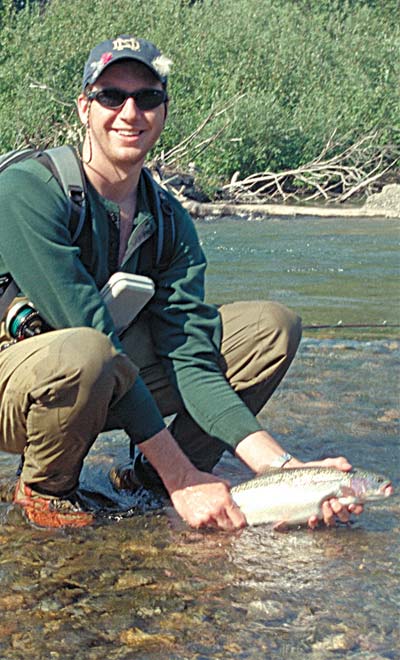
We cross the creek again. Several times. About three miles up, Patrick hooks into a big one and yells. By the time I get there, he’s got it near shore. Whereupon it decides downstream is a better place to be and strips quite a bit of line going there. Five minutes later, Pat pulls it out and I take several pictures of the most colorful Dolly Varden I have ever seen. Go ahead, look at the photo again and drool. You’re allowed.
After lunch something close to lethargy made Linda say “Anyone for heading back?” I thought it a wonderful idea and Larry agreed, so we asked Farley (who was bound and determined to make it to the falls).
“Got any protection?” he asked.
Hoping he wasn’t talking about the ribbed kind, I showed him the Blackhawk stuck in the top of my waders.
“357 magnum? Yes, that will irritate a bear.”
Humor. At my expense. My favorite kind. But I knew he was more right than wrong so I continued ” . . . and Linda’s got pepper spray.”
Where upon Larry spoke up, “Say, how about I hike back between you two?”
So off we went. And twenty minutes later, when lethargy returned, we stopped. In the shade. Big trees, clear water, and fish in the sweet spots. Life is good, I thought.
“You know, if we don’t get up, we’re not going to catch any more fish,” Linda said.
“So?”
“And if we don’t get moving again, we’re not going to get back to camp.”
“So?”
So we talked. About fishing, about camping, about food. Larry said “I can hardly pull myself out of bed to go to work; but this . . .”
Forty-five minutes later, he came up with another good one: “Either of you notice that mud flat we just crossed was FULL of bear tracks?”
It felt good to get back to camp. My notes say: “5:00 pm, wash face in cold water, comb hair.”
At 5:50 pm the up-the-creek crew returned. No fabulous stories about grayling, but Patrick caught that big Dolly Varden again.
Another good meal and another run at fishing the gravel bar wound down the day.
Knowing this was the last night, Billy fished harder than usual (if that’s possible) and brought in 30 fish (he counted) before he saw the bear “right across the creek.”
We traded stories around the campfire. I’d put a couple down on paper, but I wouldn’t want to embarrass anybody. Well, yes I would, but editors being editors . . .
I’d describe breaking camp next morning and running the river again (seeing Mt McKinley through scattered clouds) but I’d rather leave it around that fire. Farley’s voice booming into the darkness, Tom’s jokes, and Larry’s drawn out joke. Can’t tell you. Sorry. If we had any sense at all, we would have pile on the wood and stayed up all night. Almost did.
Oh, two more things: One, I lied. Farley’s jet boat does not go five hundred miles an hour. That’s an exaggeration. Not much of one, but an exaggeration. And two, Disneyland is a fine place. As soon as I save enough money to go there, I’m . . . going fishing again. [/emember_protected] [emember_protected scope=”not_logged_in_users_only”]
- Need to subscribe? Now’s a good time! Check out our current subscription specials!
- Already a subscriber? Login below to access all of our online articles and content!