


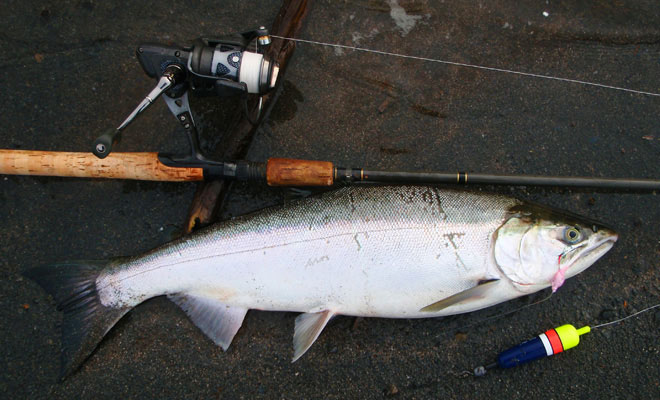
By JD Richey
I’ve said it a thousand times…silver salmon can drive you nuts! Especially since they often hold in slow, snaggy, “bassy” water that’s typically best covered by casting hardware like spinners, spoons and plugs. Which is not a big deal—if they’re in the mood to bite lures.
But here’s the rub: Coho aren’t always receptive to such offerings, and at times, you can cast until you need rotator cuff surgery without getting so much as a sniff from the fish.
Here you have a situation in which the fish are completely ignoring your lures, yet are holding in frog water that’s not at all conducive to traditional drift-fishing methods. What to do?
Hit ’em with a float and eggs. [emember_protected custom_msg=’This content is available for subscribers only.’]
Silvers will often eat freshly cured roe when all else fails—and suspending it under a bobber gives you the opportunity to get your bait into their faces. If you tried to drift a glob of eggs with a chunk of lead in some of the slow, snag-infested holding areas coho prefer, you’d never really get your gear into the strike zone…and you’d lose a bunch of terminal tackle in the process.
A float rig will drift downstream in places regular gear would stall out and end up anchored to the bottom. Plus, it keeps your bait above the snags and right where the fish can see it. As an added bonus, bobbers allow you to fish distant seams and holding lanes both above and below your position. You can also extend your drift by simply letting more line off your reel—all things you will be hard-pressed to do with conventional methods.
The Drag-Free Drift
Before we get too far along, let’s cut to the meat of this technique and discuss the number one thing you have to master: The drag-free presentation.
When fishing bait under a float, your gear needs to travel downstream at the speed of the current. While there are times when silvers will grab a bait that’s traveling a bit slower than the current (more on that later), you generally want to keep your gear moving with the flow of the river.
To keep the proper speed going, you have to keep as much line off the water as possible. When a belly forms in your line between the rod tip and the float, the current will grab it and drag your line downstream too quickly. Similarly, a bow in the line can also occur upstream of the bobber (in eddies and calm spots behind rocks, for example) and that will make your bait slow down and lift off the bottom.
To keep the belly out of your line, you’ll have to lift and “mend” it to make sure it remains free from being influenced by grabby sections of current. When a bow starts forming on the water, gently reel towards your float and then, just as you come tight to it, lift the line in the opposite direction of the belly. Take care to avoid violently jerking the float as you mend, as that can cause your bait to drift unnaturally, too.
While I’ll cover float-fishing gear later, it is worth mentioning that braided line is far and away the best choice for this technique. Most braid floats and that buoyancy makes mending quite a bit easier. Mono and fluorocarbon lines sink—and thus catch a lot more current.
Float Attitude
By closely paying attention to your float as it drifts, you can get a better feel for what’s going on beneath the surface. As a basic rule of thumb, you want your bobber riding straight up and down, which is an indication that you’ve got the all-important drag-free drift going. If the top of your bobber is pointing downstream, you’ve either got a downstream bow in the line that’s pulling your gear too quickly—or your hook and/or sinker is dragging on the bottom. In either case, your bait doesn’t look natural and is less likely to get eaten by a silver. When the float is leaning upstream, you may not have enough weight on and your bait is getting blown out towards the surface. Or, perhaps, the line between you and your float hit a slower pocket of water and is reducing the speed of your drift.
Holding Back the Float
Now that you’ve got a grasp on the drag-free drift, I will say that there are a handful of cases in which intentionally slowing down your gear can help you get bit. When salmon are suspended off the bottom of a slow hole, I like to slow my float’s speed slightly by applying pressure to the line with my fingers or thumb. This causes the float to “hold back,” which in turn makes the bait rise higher in the water column. This also is effective when the water is slow and really clear and ensures that the fish see your bait before they notice your swivel and sinker.
Holding your float back is also handy when the silvers are sitting, as they sometimes do, on the break at the downstream end of a hole or slot—just before it transitions into a riffle. Fish in those spots can be a little tough to get with the float on the dead-drift because the bottom comes quickly and your gear can end up actually passing under the fish. Say you’ve got your float set at 10 feet so that it puts your bait just off the bottom of a hole. But the fish sitting on the break are only in four feet of water….when your eggs get to that shallow spot, they’ll be out of the fish’s window of vision. By slowing down the bobber as it approaches such a spot, the bait will rise to the fish.
The Bite
When a salmon picks up your eggs, the type of “bobber down” you get depends a lot on the speed of the current. In swift water, the float goes under more quickly, while it tends to go under somewhat slowly and methodically in softer flows. Either way, reel any slack out of the line, and then when you feel resistance, set the hook. It’s critical that you to try to keep a tight line between your rod tip and the float when fishing so that you don’t have to reel up a bunch of slack before setting the hook.
Bobbers
Now, let’s take a look at floats and their uses. The two basic styles of floats commonly used for river fishing are fixed and slip. With the slip variety, you run the line through the center of the bobber and it can slide up and down your line. An adjustable bobber-stop is placed on the line above the float, which can be moved up or down, depending on the depth of the water. A fixed float is attached to the line via tight-fitting rubber bands that hold it in place wherever you set it.
I will use fixed floats like Thill’s Turbo Master in situations that call for a stealthy presentation—low, clear water where light weights are necessary. Because a fixed float can be hard to cast when you’ve got it set for anything deeper than about 6- or 7 feet, they also work best in spots where the fish are holding shallow.
Slip floats are much easier to cast and come in a wide array of sizes that can accommodate anything from a half-ounce of lead to 5-ounce sinkers. For silvers, they allow you to cover the widest range of situations. In big water, I’ll go with Salmon Stalkers (usually in the 1- or 2-ounce models), and on smaller streams, Thill’s Big Fish Slider is tough to beat.
The best way to choose a float is to first figure out how much lead you are going to need to get your offering near the bottom. Then, pick a float rated for that amount of weight. A properly weighted bobber will ride straight up and down in the water—too much lead and it will be barely visible or sink, while it will lay flat on the water if you don’t have enough weight.
Gearing Up
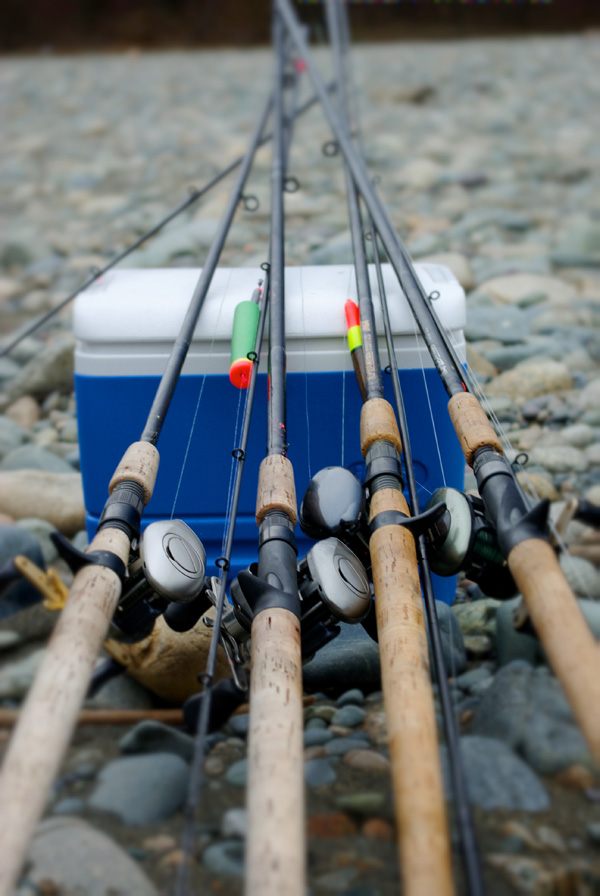
When float-fishing for silvers, you can go with either spinning or casting gear. I prefer spinning tackle when I’m using light weights or have to make difficult casts under trees and brush. A baitcasting rig works great when you’re fishing weights of a half-ounce or more. They also give you better control of your presentation because you can easily play line out under your thumb to extend the drift.
As far as rods go, use the longest model you can get away with. Typically, I fish 9 ½- to 10 ½-footers unless there’s a lot of overhanging vegetation. A long rod makes mending the line to get the drag-free presentation so much easier than with a short stick. You’ll want a bit of a slow tip but also plenty of backbone in the lower two-thirds of the rod so you can horse big coho out of the wood.
Braided line is absolutely the way to go when float-fishing. Most braid floats, so it sits on top of the water, rather than down in it. Again, the buoyant nature of this type of line really helps with the mending process. I like 30- or 40-pound Berkley FireLine, but you don’t want braid all the way to your hook, so I’ll finish off my rig with a fluorocarbon leader—20-pound Sunline Super FC Sniper is extremely reliable.
Basic Float Rig
There are several ways to rig for float-fishing for silvers, but let’s keep this simple and give you a basic one with which to get started. Once you master the fundamentals, then you can branch out and try other rigging styles.
Start by tying (via an Albright knot) a 10-foot section of 25-pound mono to the end of your braided line. Then, slide a bobber-stop up the line followed by a small plastic bead. Next, run the line through your float and then it’s time to add your lead. You can use an egg sinker and finish the rig off with a bead and a quality barrel swivel. Even better is to tie an inline sinker (I like the kind sold by First Bite Jigs)—they’re torpedo shaped with a line attachment eye on either end—to the end of the 25-pound mono.
Finally, add an 18- to 36-inch section of 20-pound fluorocarbon leader and tie on a size 2 to 2/0 octopus-style hook with an egg loop and you’re in business.
Egg Cures
Silvers seem to like sodium sulfite cures in either bright red, hot pink or orange shades and you can find plenty of commercially produced cures that are relatively easy to use from the likes of Atlas-Mike’s, Pro Cure and Pautzke’s among others.
In low, clear water, I’ll use egg clusters ranging in size from a nickel to a quarter. When the water’s off-color or has a glacial tint, you sometimes have to go with baits that are nearly the size of a ping-pong ball. In any case, use the freshest eggs you can get your hands on.
Give it Time
Mastering float-fishing and the drag-free presentation takes a little practice, so be sure you give yourself some time to figure things out. You may not have immediate success, but once you get the hang of it, those crazy, lock-jawed silvers will never know what hit ’em!
###
A longtime Pacific Northwest salmon and steelhead guide, JD Richey is a contributing editor for Fish Alaska magazine. He can be reached at www.fishwithjd.com. [/emember_protected] [emember_protected scope=”not_logged_in_users_only”]
- Need to subscribe? Now’s a good time! Check out our current subscription specials!
- Already a subscriber? Login below to access all of our online articles and content!