


A Hunt for Monster Yukon River Pike
Story and photo by Marcus Weiner
“On my planet, we have a sun.”
It’s pushing 90 degrees, Alaska is on fire, and we are on a hunt for the monster pike of the Yukon River. With a camp that includes a shower, sleeping tents with cots, generator, dining tent, screened gazebo, and meals like Copper River sockeye, fried potatoes, salad, apple pie and ice cream, roughing it was never so nice. Throw in 40-plus-inch pike and we have all the makings of an epic adventure.
Bill’s one-liner (and when you are as funny as Bill, the one-liners are unending) is a comment on our smoky surroundings. On an otherwise crystal-clear day, the smoke enshrouds everything in gray and leaves the sun as nothing more than a distant orange ball. It’s as if we are experiencing some new form of solar slight-of-hand, leaving us to feel like we’ve been transported to another planet. This is an especially dry year across interior Alaska and the forest fires are raging.
But what’s a little smoke when there are monster pike to hunt? [emember_protected custom_msg=’This content is available for subscribers only.’]
Among all the fish available in Alaska, northern pike seem to have the least shining reputation as a worthy gamefish. Some believe that the “water wolf” invades a system, eats everything in its way, and leaves a barren wasteland devoid of life. Others simply believe that pike don’t fight and still others think that the fish is inedible—probably a notion construed from the odor of pike slime. I’m here to tell you that all of these are untrue. Pike are apex predators, and in their native habitat in northern and western Alaska, they share habitat with many other species. On the Yukon for example, pike coexist with sheefish and salmon. Granted, they are eating machines with a rapacious desire for fish, but can you really blame them? In areas that are not native to pike—Anchorage and Mat-Su Valley lakes, for example—illegal introduction of this efficient predator has negative effects. They quickly alter the species balance in the ecosystem and quite often destroy the native fish species. For those that really enjoy pike, introducing them into non-native waterways continues to malign the species.
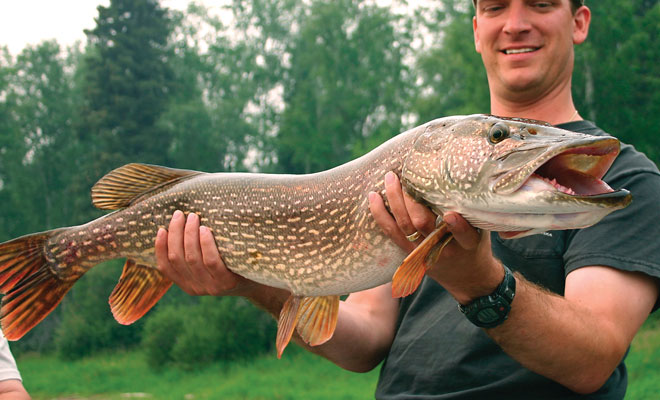
For those that think that pike don’t fight, try landing a 40-inch fish. If you don’t expire from a heart attack from the initial ambush of your lure, then you’ll have a battle on your hands when trying to land a 20-pound fish capable of reel-screaming bursts of speed. Now that you land one, be careful of the toothy maw. Keep your fingers out of the line of fire and be careful when the pike flares its gills. Typically this will signify a mad thrashing of the body and a wide-open mouth. You’ll get a look at the some 700 backward-slanting teeth that occupy the jaws, tongue, roof of the mouth, and even the gillrakers of a pike. Quite a set of pearly whites.
Finally, for those that don’t eat pike because they figure it to be “slimy” or “fishy,” here is the news: Pike meat is white, flaky, and delicious. The difficulty is in the plenitude of “Y” bones in the fish. ADF&G has a good brochure on how to cut 5 bone-free fillets from each pike in addition to a lot of useful information on where to find pike and how to harvest them at http://www.sf.adfg.state. ak.us/region2/pdfpubs/02pike.pdf. In addition, ADF&G puts out a northern pike video that includes the following information: bow fishing gear and methods, spear—open water and through the ice, fly fishing and popular patterns, spin fishing and the “must-have” lures, how to make boneless fillets. Check out http://www.sf.adfg.state.ak.us/region2/pikevideo.cfm.
I’d heard tales and seen photos of giant pike that roam the enormous Yukon River drainage. It is Alaska’s largest river, is chock full of pike, and quite possibly holds the next world record northern. The endless sloughs and backwater channels that feed into the main river offer unlimited habitat to prosper. It seems a strange land, filled with more water than solid earth. It’s this environment that provides perfect ambush cover as the pike’s coloring is designed to allow it to blend into the weedy bottom. When the unsuspecting prey swims by, the pike erupts from a holding position and ambushes its quarry with vicious precision. Prey ranges from other fish species including trout, grayling, other pike, juvenile salmon, and whitefish to frogs, shrews, birds, and even muskrat and beaver.
Pike can be found around the globe from Europe to Asia to North America and is considered to be the most widely distributed freshwater gamefish on the planet. In Alaska, the pike’s native range extends from the Alaska Range north and includes the waters from Bristol Bay west. Illegal transplants are responsible for significant populations in the Anchorage bowl, Susitna River drainage, and Kenai Peninsula. Most pike overwinter in deep-water spots in lakes and rivers, and move into lake shallows, sloughs, and slow-moving streams to reproduce. After the spawn, they remain here to feed.
Our journey to the Yukon begins with a drive to Fairbanks and a flight to a Yukon River village. From here, we will be picked up by John Grimsley, owner of World Class Expeditions and Bill O’Halloran , owner of North Country River Charters, and taken to a very special spot they have fondly nicknamed “The Pike Paradise.” John and Bill have teamed to host fishermen from all over the world in this wilderness spot. A scenic boat ride on the Yukon and countless backwater sloughs later, we miraculously emerge at camp. It’s got plenty of amenities—a shower, generator (which comes in handy keeping the ice cream cold), big sleeping tents with cots, and a large screened gazebo to hang out in after the day’s fishing is over. Make no mistake, Alaska is bug friendly country and this endless land of connected waterways around the Yukon makes for ultra-productive breeding grounds and plenty of bugs.
It’s clear that we won’t experience traffic jams, combat fishing,or smog at this camp. Rather, clean air, few other anglers, and true peace and quiet are what you can expect. Unlike city life, beaver tails slapping the water are the most common sound to break the silence. Wildlife is in abundance here and moose, bear, caribou, and eagle sightings are common. For me, the bush experience is even more satisfying than the stellar fishing.
The camp boats are custom 25-foot Thunderjets—very well powered and capable of covering water quickly. Each boat is equipped with a large electric motor in the bow to allow the captain to operate in shallow water in stealth mode. This works very well in pursuing pike in the weed flats. In addition, there is plenty of fishing room on each boat, enough for six anglers to fish from and “poach” each other’s quarry. Let me explain. The first few days of fishing in our party, everyone is civil, courteous, and respectful of another angler’s water. As we grow comfortable and accustomed to fishing together, whenever anyone misses a strike, two, three, and sometimes four lures can be heard flying through the air on their way to the spot where a pike had just ambushed the initial angler’s lure. It becomes part of the game to “poach” someone else’s pike.
Wayne Norris and I are accompanied by certified Yukon River pike fanatics Randy and Floyd Appeling. Randy is Floyd’s son and our quest on this trip is to get Randy a pike over 40 inches. Also present in camp are George O’Halloran, Bill’s dad, up to Alaska visiting from Sun City West, AZ, and Don Gallup, a client from San Diego, CA. Joe Kazense and Roger Fleming are guides at the camp and share responsibilities with Bill and John in running camp and guiding clients fishing.
After unloading our gear and eating lunch, we are ready for an afternoon’s fishing. By any normal standard fishing is spectacular as we land about 30 fish among six anglers in about three hours. Many are in the 30 to 40-inch range, and John tapes a 20-plus-pound specimen at 43 inches. We use spinning and baitcasting gear in the 8 to 20-pound class and throw spoons, spinners, and topwater plugs. All riggings include a short steel leader. John and Bill understand the need for responsible angling practices and seek to promote catch-and-release in this trophy fishery. We handle all fish carefully and pay special heed to get the truly large fish in the water as quickly as possible. Pike are very hardy, some estimations suggest that they can live out of water for many hours, which lends to low mortality rates during catch-and-release. After dinner at camp, Wayne and I take one of the camp’s small inflatables for a short ride downriver to another large slough near camp. Using a 9-foot 6-weight fly rod, floating line, a stiff 6-foot leader, and a wire tippet, I throw mouse patterns from the center of the slough into the weeds at the shoreline. Slowly twitching the mouse from its landing spot into the open water serves to instigate a vicious strike. After hooking six and landing three, my mouse is thrashed (and has had its tail bitten off) and we call it quits for the night.
Day 2 is hot, sunny, and still. We set out for a full day’s fishing and will return to camp in the evening for supper. We begin down a narrow channel that eventually leads to a larger expanse of stillwater with several sloughs breaking out from the main. Most lures work here, and we use the Johnson’s “Silver Minnow” spoon, the Luhr-Jensen “Wood Chopper” top-water plug, and large bunny strip streamer flies to great success. Upwards of 100 fish are landed on our boat during the day. At lunch, we join the other boat to eat together, tell stories, and share intel. I wolf down a sandwich and proceed to start fishing. Casting across the current, I let the spoon sink into the deepest hole and begin to retrieve it upstream. I am rewarded by a stunning smash of the lure, and 10 minutes later, we land a 43 1/2-inch fish, probably in the 21 to 22-pound range. It is heavy, slippery, and full of big teeth, and as it thrashes about, I instinctivelyhug it to avoid dropping it. Don fishes with George, Roger, and Joe on the other boat, and is relentlessly catching big pike on his fly rod and personally-tied flies. Today he meets another goal, and lands a sheefish on fly gear.
Day 3 is cooler outside, but fishing is hot on the other boat. Roger lands a monstrous 46H-inch pike and Don lands four over 40 inches. Our best fish of the day is Randy’s 40H-inch pike—very fat and healthy, with beautiful color and markings. We can’t wipe the grin from his face for the rest of the trip. Bill and John spot a couple of scary fish that they guess to be in the 50-plus-inch range. Camp record is 53 inches, 34 1/2 pounds. I begin to experiment with a topwater plug called the “Hellraiser.” It’s obscenely large—about 12 inches long—and takes both arms and two big steps forward to launch it into the river. It seems to elicit even more explosive strikes, as if the pike strikes harder because it is attacking larger prey, but the fish miss the lure more often than not.
Day 4 sets the benchmark for heat, and the pike seemed to feel it as much as the anglers. We catch a handful of fish mid-morning and decide to go back to camp to wait for it to cool down. After an afternoon siesta and an early dinner, we fished the evening bite and landed a bunch of northerns in the 25 to 35-inch range. At the mouth of a slough near camp, Roger catches a sheefish on a green and silver spoon.
On our final day, after a tasty breakfast of eggs, bacon, and pancakes, we pack the boats for a ride back to the Yukon River village. We leave a few hours early to give ourselves enough cushion in the event of some unforeseen obstacle. We make it without a hitch and fish for sheefish at the mixing point of a large Yukon tributary and the Yukon River. Casting a Johnson’s Silver Minnow spoon across current, I retrieve it at a 45-degree angle back upriver and am rewarded with a hard strike. Sheefish have very bony mouths and require an extra-hard hookset. Unfortunately, I didn’t get a solid set and lost the fish within 10 seconds. Shortly thereafter, Randy hooks a 20-pound king salmon and has quite a fight on his hands. The guides coach him along, mouths watering, already smelling barbecued king salmon. Sadly, the king comes unbuckled before it finds its way to net.
Bill’s satellite phone rings with news that our flight has been canceled because of low visibility combined with a short runway. We pull into the village and after a few calls, Bill has arranged for us to leave from another village in a couple hours. Quickly refueling the gas-hungry boats, we disappear into the smoke for a 30-plus-mile ride downriver. It has been an exciting trip and this final element caps the adventure. We have caught monstrous pike, have enjoyed good food and great company, and look forward to many other exciting adventures pursuing the water wolf of the wild Yukon.
Marcus Weiner is publisher of Fish Alaska magazine. [/emember_protected] [emember_protected scope=”not_logged_in_users_only”]
- Need to subscribe? Now’s a good time! Check out our current subscription specials!
- Already a subscriber? Login below to access all of our online articles and content!