


Cut through Pinks: A Fish Alaska How-to
Story and photo by Scott Haugen
Tolerating pink salmon while targeting prized silvers can be a frustrating experience. Here’s how to beat the pinks and land more coho.
From the elevated vantage point of the boat’s bow, I could clearly see silver salmon lying beneath the dark cloud of pinks. The pink salmon occupied a stretch of water maybe 30 yards wide and 75 yards long. They were dispersed on the upper end, more concentrated in the middle, deeper section of water, where the silvers lay.
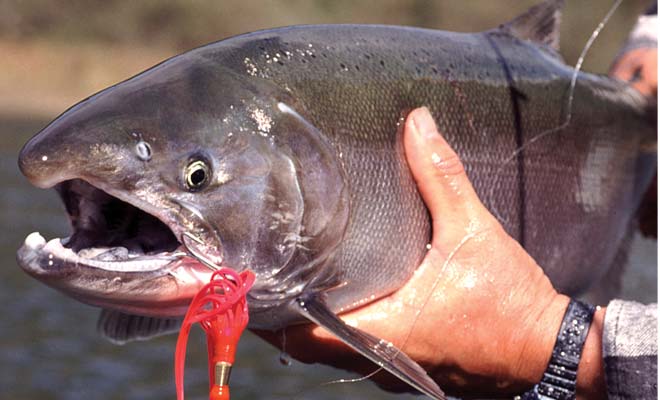 Trying to work various fly patterns through the pinks, I grew frustrated at my lack of success. Don’t get me wrong, I love catching pink salmon, but when there’s a wad of fresh, foil-bright coho so close, it’s no contest as to which I’d rather be battling. Not even my weighted patterns had a chance of reaching the silvers before a pink would gobble it up.
[emember_protected custom_msg=’This content is available for subscribers only.’]
Trying to work various fly patterns through the pinks, I grew frustrated at my lack of success. Don’t get me wrong, I love catching pink salmon, but when there’s a wad of fresh, foil-bright coho so close, it’s no contest as to which I’d rather be battling. Not even my weighted patterns had a chance of reaching the silvers before a pink would gobble it up.
[emember_protected custom_msg=’This content is available for subscribers only.’]
Intent on catching coho, I picked up the jig rod. The first few casts with a 1/4-ounce jig produced fish, but only humpies. Then I switched to a 1/2-ounce jig. Three casts, three silvers. Eight silvers would be hooked and released from that hole before moving on, and all because the 1/2-ounce jig was perfect for cutting through the pinks to reach the silvers.
This year, 2006, marks another pink-run year for most of Alaska. Though pink salmon enter some Alaska streams on odd numbered years as well, it’s even numbered years that see millions of pink salmon making their way into Alaska’s waterways. Pink runs can spread out over several weeks, even months, and routinely occupy the same rivers as silvers, often at the same time.
As fall progresses, most pinks have spawned and died, while silvers begin transitioning into their spawning colors as they move upstream. This is a great time to pursue silvers, but by this late in the season, many touring anglers are back home, not in Alaska.
If you find yourself streamside in Alaska at summer’s end, having had your fill of pink salmon, yet you know silvers are around, don’t give up; there are ways to cut through the pinks to those awaiting silvers.
Getting Started
Before hitting the water, there are two points worth noting, points that will increase your odds of catching silvers before even wetting a line. First, know your target stream, and if you don’t know it, don’t be afraid to explore. Second, invest in a reliable pair of polarized sunglasses.
Why is it critical to know the stream you’re fishing? Simple, it comes down to fish behavior. Pink salmon typically spawn in shallow, graveled sections of river fairly close to the stream’s mouth. Based on personal experience, generally speaking, it seems the smaller the stream, the closer to the mouth the pinks spawn.
If targeting coho, this is good to know, as silvers routinely push farther upstream prior to commencing their spawning duties. This means moving upstream, often only a short distance, can separate you from pinks, allowing you to focus on silvers.
While bank fishing a small Alaska stream early one September day, I met a man who was frustrated at finding only pink salmon. He saw I toted a limit of silvers and was curious as to where I found them. “Head around that corner, about 150 yards from here and you’ll be into silvers for the rest of the day,” I shared.
Before leaving the area, I hiked up over a knoll to see if the angler had found the sweet spot. Two fat coho lay on the gravel bar behind him and a thumbs-up, ear-to-ear grin said it all. This was a prime example of how, by taking the time to explore a river and cover water, anglers can escape pinks and find silvers.
Because so many Alaska streams are running fairly clear this time of year, save for some tannic-stained or heavily glaciated waters, physically locating silvers, then fishing to them, is very feasible. This is where a pair – or two, or three – of polarized fishing glasses are key. For years I’ve depended on Smith Action Optics glasses with amber, copper, and gray lenses to meet all my Alaska sight-fishing needs.
Bait Options
If you are looking to cut through pink salmon in search of silvers, try cured eggs
In another pink/silver encounter, I could plainly see both species, and again, the coho were staged beneath the humpies. Flies, jigs and lures failed to produce silvers, so I went to bait. Rigging up a drift-fishing rod, I cast upstream of the silvers, right through a thick mass of pink salmon.
I could feel the line hitting pink salmon as the terminal gear worked hard to find the bottom. Then the familiar feeling of lead ticking rocks confirmed it made it to the target zone. As my line approached where the silvers were, they began going crazy, swimming tight circles and darting about in the hole, until finally, one struck.
Two more silvers would be pulled from the little pocket tucked tight to shore, both on the same setup. Though I’d been fishing those silvers with other terminal gear, I’d failed to capture their interest. Not until the scent factor was introduced did the silvers want to play.
Pinks, though obviously a member of the salmon family, don’t seem nearly as scent-driven to strike when compared to silver salmon. In this case, switching to bait paid off, as the pinks couldn’t have cared less about it, while the silvers devoured it. I’ve had similar success with small strips of sardine and herring threaded onto the hook. Artificial scents can also make a difference, so don’t overlook the scent factor when combating schools of pinks.
Back-bouncing Bait & Plugs
In larger rivers, where deeper holes dominate, actually seeing fish can be a challenge, if not impossible. This is where getting down through suspended pinks is key. One of my favorite presentations, back-bouncing from a boat, is an often overlooked approach for silvers, but it can have big payoffs.
In back-bouncing, the setup is key. It’s vital to start well above where fish are holding and work down to them; this is especially true when competing pinks are in the area. If pinks are a problem, an objective should be to get that bait down to the bottom as quickly as possible, and that means using ample weight.
Another advantage of back-bouncing for silvers is that it allows you to present bait as well as plugs, two sources of terminal gear pinks are not in any hurry to gobble up. The rigging is simple, a three-way swivel tied to the mainline, an eight-inch dropper and a leader of two to three feet in length. Dropper size can vary, but on coho I prefer a short one since the fish are usually congregated in specific locations within holes and deep runs.
Eggs are my preferred back-bouncing bait, and silvers love them. Bright pink or brilliant red cured eggs are a top choice. If pinks won’t leave the eggs alone, switch to a plug presentation. The SE12 series Hot Shots, along with K12 Kwikfish, seem to be good size choices, a bit too big for pinks, just right for coho.
Depending on the river, even the hole being fished, the back-bouncing presentation can be delivered from either an anchored boat or on the move. If anchored, simply gauge the amount of weight being used so line can be fed out, allowing the terminal gear to move downstream to where the fish are. If working from a moving boat, the boat determines your rate of presentation.
Interestingly, given the anatomy of many Alaska streams, back-bouncing can even be applied from solid ground. Given the many cut banks and deep holes associated with these streams, bank anglers can often position themselves so that they can effectively maneuver the same back-bouncing presentations from shore. Because both pinks and silvers travel tight to the bank, fighting the pinks can be a problem, but put on enough lead and pump the presentation downstream, along the bottom, and the problem may easily be solved.
Jig Fishing
Much like back-bouncing, I’ve learned through trial-and-error that when presenting jigs to silvers, through competing schools of pinks, setup is key. I’ve tried dropping jigs through schools of pinks to reach silvers, but it doesn’t always work as the pinks often attack before the jig reaches the strike zone.
Instead, taking the time to introduce the presentation well upstream, ahead of the pink school, has paid off numerous times. The objective is to get the jig down below the pink salmon, which are typically suspended higher in the water column than coho.
However, if both species are stacked in a small hole leading to a shallow section at the upper end, it can be a challenge actually getting in front of the pinks, which are not afraid to hold in the shallowest of water. In this case I’ll concentrate on hitting the break point, where the shallow water starts diving into the deeper slot. With a 1/2-ounce jig, the fast sink rate will often plunge through the pinks before they can react to it.
Another benefit of the jig presentation is that it can be fished well downstream of the angler. I once located a pod of silvers holding tight against the inside bend of a stream. Pink salmon were thick, and I was having a heck of a time getting my presentation down to where the silvers were stacked.
Walking upstream, I worked well ahead of the holding pinks, flipped the bail and started letting out line. As the float and jig were carried downstream with the current, I continually mended my braided line as it floated on the surface. At about 60 yards out, the bobber when down. Whack! A fat silver, just what I’d been looking for. Next drift, same results. Before they quit biting, several silvers succumbed to the jig, and all because of the angle of presentation and the fact so much water was being covered.
Hardware
Another effective method for covering water is tossing hardware. The problem here is that pinks also love the same spinners and spoons that silvers do. The options, however, are to find places where only silvers are holding (slack water and sloughs), or going with larger, faster presentations.
If coho are located, and the pinks won’t leave your lure alone, go to something larger. Pinks will often shy away from larger lures, while silvers will attack them. At the same time, a larger lure often means a heavier lure, which allows the presentation to quickly sink through the humpy school, into silver territory.
My best results have been going to a larger, heavier lure, letting it sink through humpies to the target depth while simultaneously being carried downstream, much like how a drifting rig is presented. Once in the target area, a quick retrieve gets the lure moving, a move which spurs a reactionary strike from coho.
By nature, coho salmon are very aggressive, and particularly in comparison with Alaska’s other salmon species, will travel great distances to devour a bait, fly, or lure. They especially seem to like a lure that zips across their face and progresses into a fast-paced swing as it works against the current. In such cases coho will often travel many feet, even yards, chasing a lure. It can be a thrill when it happens, and one of the hardest strikes in the world of salmon fishing.
When it comes to plucking out silvers from beneath schools of pink salmon, diversity is the ticket to success. By having an array of methods at your fingertips, you’ll be better able to meet the conditions and offer a presentation that will effectively cut through clouds of pink salmon. And once dialed in, you’ll be glad you stuck with it, for it’s tough to beat the fighting power of silvers.
Scott Haugen is a contributing editor for Fish Alaska and the author of A Flyfisher’s Guide to Alaska, which can be obtained by sending $38.00 (includes S&H) to Haugen Enterprises, P.O. Box 275, Walterville, OR 97489. The 455-page book is one of the most complete travel guides ever written for anglers heading to Alaska, with hundreds of rivers, lakes, and streams covered in detail. This and other titles by the author, including cookbooks, can also be ordered at www.scotthaugen.com. [/emember_protected] [emember_protected scope=”not_logged_in_users_only”]
- Need to subscribe? Now’s a good time! Check out our current subscription specials!
- Already a subscriber? Login below to access all of our online articles and content!