


by Melissa Norris
The trip initiated at least three firsts . . . my first time to the Talachulitna River, my first time flyfishing, and my first time fishing with Pudge Kleinkauf. All three are things I can’t wait to do again.
I had planned to stay a couple of extra days at Talstar Lodge with Pudge after the gals from AWAIC headed back to Anchorage (See Alaska Fishing News from the June 2003 issue of Fish Alaska). That evening Pudge and I sat on the deck at Talstar Lodge and talked while she tied flies for the next day of fishing. [emember_protected custom_msg=’This content is available for subscribers only.’]
We awoke at 5 a.m. After a homemade breakfast prepared by Chef Robert, we geared up and walked down to the river to begin flyfishing lessons. Although it was a trip of firsts for me, Pudge had been here teaching women to flyfish on many previous occasions. We walked along the scenic path that follows the water and onto the gravel bar in front of some faster moving water. First she takes the 5-weight, Sage fly rod and quickly explains to me the casting method I would learn. She hands me the rod. “11 to one,” Pudge calmly instructs. “Good, now stop short on that back cast. You want to see that line stretch all the way out. Hold it a second and cast forward. Good, now you’re getting it.”
I practiced and practiced, making mistakes along the way, but with Pudge’s consistent encouragement and unconditional patience, I began to catch on. “Watch the fly float downriver. Mend the line, you don’t want your line dragging your fly; it’s all in the presentation.” she said. After about a half-hour of lessons, Pudge declared me ready to fish.
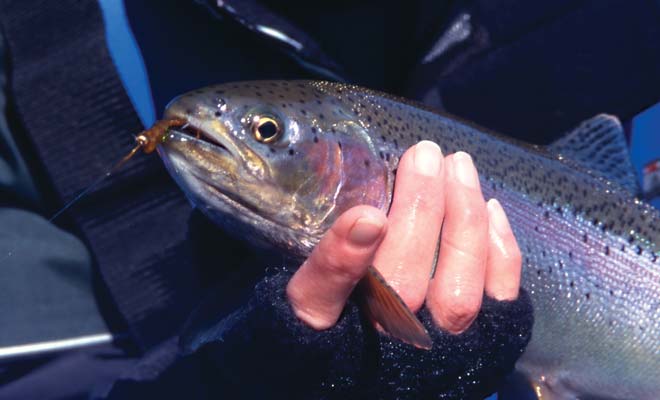
We headed farther downriver. There was a small group of anglers on the right side fishing, so we headed another 100 yards down and began to fish. “Stand out a little farther. You don’t need much distance, so just flip your line out like this,” Pudge says as she demonstrates a roll cast. I move a few steps out and attempt the roll cast. Before you know it I feel a strong grab at my Iliamna Pinkie. I set the hook and palm the reel. I had a little background knowledge having been out on the water with other flyfishers, so I let the fish run before gently bringing him back. “Palm your reel, good, now reel in, take a few steps back, palm it, good. All right!” Pudge explains as I capture my beautiful little leopard rainbow trout. It was certainly a small fish by Talachulitna River standards, but to a beginning flyfisher, it is a trophy.
We fished until lunch and then walked back to the lodge to grab a bite before heading upriver to try our luck there. Since Talstar Lodge is our base camp, we departed directly from the lodge and walked down the river to a point where we could wade either upstream or down. The river is easy to wade, so we walked across to the gravel bar. Pudge and I fished on our own and this was our preferred method, but the lodge also provides a guide and motorized boat for running clients both upriver and down to fish.
We fished all afternoon, catching silvers and pinks. It was a real pleasure watching Pudge fish, as she was not there on official guiding business, and she rarely gets time to enjoy her favorite pastime. Fortunately, her love for teaching people to fish comes close to her love of fishing.
After dinner at the lodge with father and son, George and Mike Pollak from Texas, we all headed out again to the river. I opted to stay out of my waders as the evening is an opportune time for photography, and with the beautiful scenery of Alaska surrounding us, I couldn’t pass up the chance.
The Talachulitna River
Learning to flyfish can be intimidating. Very few people can pick up the rod and have it come as second nature. The best part about learning to flyfish on the Talachulitna is the variety of species present. There are eight types of fish in the Tal; kings, silvers, reds, pinks, chum, trout, grayling and char, For this, the Tal is known as a flyfisher’s ‘dream come true’. You can see your backing while fishing a strong king salmon run from June until early July each year.
The pink salmon are in the river every year (even years boast of the stronger runs), and since these fish are traditionally easier to catch, beginning flyfishers can learn the whole process of catching and releasing fish with the abundant humpies. September marks the height of rainbow fishing that is legendary on the Tal. Few rivers contain this variety of fish, making the Tal a true Alaskan treasure.
The Talachulitna is not very crowded, another good reason to visit for budding flyfishers. The first major freshwater tributary on the Skwentna River, the Tal is only accessible by floatplane or snowmachine. Since the Skwentna is a braided stream and unsafe for a boat ride (unless you are an experienced boatsmen with knowledge of the river), there are less people on this river than the more easily reached kind. The beauty of the river and wildlife viewing opportunities are two of the main reasons flyfishers make their annual pilgrimage to the Tal.
The water is often crystal clear, which makes sight-casting to the fish a much more viable enterprise. It is most enjoyable to watch the fish chase your fly, and for beginners, it is much easier to practice. A good pair of polarized glasses help.
What I quickly learned from Tal flyfishing fans is the rainbow fishing is most coveted. Average rainbows on the Tal weigh from 2 to 4 pounds, and can reach up to 8 pounds in size. The river served as a model for statewide catch-and-release programs after successful protective measures were implemented years ago. The rainbow trout was so popular it was overfished and the population nearly decimated, until the Board of Fish made the river catch-and-release only for trout. Now the trout population has stabilized.
The Tal is located about 60 air miles west of Anchorage and is a quick flight from Lake Hood, the float plane services’ mainstay. It is a very affordable wilderness vacation for both visitors and Alaska residents. Some experienced anglers prefer the do-it-yourself method of floating the river, and others prefer the full lodge experience with outfitters like Talstar Lodge. Whichever you prefer, there are some good businesses to work with who can supply the services you will need.
Talstar Lodge
Talstar Lodge was started in 1988 when Claire Dubin-Scheer and her late husband Allen traded their property on One Stone Lake sight unseen for what is now the lodge. Tragically, Claire’s husband was killed in a plane crash shortly after the property was acquired, leaving only Claire and their baby girl, Samantha. It would have been easiest for Claire to sell the property, but she knew that was what her and Allen would have wanted for Samantha and themselves, so she picked herself up and began the building process. For five years, Claire ran the lodge entirely on her own while she established a repeat clientele. Now, Claire and husband David Scheer own and work the lodge together. Claire is responsible for marketing and operations, while Dave lends his skills as a guide and helps with building and maintenance. Like most family-run outfits, this is a cohesive effort, with everyone pitching in. Daughter Samantha is quite the budding flyfisher. Claire and Dave have a son, Adam, who is responsible for making the guests smile. The last part of the “family” is Chef Robert Betencourt, who has been with the lodge for many years and is also responsible for making the guests smile.
In an amazing wilderness setting, surrounded by luscious ferns, Talstar Lodge is nestled into the tall cottonwood, spruce, and birch trees that line the Talachulitna. With a main lodge for dining and gathering, a bath house, three guest cabins, sauna and deluxe cabins, the lodge can accommodate between six and ten guests at a time. This allows the owners to maintain the close-knit family environment that they strive to provide their guests.
Flyfishers make up about 75% of the clientele at Talstar lodge, but spin fishers like George and Mike who were on vacation while we were there, are often staying at the lodge as well. I asked Claire what made Talstar Lodge unique. She replied that it was the river, the people, equipment, knowledge, and flexibility that the lodge offers, but I could tell that it was the sheer joy they received in providing their service to their guests. For more information about Talstar Lodge visit www.tal-star.com or call 907-688-1116.
For those of you thinking about experiencing your own firsts, consider attending the annual flyfishing schools for women hosted by Pudge Kleinkauf, owner of Women’s Flyfishing, at Talstar Lodge each summer. Contact pudge@womensflyfishing.net for more information. In Flyfishing Women: Explore Alaska, Pudge’s recently released book, she writes, “Being with these women for these ‘firsts’ is what makes teaching and guiding so rewarding for me. I recall my own first fish on a fly, my first fish on a fly I tied, and more.” Her enthusiasm is contagious. [/emember_protected] [emember_protected scope=”not_logged_in_users_only”]
- Need to subscribe? Now’s a good time! Check out our current subscription specials!
- Already a subscriber? Login below to access all of our online articles and content!