


by Cecilia “Pudge” Kleinkauf
The “real Alaska” awaits those seeking adventure, beauty and great fishing. Just be sure to bring a spare tire or two!
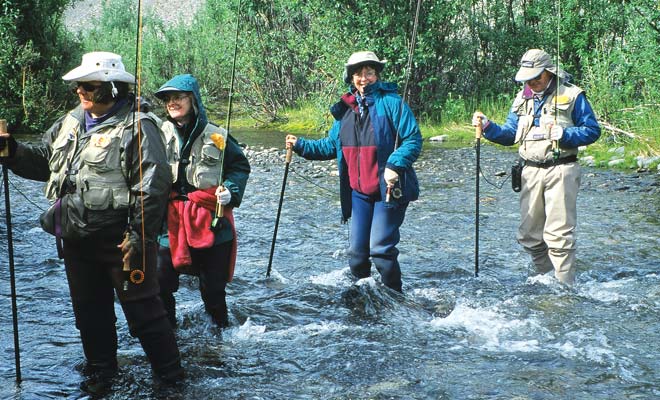
“I’ve got him this time,” Patti said as the tip of her 5-weight fly rod danced with the heft of a nice Arctic grayling. She’d had several hits-and-misses as her elk-hair caddis drifted down the tea-colored water of the Tangle River, but this was a solid hook-up. “I finally remembered to wait just a second or two before lifting the rod tip when I saw the hit,” she reported, “and it paid off.”
Paid off is right! The bend in her rod indicated a larger fish than is typical for the area, and it took some patience for her to land it. Finally, there it was in all its shimmering glory, a 17-inch hog with a spiny, florescent-dotted dorsal fin so long that it lay draped over the fish’s tail. [emember_protected custom_msg=’This content is available for subscribers only.’]
“He was definitely worth waiting for,” she said while admiring the catch and lifting his prodigious fin for a picture before carefully removing the hook. He rested briefly in her hand as he revived and then darted away.
Although not all this size, it’s the presence of Arctic grayling in every stream and every lake in the Tangle Lakes area of Alaska’s Denali Highway that makes the region so famous.
The Tangle Lakes Region
The only road link to Mount McKinley National Parkfrom 1957 when it opened until the completion of the Parks Highway in 1972, the 135-mile-long Denali Highway now connects the Parks with the Richardson Highway north of Anchorage. It offers the traveler two possibilities for access to Tangle Lakes. The first choice is to enter from the west via the town of Cantwell, at Milepost 209 of the Parks Highway. The second option is to begin on the eastern end from milepost 185 of the Richardson Highway, a road famous for its hummocks turned to corduroy by winter frost heaves.
From Cantwell, the drive to Tangle Lakes is a 100-plus-mile marathon on a narrow gravel road, so most anglers use the Richardson Highway entrance on the east. From there it’s only 22 miles on a paved road to reach the water. The paved section takes off from the tiny hamlet of Paxson, where a famous lodge serves the best hamburgers and pie for miles around, and ends at the Tangle Lakes/Tangle River area of the highway.
Besides leading to this premier dry-fly grayling fishery, however, this end of the highway is also a scenic delight. Shortly after leaving Paxson, the first pullout along the road provides a stunning introduction to the area. On a clear day, views of Icefall Peak and the Gakona and Gulkana glaciers rise above an unbelievable panorama of lakes, valleys, and mountains.
In spite of the paving, this portion of highway always feels particularly remote and inscrutable to me. The area is more hilly than mountainous, and constantly shifting cloud-shadows lend a secretive quality to the vastness spread out in every direction. Here tiny lakes, resting at the base of glacier-carved valleys, sparkle like jewels tossed randomly across the treeless expanse. In a land of few roads, the Denali Highway is unique in its desolate beauty and mystery.
The Tangle Lakes and Tangle River are an integral part of that mystique. This area harbors the remnants of a nomadic people who for thousands of years engaged in a subsistence lifestyle centered around the migrations of caribou that modern hunters refer to as the Nelchina herd. Over 400 excavated sites contain “some of the densest concentrations of archaeological resources in the North American sub-arctic,” according to a BLM informational brochure on the area.
The presence of these ancient hunters seems to manifest itself in the shifting veils of rain or fog that often obscure the hills, and in the caribou bones we find buried among the soft tundra moss. At times I can almost feel them with us on the river; I even find myself expecting to come upon them as we turn a brushy corner on a stream or top a hill that we are approaching. Surely they, too, fished for the native grayling and lake trout on their journeys across the area.
Unlike the hunters of old, who wandered far and wide throughout the region, most of today’s civilization centers around the Tangle Lakes. The area boasts a large campground on a ridge overlooking Round Tangle Lake and a smaller wayside and camping area tucked in beside the Tangle River as it emerges from Upper Tangle Lakes. Both have boat launches. Two well-known lodges provide services for visitors. Both offer food, lodging, cocktails, tire repair service, showers, and information. One has gas for sale (usually), and the other is known for its birding tours and expertise. Both have canoe rental services.
Modern day visitors are both recreationists and hunters. The caribou, the scenic location, and the abundant fishing opportunities in the area afford lots of possibilities. It’s the myriad of waters that make it all possible.
The Lakes and the River
The wide, hilly expanse of the Tangle Lakes area creates the geographic divide between the Delta and the Gulkana rivers, both designated National Wild and Scenic Rivers. Anglers, canoeists, hikers, mountain bikers, birders, and, when in season, hunters, all use the area extensively.
A series of long, narrow lakes, the first two of which are connected by the Tangle River, form the headwaters ofthe Delta River. A popular float trip begins at the boat launch at the campground and proceeds through Round, Long, and Lower Tangle Lakes to the Delta. Rafters can then continue on for a 29-mile float, including a half-mile portage around two falls to the takeout at Milepost 212 on the Richardson Highway.
The Gulkana River drainage can also be reached from the area. That trip begins at the wayside boat launch at Milepost 21.5 on Upper Tangle Lake and requires a mile-long portage from there to Dickey Lake in the Gulkana drainage.
The Tangle River, draining Upper into Round Tangle Lakes, rushes and tumbles along a rocky, meandering course interspersed by small brushy islands. The slightly rust-colored water in riffles and pools shadowed by birch, alder, and willow makes for perfect grayling habitat.
The Fish and the Fishing
Arctic Grayling
As we arrived on the creek early one morning, dimples, swirls, and blips marked the places where the grayling found their sustenance and identified the feeding lanes for the anglers. We were ready to get to work, and the fish were ready to cooperate.
Karen had selected a spot where the water dropped off a small rock ledge and then continued down a beautiful slow run. Fish rises broke the water everywhere. “I can sure see why accuracy is essential,” she commented as I waded down to see how she was doing. “If my fly is even a couple of inches out of the zone, the fish won’t move over to get it. It really is important to be ‘right on’ the feeding lane.” Every time she was able to put that rule into practice and drifted her #14 yellow humpy to the fish just right, she was hooking up.
“Look at this beautiful girl,” she said as she lifted a 12-inch prize just above the water so everyone could see what she meant. This fish had freckles!
Grayling typically have a black spot or spots along their sides just behind their gill plates, and each fish’s spot pattern is different. This fish’s spots were unique because they were so small and because they were right on her gill plates. I’d never seen any grayling quite like her. Too bad none of us had a camera capable of doing her justice.
As they increase in size, Alaska’s grayling exhibit brilliant aqua, fuscia, purple, and azure hues along their dorsal, ventral, and pectoral fins. A pearlized emerald glow typically rouges gill plates and tail. The dorsal fins can be huge, especially in large males, and it is not uncommon to see them drape along beyond the adipose fin and across the tail. Patti’s fish was a good example. Until taken from the water, the iridescence of the colors is absolutely indescribable. As all grayling anglers know, pictures hardly ever do them justice.
Both dry flies and nymphs were working this particular morning, and fish after fish came to hand. No one was going without fish, and no one was complaining if their “trophy” was only 10 or 12 inches long. Everyone simply marveled at the quick response from the fish to a well-placed offering.
Across the river some anglers fishing with extra small spinners were also doing well. They were using single, barbless hooks and also releasing fish. One of that group also had a fly rod with him, and we watched him switch off to it when he noticed us doing well on dry flies. “There really is some magical connection between grayling and flies,” he laughed.
He’s right. Study after study has proven that grayling’s preferred diet is aquatic and terrestrial insects, in all stages of development. Their cooperative nature and their penchant for bugs are two of the things that make them the perfect fish for anglers wanting to learn to flyfish.
“Why is it that grayling are so cooperative?” someone asked. “They never seem to stop eating, yet they are relatively small fish.”
A seemingly endless appetite characterizes grayling as much as does the sail-shaped dorsal fin. Yet, they are the slowest growing of Alaska’s sport fish. Studies show that a twelve-inch fish is probably already five to six years old, while a nineteen-inch fish can be ten years old or more. Recent studies indicate that grayling may have a much longer life span than originally thought. A fish over seventeen or eighteen inches in length is considered a trophy anywhere.
In spite of their voracious feeding habits, the grayling’s small size can be attributed to their harsh environment and their failure to feed in winter. Grayling spend the winter in deep pools under the ice. They survive there in oxygen levels much lower than either rainbows or char could tolerate and feed very little during that time. Since grayling spawn in the spring, they must feed ravenously all summer to develop the eggs and sperm for the following year’s spawning before winter arrives. No wonder they’re eating all the time!
Just because grayling are small fish doesn’t mean they can’t put a real bend in a 5-weight rod, however. Their eagerness to take a properly presented fly and their plucky spirit when hooked make them a favored sport fish of Alaskans and visitors alike.
Because they are so cooperative and so slow-growing, though, grayling populations are easily impacted by over-fishing. Single barbless hooks are recommended and the “limit your kill, don’t kill your limit” ethic is also embraced by many who fish the area. Both efforts help to ensure the continuation of healthy, strong populations of fish.
Lake Trout
Anglers at Tangle Lakes also target lake trout, especially in the spring and fall, when they are known to feed at the mouths of the creeks that enter or drain the lakes. Fishing for them can be dynamite. And just to make things more exciting, sight-casting is usually possible at these times.
“What’s that?” Linda cried as a large, dark shape drifted into view among the eager grayling that she was casting to one June day. This phantom dwarfed the fifteen-inch grayling she had just released. “It looks like that big fish was trying to eat the fish I just released,” she said. “Is it a pike?”
“Nope,” I told her, “It’s a lake trout.”
We were fishing just up from the mouth of a small creek that fed one of the tundra lakes along the highway in which lake trout are known to be present. As she peered down in to the deeper water just where the creek entered the lake, she could see several more large shapes. “There’s more of them right here,” she told the group. “Let’s fish for them instead.”
I had brought a couple of 8-weight rods along and told the group to keep fishing for grayling while I walked back to the van to get them. Soon, a couple of #4 olive zonkers and sinking-tip lines were busy tempting lakers.
Following my advice to “make your flies look like fleeing little bait fish in the shallows,” both rods were soon hooked-up. The gyrations that lake trout are known for soon resulted in a “fish-off” for Joanie, however. Seeing that, Barb quickly set the hook a second time so as not to lose her fish, too.
“Wow, this is one strong fish,” she announced as her arm got more and more tired. “This must be a monster.”
When she finally brought her fish to the bank, she was surprised that it was only about a four or five-pounder. “He certainly fought as hard as a ten-pounder,” she declared. His large head and yellowish spots were something they wouldn’t soon forget.
Because aquatic insects and forage fish, such as sculpin, are both available in the shallows in the spring, that’s what anglers need to imitate. Spinners or streamer flies are both effective at this time, as are nymphs such as gold ribbed hare’s ears and pheasant tails. Black woolly buggers, large, silvery smolt-like patterns, sparkly zonkers, and even large pike patterns work well throughout the year. Spinners and spoons in black, silver, gold or chartreuse are also deadly.
Visitors who bring canoes, pontoon boats, kayaks, and float tubes to the area frequently direct their fishing efforts toward lake trout instead of(or as well as) grayling. In the summer, that means trolling, as lake trout generally descend to cooler water as the water warms. Forage fish such as whitefish and small grayling provide the bulk of the lake trout’s summer diet, along with the ever-present leeches.
Except in spring, lake trout are known to inhabit the thermocline, those layers of water that separate different temperature zones and typically occur in about ten feet of water. Most successful anglers employ fish-finders of various types to locate this depth and then use weight or sink-tip lines in order to keep their flies or lures in the right area.
Fly anglers can also use the “count-down” method to help find fish-holding areas. Cast out the fly and then “count down” slowly to a particular number such as twenty as it sinks. Next, begin retrieving the fly, now counting backwards from twenty. Remember the number you were at when a fish hits. That will tell you how far to count down on your next cast to put your fly in the strike zone.
Whitefish
Tangle Lakes’ anglers don’t generally target whitefish for their fishing adventures. These fish can, however, provide some great fun on a fly rod or on an ultra-light spinning rod. One lovely, quiet evening as I was sitting beside the fire after I thought everyone else had gone to bed, one of the women with me returned from a walk down to the lake. “I can see lots and lots of big grayling holding on the bottom, just where the creek enters the lake,” Nancy said. “Could we go down and fish for them? There’s no one there.”
It was a delightful evening, and Nancy was right, there was no one else there. The wind was calm, and the sky had edged the clouds with orange and gold borders. The bugs were bad, but we had our head-nets on, so we could fish in peace. The water was so clear we could both see a large school of fish just holding in the gentle outflow. I was pretty sure that they were whitefish, but there was only one way to find out.
I’d told Nancy that we’d have to use our sink-tip lines and a split-shot to get down to the fish, but she was ready for anything. We put on a gold-ribbed hare’s ear nymph and went to work.
“Keep your line and your cast short,” I advised. “That way your fly should bounce right to them along on the bottom.” As I watched Nancy fish I could tell that she was having hits on her fly, but she had too much slack in her line to set the hook effectively. After we fixed that problem, the next fish that hit got hooked. The fish didn’t seem very active and held stubbornly on the bottom. Nancy realized that she’d just have to wear it out to land it, but it wasn’t long before we began moving toward the bank for the release. “This certainly isn’t a grayling,” Nancy observed as she brought the fish from the water. “It has the same scales and basically the same shape, but the head is different and it doesn’t have the big dorsal fin. What is it?”
She was surprised when I told her it was a whitefish, a cousin of the grayling. She had seen for herself that they are primarily bottom feeders and seldom will rise to a dry fly. “I love to see and learn about the different fish,” she said as she returned to the water and proceeded to catch several more before we finally did call it a night.
The Wildlife
Populated by caribou, moose, fox, beaver, wolf, bear, porcupine, river otters, ground squirrels, ptarmigan, a variety of birds and ducks, and, during the summer, the occasional swan, wildlife encounters in Tangle Lakes are everywhere. One memorable afternoon, Maureen, who’d already caught five fish from a lovely little run, was preparing to make another cast. A #10 zug-bug nymph with a small split-shot on her leader had the fish doing her bidding.
“Maureen, don’t move,” her friend Jodi said softly from across the river. Fearing the appearance of a bear, Maureen froze.
“What is it? What is it?” she whispered back. “Is it a bear?”
“Something much better,” Jodi replied. “It’s a beautiful red fox right behind you.”
Sure enough, everyone but Maureen could see the black nose, the bushy, white-tipped tail, and the glossy, red-orange coat of a large fox that had emerged from the bushes right behind her. He’d proceeded to plop down on his haunches to watch her as she fished, and he licked his chops nosily, perhaps in anticipation of a fat grayling for lunch.
Maureen slowly turned her head so she could see him. When she quietly said hello, he cocked his head, listening to her. We all had the feeling that he had conversed with anglers in this spot before.
Following her declaration that she didn’t have a fish for him because she was putting them all back, he lazily rose, lifted a paw to brush the bugs from his snout, and then ambled along the bank a while before disappearing back into the bushes.
“Wow,” Maureen declared, “and I thought all we were going to do here was fish!”
She and the others were equally impressed by the single caribou bull that rose up out of the willows right next to the road the next morning. His rack was so magnificent, it was hard to see how his neck supported it. He posed there for a few minutes before lifting his nose to smell the breeze; then he bounded off toward the distant mountains. “He must have slept late, and the herd left without him,” someone said.
This past summer it was a huge, spiny porcupine that amused us one evening as we sat by the campfire with our evening tea. He’d come waddling down a tiny trail across the river, hardly wide enough to accommodate him, and was sniffing his way along the bank. He stopped to investigate the remains of a small fish that a noisy Arctic tern had deposited there, and the show was on.
Defending his dinner, the tern dive-bombed the intruder repeatedly, screaming and flapping wildly. The porcupine, of course, flared his quills and hunched down over his find. Finally, the tern decided that it was hopeless and departed to look for another fish. The porcupine nonchalantly waded to the edge of the water for a drink and then returned the way he had come.
Besides the noisy terns, our bird sightings are simply too numerous to describe in much detail. We’ve come to a screeching halt in the middle of the road as a peregrine falcon flew in front of us with an unlucky ground squirrel dangling from his talons, watched breathlessly as a pair of swans lifted off from a tundra pond in perfect unison, enjoyed the chirps and songs of the yellow Wilson’s warbler in the willows across the river as we fished, and got a rare up-close look at a great horned owl perched in a stumpy tree beside the river. I always have my bird book along on these trips.
Flora
For those who look down as well as up, the Denali Highway’s wildflowers are another part of any sojourn along the road, the creeks, or the lakes. Early July, when we make our annual safari, is the prime time for wildflowers. By then, blossoms of every color and size lie hidden among the willows or sprout next to the road or along the creek banks. Some are such wee things they remain virtually invisible until we’re actually sitting amidst them on the tundra while tying on a fly or eating our lunch.
Along roadside and hillside, lavender or butter-yellow posies wave in the breeze. Dwarf fireweed blooms in large fuscia clumps that would make a perfect bride’s bouquet. Yellow and purple arnica, monkshood, wild geranium, star flowers, tiny violets, blueberry and cloudberry blossoms, and many others thrive in this incomparable ecosystem. A wildflower book is always right next to my bird book when we’re here.
The Rest of the Road
The glaciers, mountain ranges, high plateau lakes, and meandering creeks and rivers (all filled with grayling) make the entire highway a feast for both eye and soul for all who venture here. Cut banks, dotted by the nests of mud swallows, and hills with constantly shifting shadow patterns decorate the roadway. Only the 30-mile per hour speed limit prevents people from going off the road while they gawk at the splendor.
Heading west from the Tangle Lakes toward Cantwell, one can feel the road climbing to a summit. It isn’t long before the spectacular MacLaren River valley spreads out below several strategically placed pullouts along the road. The view from the top extends across tiered rock and lake formations that descend to the mighty MacLaren River, then rise again to the distant glaciers, whose retreat carved out this extraordinary scene. The old highway sign still declares this to be the highest highway pass in Alaska, but Atigun Pass on the Dalton Highway is over 700 feet higher. As one descends from the heights, the MacLaren River Lodge is situated beside the river at Milepost 42. Mount Hayes, Hess Mountain, and Mount Deborah dominate the skyline.
Crooked Creek and Clearwater Creek offer grayling fishing as you continue west along the highway. Susitna Lodge comes into view at Milepost 77.5 and the road crosses the Susitna River bridge at Milepost 79.3. Two other lodges, Gracious House at Milepost 82 and Adventures Unlimited at Milepost 100, offer a variety of services. In between, at Milepost 85, travelers can see the Valdez Creek Mine reclamation in the foothills of the Clearwater Mountains.
Other spectacular views of Mount Hayes, Hess, and Deborah occur at Milepost 96 and 97. Nearby, at Milepost 104.6, lies the Brushkana River and campground. Only this campground and the facilities at Gracious House lodge provide camping opportunities along the western end of the highway.
Continuing on toward Cantwell, several high pullouts along the road provide beautiful views of the Upper Nenana River and the river valley. Access to the river itself occurs at obvious put-in spots for rafters at Milepost 117.
The section of the road between Milepost 124 and 130 provides outstanding views of Mount McKinley (Denali) during clear weather. The BLM brochure on the area reports that since 80% of its 20,320-foot elevation rises above the surrounding landscape, McKinley’s base-to-summit rise is greater than that of Mt. Everest.
The mountains on the Cantwell end of the highway, dominated by the rusty-colored Pyramid Peak, rise quite close to the road. Tucked in at the base of the mountains lies the small town of Cantwell. From there, one can return to Anchorage, or continue on to the entrance to Denali National Park, which lies just over fifty-miles to the north.
Although it varies in sights and topography, the entire highway is truly one of Alaska’s special places, with the Tangle Lakes area its crown jewel.
Conclusion
Once visited, Tangle Lakes enchanting web of waters somehow manages to twist and coil itself around your heart, your mind’s eye, and your fly rod. It’s not because the fish are all that huge, nor because the campgrounds are the best in the state. Rather, the spell seems to be cast by the shifting cloud-shadows that move across the land much as the early people must have, the pure waters, the prolific wildflowers, and the fish that are so completely engaging. The sense of antiquity that I get from this place is unmatched anywhere else in the Great Land. I think you’ll also find that once you’ve visited, you must go back. [/emember_protected] [emember_protected scope=”not_logged_in_users_only”]
- Need to subscribe? Now’s a good time! Check out our current subscription specials!
- Already a subscriber? Login below to access all of our online articles and content!