

The Trials and Tribulations of the Wild and Scenic Gulkana River
By Larry Bartlett
Every year, usually beginning around mid-June, I head south from Fairbanks to the highly popular Gulkana River. This past season was no different—except for one thing—I had a boatful of fish-hungry Texans who were more than anxious to get on the river and begin catching their bounty of king and sockeye salmon.
While each river adventure I guide offers something new and different, my objectives remain constant …I must find fish, fast, and before anyone else decides to hoard the choice campsites along the river. You see, the Gulkana River is one of the most affordable and productive fisheries in the state. People from Interior, Southcentral, and Southwest—not to mention those from Outside—swarm the Gulkana each season. And by July, over 500 river users have already caught and released thousands of salmon. It’s no wonder why this river system is one of the most popular in the state.So, there I was, guiding a group of eight Texans down the Wild and Scenic portion of the Gulkana. I had anglers stretched out for several hundred yards beyond our inflatables. This sight must have resembled a Wild West firing squad from the 19th century—wearing waders instead of chaps and each person decorated from forehead to big toe in mosquito netting, bug dope, neoprene, and big guns. I’ve yet to meet a Texan who goes into the wild without his or her “hog leg.” Nonetheless, my job was not to judge appearance, but to put these folks on fish, and it wasn’t long before it happened. [emember_protected custom_msg=’This content is available for subscribers only.’]
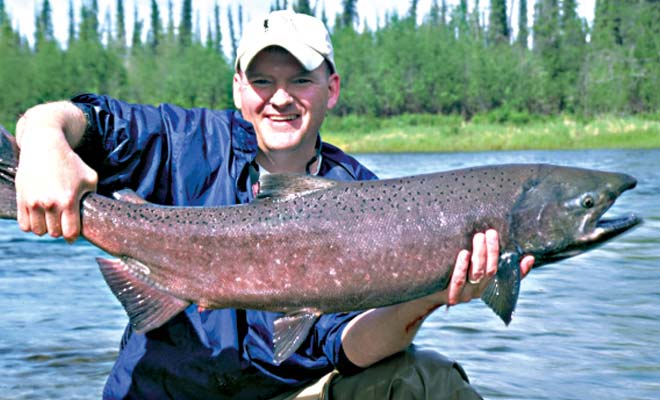
As I glanced down the ranks of my formation, I heard the familiar zipping and squealing of my favorite Ambassadeur reel. I yelled down the line to the oblivious fisherman, “You got one on, set the hook!” The guy quickly responded with what I’ve learned to be a common reply by first timers to Alaska fishing, “Nah, I think I’m snagged on a rock!” Meanwhile, a fat and angry buck king had managed to spool my unlucky client. I rushed over to inspect the situation, just in time to hear the “snap” of the knot at the end of the spool, once loaded with 30-pound test line. It all happened too quickly for my astounded client to react. He replied with only a, “Damn, what the hell was that?” As the surprised fish somersaulted from the water’s surface about 20 yards upstream, crowned with a bright orange Spin-N-Glo and a couple of razor sharp Mustads while trailing 150 yards of Trilene, his question was answered.
To my complete surprise, that same fish swam directly into the line of one of the lady anglers, presumably with its mouth open. The line must have caught just inside the fish’s open mouth, and once the hook system slid to the head of that already perturbed king, the line feeding from the Lamiglas tightened, and she set the hook with enough force to rip the lips right off that poor fish. She had a fish on, and there was no getting a word in edgewise . . . she was whooping and hollering like a cheerleader at a homecoming football game. I managed to get everyone else to reel in his or her lines and clear a path for me to maneuver the net. I coached her to keep the rod tip up and line taut with no exception. And within about five minutes I managed to net the king and drag it ashore. Boy, elation doesn’t describe the tone set by this one catch. You would have thought the Alamo had been re-claimed by this piscatorial patrol.
By the end of the trip, nearly everyone in the group had their turn behind the fighting stick. With lines stretching and burning off reels, occasionally snapping like dry tinder, we managed to land over 30 kings and probably double that number in sockeyes, not to mention hundreds of Arctic grayling and scores of rainbow trout. Wow, these are trips outfitters dream of! However, this productivity in sport fisheries comes at a great expense.
Over the past several years I have watched the numbers of fishing guides and do-it-yourself anglers along the Gulkana River grow from crowded to over-crowded. Yet, when asked which waterway continues to mix quality adventure with better than average success rates for landing king and sockeye salmon, rainbow trout, and Arctic grayling, the Gulkana River almost always tops the list. Why? It’s simple, really. Exciting rafting and canoeing options, affordability, easy access, and well-established management plans for land and fish. And numbers of Gulkana users will likely continue to grow, especially now that the three-year moratorium has been lifted, which allows increased sport fish guiding activity along the entire river corridor. While this may not improve the fishing experience on the river, it will undoubtedly increase the likelihood of land and fish management intervention, all in an effort to lower the cumulative effects of over-crowding by campers and fishermen.
In 1981 the U.S. Department of the Interior designated the Gulkana River, a clear-water tributary of the Copper River in southcentral Alaska, as wild and scenic, and in 1983 the Gulkana National Wild River Management Plan was written. Since then, the Gulkana has had its share of trials and tribulations.
For those who aren’t aware of this high-demand sport fishery, the Gulkana River is one of the most popular road-accessible fisheries in the state. Anglers are awarded the chance to land two species of Pacific salmon (king and sockeye), steelhead, rainbow trout, and Arctic grayling—to name a few—and with great success. Access is easy; the river is mild and navigable by intermediate boaters; the water is generally clear and free flowing, and the fishing is considered spectacular, offering anglers the chance at king salmon from 25 to 50 pounds, as well as rainbows up to seven pounds.
Spanning two decades, Gulkana River users have slowly and disconcertingly created a high-impact-type environment, and the river’s land manager (Bureau of Land Management) has begun intervening in what has become a series of attempts to manage the overall integrity and aesthetics of this depleting resource.
One of the first written analyses was published by Doug Whittaker of the Bureau of Land Management (BLM), which described the impacts on the Gulkana by river users. In this document Whittaker placed the Gulkana River at the top of the list for waterways showing the greatest signs of impact, directly relating this to the growing number of annual visitors. And in 1998, as a sort of alternative and non-biased approach to objectively observe the problems of high-impact usage along this waterway, BLM allotted $262,000 to a scientific team from Colorado. This group of seven scientists was to come in, study the river and its impacts by users, and then offer suggestions on how to properly approach the future management of the river. Deemed over-budget, the study team was aborted before any implementations or plans of action were solidified. The BLM is currently back to the proverbial drawing board; and although the public has been allowed to contribute opinions and suggestions regarding the issues surrounding the Gulkana River, BLM continues to brainstorm ideas on how to reduce the signs of impact along this scenic river.
To further complicate matters, the Alaska Department of Fish and Game (ADF&G) has pulled the Gulkana River back to the surface of attention by planning an observation post for surveying the numbers of king and sockeye salmon as they swim to spawning beds in the upper Gulkana. With any type of fisheries survey, the ADF&G is required to solicit the help of the region’s land manager, in this case, BLM. Therefore, this five-year survey will be a cooperative effort by both ADF&G and BLM to attempt to obtain accurate numbers of the main stem migration of king salmon. And while this survey will allow coincidental survey of migrating sockeye salmon, the ADF&G will concentrate its efforts on counting king salmon.
This post, a simple conduit scaffolding construction 15 feet wide by 24 feet long, will be manned from June 1 to late July, until 2006. According to Kari Rogers, BLM’s fisheries biologist, the location of the observation tower will be “about 1.5 miles above the West Fork confluence, toward Paxson Lake.” The post is proposed to be near the BLM signs warning motor boaters of shallow waters ahead.
This proposal, or public notice, comes with many questions. Perhaps the one foremost on the minds of most naturalists is the concern of how this observation site will affect the already fragile landscape and depleting aesthetics as seen by river travelers. Other puzzling questions, begging for answers, will need due thought before this measure is widely accepted by Gulkana users—professional and recreational. I believe the following Q&A session will help identify and hopefully clarify a few of the ongoing battles of Operation Gulkana.
What is the purpose of the fish survey tower to be constructed in the upper Gulkana River?
The purpose of the fish survey tower, according to Tom Taube, ADF&G fisheries biologist, “is to have a site managed for five seasons that offers the most reliable means of counting migrating salmon, so that we [ADF&G] can maintain a more suitable management plan for and prevent over-harvest of Gulkana River king salmon.”
How will environmental issues and high-impact usage created by the survey team be kept to a minimum?
According to Kari Rogers, “We [BLM and ADF&G team members] will be doing everything we can to minimize our impact on both the land and river while undergoing this process. Before this proposal is set in stone, there will be guidelines and procedures governing our behavior while afield. For example, areas containing sensitive vegetation will be protected by elevated wooden planks, which may help prevent a trailing effect on highly traveled routes.” Another example is the use of techniques to reduce refuse and human waste by removing it from the site and off the river completely, which Rogers states will be addressed in great length before this survey is implemented.
Why use a tower survey post versus more traditional methods of surveying migrating salmon?
The tower survey post seemed to be the most reliable nature of obtaining accurate data [fish counts] due to difficulties with other means, such as aerial surveys, which are highly influenced by weather and water clarity, and coded wire tagging, which is more a random survey method used for tracking distance traveled by one fish and not total numbers. Sonar surveying was decided against because this method counts total numbers of fish but does not identify fish species; so, while the survey team may get an accurate count of fish that swim under the sonar device, they won’t know how many of each salmon species was counted. And since this survey is concentrating its efforts primarily on king salmon, and secondarily, on sockeye salmon, it appears as though visual methods, though somewhat primitive, will give the biologists more reliable results.
How was the survey site selected for use in the upper Gulkana River?
“The proposed survey tower site was selected by consideration of several factors, which include: the water clarity of the Gulkana River above the West Fork confluence; the likelihood of murky conditions below the confluence of the West Fork; the ease of access from Sourdough Campground, less than ten miles downstream; and the narrow nature of the river channel above the West Fork, which increases observation potential and decreases the likelihood of miscounting fish,” relays ADF&G biologist, Tom Taube.
How does the ADF&G expect to obtain realistic counts of main stem migration of salmon when the survey tower site is not along the main stem fishery, as professional guiding and sport fish catches will be downstream of the survey site?
“The majority of spawning king salmon do so in the upper reaches of the Gulkana River, above the selection site for the fish survey tower,” says Taube. “And although some fish spawn downstream of the survey tower site and upstream along the West Fork, we [ADF&G] feel as though we will observe the essence of the entire king salmon run by utilizing this site.”
Is there currently a management plan in place to guide the course of action by the ADF&G in response to survey data obtained by fishery biologists from this site?
ADF&G has stated that they intend to obtain five years of survey data from the Gulkana River site before any management interventions ensue. This will hopefully prevent the typical knee-jerk responses by state and federal establishments regarding attempts to “better” particular situations. Therefore, if next year the survey team finds recruitment is lower than previous years, the Gulkana River is not likely to become a casualty of immediate reduced bag limits or tightened commercial-use restrictions. “This is merely a five-year project to see where we stand on current management plans and techniques. We won’t know a great deal until after the survey is completed in 2006,” affirms Taube.
Another issue that has been addressed by local fishermen and the professional guiding community begs the “real” agenda behind this five-year fish survey and cooperative effort set forth by state and federal departments.
Fish On River Guides’ Doug Herron recently shared his views on this and many other issues concerning the Gulkana River and its management. He states, “Sound management plans and strategies will ultimately promote a healthy balance between recruitment [fish survival] and harvest. The intent should be to maintain and preserve a viable sport fishery.” He affirms concern with a modest connotation, however, with hopes that, “The Gulkana survey is a management plan with the intent to maintain and preserve—not a plan to reduce or eliminate.”
Giving due thought to a “conspiracy theory,” could this collaboration of state and federal departments have some methodical agenda, such as a foot in the door rule? Why else would a federal department be so interested in a state managed fishery?
Herron, like hundreds of fellow Alaska anglers, recognizes the potential threat of a “federal take-over,” which would drastically impact the entire management regime currently in place—undoubtedly affecting bag limits and guiding activity.
While BLM and the ADF&G are well aware of the larger issues at stake, regarding impacts of federal management, both departments insist the two reasons BLM is involved is because the survey site will be located on land managed by BLM, and BLM is funding much of the project. Otherwise, budget constraints within the ADF&G would not allow the Gulkana survey to exist at all, especially not for five years.
Regardless of current political agendas, nothing can detract from the Gulkana’s reputation as a great place for the average angler to catch fish. Don’t be too dismayed by the over-crowded camps along the river. Simply find an open stretch of water and fish it like there’s no tomorrow. Because we really never know when things will change, and this is especially so with the uncertainty in Alaska politics.
###
Larry Bartlett is the author of Float Hunting Alaska and the owner of Pristine Ventures in Fairbanks. He can be reached through his website, www.pristineventures.com. [/emember_protected] [emember_protected scope=”not_logged_in_users_only”]
- Need to subscribe? Now’s a good time! Check out our current subscription specials!
- Already a subscriber? Login below to access all of our online articles and content!