


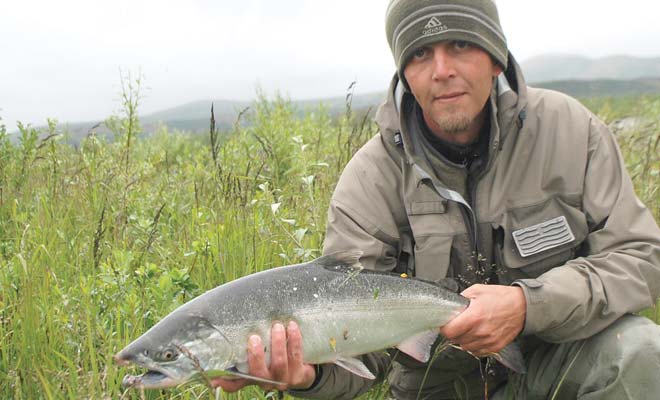
Goodnews or Gilgamesh?
Story by Troy Letherman
Fishing the Fifty-year Flood
The poppers and Pollywogs need particular housing, not least for fear of crushing foam and spun deer hair into oddly-shaped washtubs of perpetual threat to capsize. Streamers get their own box, too, a great multicolored flowering of marabou and hackle feathers strapped to big hooks and sporting lead eyes for those deeper-diving patrols. Floating lines, leaders, some extra 2X for tippet and then the reels; packing the reels is like saying goodbye to the encumbrance of responsibility, a final rite for the idea that contributing in some way to my fellow man is the least that should be offered in repayment for oxygen.
I hit the airport in a hell of a mood, floating on a mixture of ignorance and a loose, live-in-the-moment kind of courage that comes on a man when the wind picks up and no one’s there to talk about selfishness. Goodnews Bay was on the departures board and my bags were already tagged with the number of the cabin I’d occupy upon arrival at the lodge, a sign of professionalism far beyond what I expected or deserved. [emember_protected custom_msg=’This content is available for subscribers only.’]
To view angling as respite from the hardships of life is both dodgy and trite. I know that instinctively and yet I’m prone to such romance anyway. Not without coincidence, many of my friends feel the same, most of them neo-literate clowns and conmen no more dependable than goats, all less interested in work than in working an outside seam. Together we share a vagrant optimism in the power of flowing water to impart meaning to our various expeditions, and a dark suspicion that no one will ever forgive us for dropping out to fish. As if it matters now: I glanceout the window of the caterwauling TransNorthern DC-3 and it looks as if the gullet of western Alaska is swallowing the tonnage of the world. I feel freer by the second. Questing, since at least the time of Don Quixote, seems a dumb idea, but here I am, all seven-weights and waders, propelled along a senseless odyssey that I can only hope ends with fish.
The Goodnews River drains some 1,100 square miles of the Togiak National Wildlife Refuge, flowing from the Ahklun Mountains southwest to Goodnews Bay, a trip of about 60 river-miles in all, moving through a riparian habitat of willow, alder, the usual tundra vegetation and an occasional patch of cottonwood. Each of Alaska’s five species of Pacific salmon return to the system, as do sea-run Dolly Varden; resident grayling are thick and of above-average size, and the rainbow trout, existing about as far north as possible for the species, thrive. The river is clear, intimate in size and of moderate flows. Middle section braids provide outstanding habitat for trout, while lower river channels offer great opportunities to cast for all the flavors of salmon. Best yet, there’s only one sport-fishing camp on the entire river.
Mike Gorton, who with his wife Kim owns Goodnews River Lodge, is there to meet us at the end of the gravel airstrip outside the small village of Goodnews Bay, Mamterat in Central Alaskan Yup’ik. It starts to sprinkle as we deplane and the sky opens to a steady rain by the time we’ve completed the jetboat transition to camp, unpacked waders and boots, grabbed a quick soup-and-sandwich and made for the beach to receive afternoon fishing assignments. Mike’s the happiest guy on the river, beaming about the king season that’s just come to a close.
“The fishing has been truly epic,” he says, urging us to hurry to the salmon slots that might hold fresh silvers. “Best king season we’ve had in ten years; river’s packed with fish. The rainbows are peaking, lining up behind the early-run chums, which are starting to drop, and the biggest Dollies are back. Last week the average fish was 19- to 24 inches, with a few from 24- to 27 inches each day. Good fish – definitely worth some time.”
Mike moves fast, talks fast, and really likes his Goodnews. Sometimes known as The River Keeper, a title given by generations of loyal clients, Gorton’s views on the success of the season’s run are not solely the effect of favoritism for his home water. Rather, with king returns hanging by a precarious thread, or worse, throughout much of Alaska, the Goodnews has continued to make news by ticking along nicely. It’s not a significant return, not when compared to historical averages in Alaska’s major king streams, or even in the neighboring Kanektok, but what Goodnews kings might lack in sheer quantity is more than made up for by steady production and a lack of fishing pressure.
However, I’ve arrived just after the official close of king season, and thus we’re mostly awaiting the arrival of the silvers. Word is new fish are moving into the river daily and that it’s only a matter of time before the run is in full swing. Until then, there are gobs of chum and pink salmon to chase, and thousands of returning Dollies holding in flats just upstream from the lodge. The rain, actually, brings some additional hope.
“Fresh water means fresh fish,” Mike says, pointing out that anadromous species like silver salmon often hold outside their natal streams for a time before pushing upriver in a rush. Frequently, it’s a bit of rain that provokes the start of the upstream journey. “Plus, the water should remain clear upriver, meaning the Dolly and the rainbow fishing will stay good.” The best of both worlds, then, which is not something I’m exactly accustomed to in my angling history. Suitably enthused, I grab my fly rod, meet guide John Kumiski at the boat and head for a soft-water hotspot a few miles above camp.
I land six fish – four chums and two pinks – in nine casts. And here’s what I figure: anyone who grouses about too much of a good thing has probably never experienced fishing like this.
On our way back to camp for dinner I can practically feel the coho coming our way.
I once read of the Trickster Coyote, who cheated Water Monster of his fur coat in a game of chance. In retaliation, Water Monster sent a great flood upon the world, from which Coyote rescued people and animals by leading them from the Fourth World up into the present Fifth World. Of course, I also know about Noah and the Covenant of the Rainbow, and slightly more obscurely, of the Hindu puranic story of Manu. From middle-school mythology, I remember something of Deucalion, who built a chest to save himself and his wife from a deluge sent by Zeus. A few years later, in college lit classes, I finally learned of Gilgamesh and of his attempt to gain the secret of eternal life, only to be told by the flood hero Utnapishtim, “The life you are seeking you will never find.”
That last bit has always disappointed me most. Often given to a fisherman’s whimsy when staring at an unavoidable truth, such as refusing to believe in the limits of my wading ability, I don’t like being slapped by reality, or, if you will, being washed away down a creek. I’d rather bluff my way past boulder gardens and big ideas like mortality, instead grabbing my rods and heading for a bonefish flat. And so, it doesn’t bother me in the least to fall asleep to the sound of raindrops pelting the Weatherport above my head, to wake to heavier rain, to chug away from the beach in a boat that may require bailing before we reach the second bend. Water Monster can have at it – there are still clear flows to be found, if maybe a bit higher into the side-channel sloughs than usual.
I’m out to prove Mike Gorton right, the gods wrong, and catch some fish.
By noon I’ve hooked and landed five different species: two silvers, a rainbow, a Dolly, at least a dozen chums and many, many more pinks than I need. By mid-afternoon I’ve developed a wicked line burn on my stripping finger, which was so deep it wrapped around to the inside of my knuckle. I’d also picked up assorted little cuts from grabbing leader and tippet, the worst a real bleeder on my left pinky. My palm was swollen and nearly bruised just from gripping the cork. Why I continued to cast is anyone’s guess, but we ended the day by attempting to fish a long Dolly Varden flat that had been one of the lodge’s best producers during the previous week. Only twenty hours of downpour had rendered the spot virtually unfishable. There was no longer much of a gravel bar and wading to anything past the knees presented considerable risk. The river was pouring through on its way to Goodnews Bay; the anchor wouldn’t even hold. Still, with some amount of effort, a fly line could be stretched to reach the heart of the run, which was moving farther and farther away from where I could wade. You could just about get an offering down before the end of a speedy drift, and occasionally, a nice, thick sea-run Dolly would thump the fly. It was nearly perfect Dolly fishing for me – made plenty difficult by the conditions, but with enough fish turning up to compensate for the effort. Not to mention I got to pretend I was pretty good at this fishing thing.
As if he sensed I might be developing something of a big head, after dinner that night back at the lodge Mike asked me if I needed hip waders brought to my cabin for the morning. I was in the outermost accommodations, closest to a river that was swollen even more than my palm.
“She’s coming over the banks tonight,” he predicted.
I asked for a drift boat instead, planning for my own deluge myth.
I awake pleased to require less than a snorkel to make it to breakfast. The precipitation was out of hand at this point and the run downriver was a wet one. Through the miasma of rain, early-morning fog and low-hanging cloud cover it was impossible to make out any landscape beyond the river. Fishing with Mike for the day, we pulled into the first spot that we could find with any clear water. At The River Keeper’s suggestion, I tried a popper to start, and though the surface water resembled a bag of popping corn, a dime-bright coho tracked the second Plooupp and took the fly down. This was enough to keep me up top for the next four hours.
Fishing topwater for Alaska’s salmon is not always on offer, of course, but when possible, it’s about as thrilling a way to take these fish as there is, whether coho, chum or pink. However, as Mike explained, “it takes some real estate.” Typically, silvers will track a popper or ‘Wog a lot longer than they will a streamer, and so anglers must maintain a steady retrieve throughout. Also, as only about one in ten fish are interested in an offering from above, by Mike’s estimation, you also need a solid number of fish schooled up before you can begin. And then, with the need to cover some real estate comes the need to throw some thread. Actually, this is one of my favorite aspects of popper fishing for coho – unlike a great deal of fly fishing in Alaska, where thirty feet of line seems to be enough, this finally requires our fancy rods to do some work.
As the hours advanced, I managed three more coho, myriad chums and the usual procession of glinting-fresh pinks, all taken on poppers, and never in more than three feet of water. It seemed that just as the fishing would slow down, another group of travelers would move into our stretch and the next casts would end in new pains, as the line burn deepened and the finger cuts increased. Like the previous day, it wasn’t until the wind picked up in the afternoon, increasing the chop on the water, that I was relegated to the streamer box. In response The River Keeper moved us to a new, deeper run, and the production continued unabated.
The third full day of fishing at Goodnews River Lodge begins like the rest, and considering the fishing I’ve had, that’s about as much acclaim as I can imagine for a river. On this day I’m paired with a guide known only as G, a mysterious boat-rowing-savant who remains largely obscured behind one of the planet’s most impressive beards and who also appears to have been blessed with what the Scandinavians call naturkraft. Which means he gets his power from nature. Or possibly cigarettes, as clearly his mere presence in a room constitutes a fire hazard.
Either way, we shove off after properly girding ourselves for the drenching sure to come, head upstream and eventually pull into a small lake that was probably three feet above the high-water line a few days prior. There we began to scout for fish. More accurately, there we stood and marveled at the hundreds of pinks, chums and silvers milling about the neck of the bay. I again go to the popper and it’s even hotter fishing than before. Soon I’m peppering casts all over the place, sight-fishing, hooking the salmon of my choice nearly every time, until it gets to the point I’m trying to shake off solid takes after first making sure it isn’t a coho. This little maneuver helps me lose at least two prime silvers, but there were more to come. Catching certainly wasn’t a problem.
What was an issue is quite common to me, meaning that sooner or later, I’m the problem. In this case, after accidentally coming tight to a decent rainbow, I had decided to thoroughly trout-fish this silver hole. I tied on my heaviest streamer, in a nice early-season-flesh combination of colors, and started dredging the deepest nooks next to the far bank. That’s when disaster struck, in the form of a king.
Many who travel to Alaska have heard of the salmon grand slam, catching all of the state’s five species in one twenty-four-hour period, but it’s actually a rare feat. And it’s also a rare river that can provide the opportunity, especially if that chance includes all five species in top form. Perhaps the best location for accomplishing such a task is the Goodnews, and of course, Mike and the folks at Goodnews River Lodge make it their mission to offer this chance to any guests who get close.
Now I was at the precipice, having landed four species in just forty minutes, needing only a sockeye. G was up for it – more than that, in truth: he demanded I complete the slam – though due to the river conditions, there was no good plan for finding reds that hadn’t dashed for their upstream spawning beds. As it was, we roared around the lower river, poking into a half-dozen muddy offshoots and marginally clear sloughs, finding nothing but the intermittent moldy chum. After burning several hours that could have been spent feeding poppers to silvers, we dropped the anchor near a large, grassy bank and scanned for sockeye. Improbably, I spotted four.
It was the end of the angling day. For the past thirty minutes we’d heard the other boats heading back to the lodge and knew there was little time left to complete the quest. Noting carefully the position of the fish, their orientation in the water and apparent direction, I chose my sparsest fly, back-cast once and let the line go.
I cast five times in total, and caught two chums.
###
Troy Letherman is the editor of Fish Alaska magazine. [/emember_protected] [emember_protected scope=”not_logged_in_users_only”]
- Need to subscribe? Now’s a good time! Check out our current subscription specials!
- Already a subscriber? Login below to access all of our online articles and content!