


Where to Fish for Halibut: An Alaska Atlas
By Troy Letherman
Finding where to fish for halibut in Alaska is a fairly straightforward business. They’re generally found in strong numbers and while migratory, in established locations; they’re voracious predators and famously indiscriminate when it comes to the menu. In other words, they mostly eat whatever lands in front of them.
To fish successfully for Alaska’s most popular salwater targets, find the right structure, time the tide correctly and then get your bait to the bottom. Or, if you’re like most anglers who prefer to view Alaska’s coastline from the deck of a boat, leave the guile to the captain. He (or increasingly, she) has the charts, the 3-dimensional maps, the coordinates set and the bait cut. Just follow instructions – they’ll be simple enough.
[emember_protected custom_msg=’This content is available for subscribers only.’]
In this latter case, the angler’s most important job is to pick the right port – and in Alaska, that’s not a problem at all.
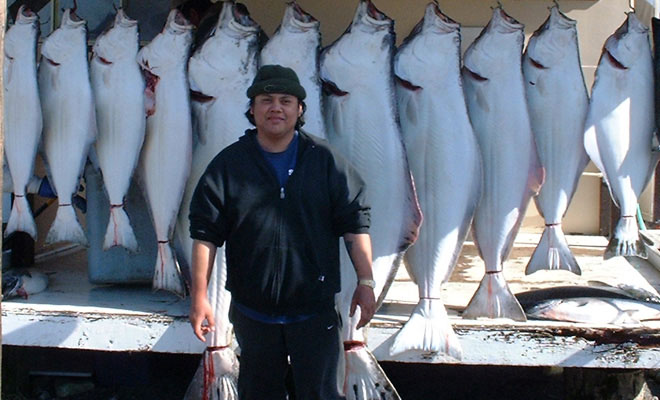
The largest flatfish of the Pacific coast, halibut are a member of the right-eye flounder family, classified further into genus and species as Hippoglossus stenolepis, and they can be found from Norton Sound south to Baja California and west to the Sea of Japan. These are truly big fish: records from commercial boats show catches of individual fish up to 550 pounds and 9′ feet in length, and in more modest terms, fish of 100 pounds aren’t at all uncommon, particularly in offshore areas or other regions where competition is slight.
In Alaska, most recreational effort is concentrated along the Gulf of Alaska from Ketchikan to the Kenai Peninsula, with over half of the current sport-catch (statewide, anglers will land more than 500,000 fish annually) coming from Southcentral’s Prince William Sound and Cook Inlet, as well as from the waters surrounding Kodiak Island. Virtually any port in that range – whether adjacent to notoriously productive fishing grounds or in areas that remain relatively unknown – offers savvy anglers the chance for an easy limit of these fine-tasting sport fish, and occasionally, a trophy. Recently, lured by the rumor of consistent barn doors, the Alaska halibut sport fishery has even begun expanding into the far-flung waters of the Aleutian Islands, the most notable new hotspot for monster flatties being Dutch Harbor (the current IGFA all-tackle world record was taken in Unalaska Bay in 1996).
Since halibut are highly migratory and move inshore and offshore according to the seasons, time of year is another variable that anglers should mind before booking a trip, especially if the depth of the water you’ll likely be fishing is a concern. Most experienced Alaska anglers might think of halibut fishing as usually taking place at depths of 200 feet or more, but as the gigantic schools of salmon smolt leave their home streams each spring – after navigating a gauntlet of hungry salmonids – the halibut, itself a major fish-predator, will move into the shore areas near stream mouths to wait. Timing must be impeccable, but when right, it’s not unheard of to find fish in less than twenty-five feet of water. Another good time to find flatfish near stream mouths is in the fall when tons of salmon flesh will be washing out to sea.
All this, like top-of-the-line equipment or fresh bait, is designed to make the fishing more efficient, and hopefully, more fun and productive.
“We’ll usually fish anywhere between 30 and 300 feet,” said Dave Morris from Bob’s Trophy Charters in Homer. “First of all, we’ll go to the place that’s productive, regardless of depth, but for the most part, we try to stay around 100 feet, which keeps things comfortable for everyone.”
Mike Bonfils, owner and operator of Big Jim’s Charters out of Juneau, had much the same to say, while minding the seasonality of his Inside Passage fishery. “Down here, the average depth we fish is probably around 180 feet,” he explained. “Our halibut generally move into shallower waters anywhere from late July through September, after the salmon have spawned and the dead fish are floating into the bays.”
Additionally, according to Bonfils, the salmon cycle affects more than the targeted depths. “During these months we can fish in relatively closer areas,” he went on, noting a cut-down in the amount of time it takes to reach the day’s fishing grounds. “In May and June, we may have to travel for some assurance of a good halibut bite – sometimes up to 30 miles one-way. In August we can be on some of our favorite grounds within an hour.”
One fishery that provides anglers with the gamut of scenarios lies at the north end of Blying Sound along the Kenai Peninsula’s Gulf Coast – Resurrection Bay. The port: Seward, just a 2H-hour drive from Anchorage.
“It sounds simple, but we fish wherever the fish are,” said Marv Thompson of Marv’s Charters. “That might be 60 feet one day and 400 the next.”
Most of the better halibut grounds near Seward are actually outside Resurrection Bay, and charter operations like Marv’s often motor their clients to underwater reefs and pinnacles that are known quantities. “I’ve got one spot out west that’s a consistent producer at depths of 50 to 60 feet,” Thompson continued. “And in another area I’ve caught nice halibut in just 25 feet of water.”
However, like the others, Thompson suggests that there is some correlation to the time of year and the number of big fish that hit the docks.
“Usually, we see our bigger fish earlier in the year, in May particularly,” he went on, admitting that the fishing then is almost always dependent on the weather. “Two years ago, on April 28 I had a local client land a 96-inch halibut. When we got back to the docks it was 80 degrees. On that same day last year it was snowing so hard we couldn’t get out.”
On the other hand, Dave Morris, who fishes exclusively in the waters near Homer – the self-proclaimed “Halibut Capital of the World” – says that their local docks see the biggest catchs in July, but simply because that’s when the fleet has the most hooks in the water.
“We trophy hunt every day,” he said, “and after that we do whatever we can to send everyone home happy. Unfortunately, the halibut aren’t all 100-pounders. I wish they were, but at least you can be sure that on my boat, no one wants a bigger fish than the captain.”
All three of the captains, and doubtlessly most charter operators in Alaska, think their port is the one fishery halibut anglers can’t afford to pass up.
“There’s no place better to go in the whole world,” Thompson raves of Seward. “We don’t have the strong current like in Cook Inlet; we don’t have the terrible exposure of the gulf, and we don’t have the long runs.”
Plus, there are all those fine-tasting, straightforward fish, but then as Alaska veterans already know, a lot of the state’s marine waters can boast of such a thing.
Troy Letherman is the editor of Fish Alaska magazine. [/emember_protected] [emember_protected scope=”not_logged_in_users_only”]
- Need to subscribe? Now’s a good time! Check out our current subscription specials!
- Already a subscriber? Login below to access all of our online articles and content!