

Last updated August 27, 2026
This Kasilof River Fishing Report delivers the latest updates, counts, and photos from this sometimes overshadowed Kenai Peninsula river. Close to the Kenai but quieter, the Kasilof offers plenty of fishing action often with fewer crowds. Check back regularly for current conditions and fresh reports from the river.
Sockeye Wrap Up Strong While Coho Take Over
August 27, 2026
July closed out with the Kasilof’s sockeye count nearing a million fish, holding a steadier pace than the Kenai’s spike-and-fade pattern and putting the river right on par with its neighbor for the season.
Sockeye Finish Near 1.2 Million as Coho Move In
The Kasilof’s sockeye run kept climbing into early August before tapering off, finishing with a cumulative total of 1,161,399 fish counted through August 5. That’s a strong overall season, even as daily numbers slowed from July’s peak pace. The sockeye bag and possession limit stayed at six fish per day and twelve in possession through the tail end of the run, with a two-fish daily cap on coho built into that same limit to protect the silver run as it built through the month. Gear restrictions requiring single-hook, artificial lures only stayed in effect through August 15, a standard seasonal measure that wrapped up right as sockeye numbers wound down for good.
The personal use dipnet fishery closed out on August 7, giving households one final week to fill freezers before the sockeye run tapered off. With that fishery closed and sockeye numbers dropping, most angler attention on the river started shifting toward coho as August progressed.
Coho Step Into the Spotlight as Fall Approaches
Coho salmon fishing built steadily through August, giving anglers a natural next target once the sockeye run wound down. Casting spoons, spinners, and jigs under a slip bobber setup produced fish through the month, a technique that carries over well from the lower Kenai’s similar coho water. As September approaches, expect the Kasilof’s coho run to keep building, giving anglers a solid stretch of silver fishing to close out the season even as the sockeye chapter of the year wraps up for good.
Steady Sockeye Cumulative Count Nears a Million
July 30, 2026
Unlike the Kenai’s sharp spike-and-fade pattern, the Kasilof has held a steadier daily pace:
- 15,995 fish on July 27
- 11,752 on July 28
- 12,087 on July 29
- 9,745 on July 30
That brings the cumulative total to 971,243. That consistency has quietly put the Kasilof right on par with the Kenai in overall numbers, even without a single blowout day.
It’s showing on the beach too, in the best way. Anglers have been spreading out along the river to find their own stretch of water, and it’s paying off. One family fishing the personal use fishery over a recent weekend filled their whole limit over three days, and sport anglers in the right spot at the right time have been limiting out on six sockeye in a matter of minutes.
Where to Fish and What to Expect
Sport fishing for sockeye remains open under the current six-fish daily limit, 12 in possession, throughout much of the river. The dipnet fishery has an expanded footprint this year: shore dipnetting is allowed from ADF&G markers on the Cook Inlet beaches upstream to the Sterling Highway Bridge, while boat dipnetting is permitted from the beach markers up to about river mile 3. That expanded zone and the personal-use season both run through August 7, giving anglers a full extra week compared to the Kenai. With the run holding steady rather than tapering off sharply, the Kasilof looks like a strong bet for anyone still looking to get out on the water.
Even Bigger Surge of Reds
July 27, 2026
Nearly 900,000 Fish and Climbing
The Kasilof’s surge has been even more dramatic than the Kenai’s. ADF&G counted 145,582 sockeye on July 24 and 95,427 more on July 25, pushing the cumulative total to 888,636, closing in fast on last year’s pace of 953,699 at the same point.
The personal use dipnet fishery remains open through August 7, and current bag limits stay in place. After a slower start to the month, the Kasilof has more than made up ground, and this stretch of surging counts is exactly the kind of push anglers have been waiting for.
Sockeye Count Trails Last Year’s Pace, But It’s Still Early
July 24, 2026
Where the Numbers Stand
The Kasilof is seeing a similar dip to the Kenai River. The cumulative sockeye count sat at 558,797 as of this week, compared to 887,129 at the same point last year. It’s a smaller gap than what the Kenai is showing, and biologists aren’t concerned yet.
Why the Comparison Looks Rough
Some of that gap comes down to last year simply being an outlier. The 2025 season was a record-setting run on both rivers, so this year’s numbers look more dramatic next to it than they would against a typical season. The Kasilof personal use dipnet fishery remains open through August 7, and current limits stay in place. As with the Kenai, the historical peak window is still ahead, and ADF&G expects a meaningful share of the season’s total run to show up within the next week or two.
Sockeye Escapement Tops Half a Million
July 20, 2026
A Run That Just Won’t Quit
The Kasilof is having a season for the books. As of July 19, the sonar had counted 11,041 sockeye that day alone, pushing cumulative escapement to 511,118 fish, well above the biological escapement goal of 140,000 to 320,000. That’s the kind of number that makes drift boaters and dipnetters equally happy, and it’s a great reminder of why this river earns its reputation as one of the most consistent sockeye producers on the Peninsula.
The increased bag and possession limits, six sockeye per day and twelve in possession, stay in effect for the rest of the year, so there’s no rush to squeeze your fishing into a narrow window. Coho retention stays capped at two per day, a smart move that protects the silver run building quietly in the background while the reds take center stage.
Kings Still Get the Respect They Deserve
Gear restrictions and hatchery-only retention remain in place through August 15, and the closed water below the Crooked Creek confluence keeps staging kings undisturbed while they wait to spawn. It’s a small sacrifice for a big payoff down the road, and it’s exactly the kind of management that keeps this river producing decades of great fishing rather than one flashy season. With the sockeye run still climbing and coho starting to show, the Kasilof is proving once again why it deserves more attention than it usually gets.
Reds on the Rise in June
June 26, 2026
The Numbers Say It All
June brought the Kasilof roaring to life. By June 23, the sonar had already tallied 117,665 sockeye, putting the run on a pace projected to sail past the biological escapement goal with room to spare. ADF&G responded the way anglers hoped, raising the sockeye bag and possession limit to six fish per day and twelve in possession starting June 26, with a two-fish daily cap on coho to keep that run protected. It’s the kind of regulatory response that shows the system working exactly as intended: watch the fish, adjust the rules, and give people more opportunity when the run earns it.
Dipnetters Got Their Turn Too
The personal use dipnet fishery opened June 25, and ADF&G expanded the dipnetting area from the Cook Inlet beach markers all the way up to the Sterling Highway Bridge, giving Alaska households more room to fill their freezers. The personal use set gillnet fishery ran a tighter window, June 20 through 24, a deliberate trade-off to protect kings still moving through the system. Between the strong sockeye numbers and the new elbow room at the river mouth, June set up July perfectly, and the Kasilof didn’t waste any time proving it.
May Saw A Careful Start to a Promising Season
May 29, 2026
Protecting the Fish That Started It All
The Kasilof’s 2026 season opened May 1 under a familiar set of protections. Only unbaited, single-hook artificial lures are allowed through August 15, and anglers may keep one hatchery-produced king 20 inches or longer per day, easy to spot by its healed adipose fin clip. Naturally-produced kings can’t be kept at all and need to go back in the water immediately. ADF&G also closed the stretch of river just downstream of the Crooked Creek confluence to all fishing through July 31, giving staging kings a safe, undisturbed path to their spawning grounds.
These aren’t new rules for the sake of rules. Naturally-produced king escapement has missed its goal in four of the last five years, so ADF&G is leaning on every available tool, gear restrictions, harvest limits, and closed water, to give this run its best shot at rebuilding. It’s a patient approach, and patient approaches are usually the ones that work.
A Quiet Month with Good Things Coming
May stayed relatively low-key on the Kasilof, more about setting the stage than making headlines. But with the sonar equipment going in and sockeye already stirring downstream, everyone on the river could feel the early promise of what’s to come!
Add Your Voice to the Fishing Report
Whether you’re a local who knows the rivers by heart or a visitor reeling in your first Alaskan catch, we want to hear from you.

A productive morning on the Kasilof with fresh catches from July 7.
A Look back at the 2025 Kasilof Fishing Season
Reds Top 1 Million and Silvers to Send Us Off
October 31, 2025
What a run we had this year. The sockeye showed up big and stayed big, and by the time the sonar counts settled in late July, we were watching the highest escapement ever recorded on this river, somewhere around 1.1 to 1.2 million fish. Days with 50,000 sockeye passing the counter weren’t rare, they were normal. I don’t think I’ve seen a season where the drift boats and the dipnetters both walked away this happy at the same time.
Kings were the hard part, same as everywhere else on the Peninsula this year. ADF&G kept the sport fishery closed, and the personal use gillnet window got squeezed down to just six days in late June, June 18 through the 24th, to give the early-run fish heading for Crooked Creek a fighting chance. Nobody loves a shortened season, but I’d rather see a tight window now than an empty river down the road.
Once August rolled in, the silvers took over, and they didn’t disappoint. Coho started stacking up by mid-month and the bite carried right through into September, plugs and spinners doing the damage for most folks, flies for the purists. It was a good, hard-fighting way to close things out.
So that’s the season. A record sockeye run, a rough year for kings that we managed our way through, and silvers that sent us off on a high note. Gear’s getting cleaned, boats are coming out of the water, and now it’s just the waiting game until next year’s fish start showing up again.
Sockeye Action Continues
August 9, 2025
Sockeye fishing remains strong on the Kasilof River this August, with daily counts averaging around 17,000 over the past ten days. While numbers are beginning to taper off, the run has been solid overall, with a cumulative total of 1,161,399 sockeye counted as of August 5. There is still plenty of action to be had.
Silver salmon will begin to appear later in the month, adding excitement for anglers targeting these hard-fighting fish.
Over a Million Sockeye and Counting: Kasilof Action Holds Steady
July 28, 2025
Daily sockeye counts have remained robust on the Kasilof, with numbers fluctuating between around 19,000 and nearly 38,000 fish per day. The count has reached a cumulative total surpassing 1 million sockeye as of July 27. This steady passage shows the run maintaining good energy well into late July, providing ample opportunity for dipnetters and anglers alike. The strong numbers also align with projections that the Kasilof sockeye run could reach around 1.24 million this season.
Fishing pressure remains concentrated on the North Shore, where the majority of sockeye are counted, with anglers experiencing consistent success as the run progresses. This sustained high escapement ensures solid fishing opportunities continue even as the season moves past its peak dipnet dates.
Dipnet Season in Full Swing
July 19th, 2025
Dipnetting on the Kasilof River has been outstanding, right in the heart of peak sockeye season. Reports from the river mouth and along the expanded dipnetting zone show that most residents are going home with ice chests full of fresh sockeye, with back-to-back pulses of fish entering the river every day. Action has been consistent both for shore and boat dipnetters, with many reaching their household limits in just a few hours of effort. While crowds have shown up for the best tides, access is still reasonable, and the fish are there, perfect for stocking up before the season wraps up.
The bag and possession limits for sport fishing sockeye are six per day and twelve in possession, and the dipnetting area was expanded this season, running from the mouth upstream to the Sterling Highway Bridge for shore anglers, and to about river mile 4 for boat-based dipnetting. Remember: dipnetting is open 24/7 through August 7, for Alaska residents only, and all king salmon must immediately be released. There is little accidental catch of kings to deal with at this point due to the current closure on all king salmon fishing and strong sockeye numbers.
If you’re planning to dipnet before the run tapers off, now is the time!
Kasilof Kings were closed entirely by emergency order on July 8th.

Angie and Todd Ferris, Lucas Adams, and Scott Lee kicked off Monday, July 7 with a solid morning on the Kasilof River.
July 7, 2025
Sockeye fishing on the Kasilof River is still going strong. According to the latest numbers from the Alaska Department of Fish and Game, the run is holding steady, with over 35,000 fish counted on both July 3rd and July 5th, and the total so far topping 420,000. Most of the action has been on the North bank, but both sides of the river are seeing solid numbers.
Over the weekend, anglers reported steady sockeye action, with some down time between pushes up river. Many experienced folks were able to hit their limits in just one to two hours. The best bite has definitely been early in the morning, especially before 7 a.m. Once the commercial nets go in, things slow down a bit, but there are still plenty of fish making their way upriver. The daily bag limit for sockeye is six per angler, and with a little patience, most people are still filling their limits in 3-4 hours.
If you’re looking for a quieter spot, Monday morning has been much less crowded than the weekend. Weekdays are a great option if you want a little more elbow room, but the fishing on the weekend is still a great time.
This year’s sockeye run on the Kasilof River is outpacing the last several seasons and is shaping up to be one of the strongest in recent memory. The run has been so robust that the bag limit was increased, and anglers are enjoying some consistent and productive fishing.
All in all, the Kasilof is offering some of the best sockeye fishing of the season right now, so it’s a great time to get out there and enjoy it.
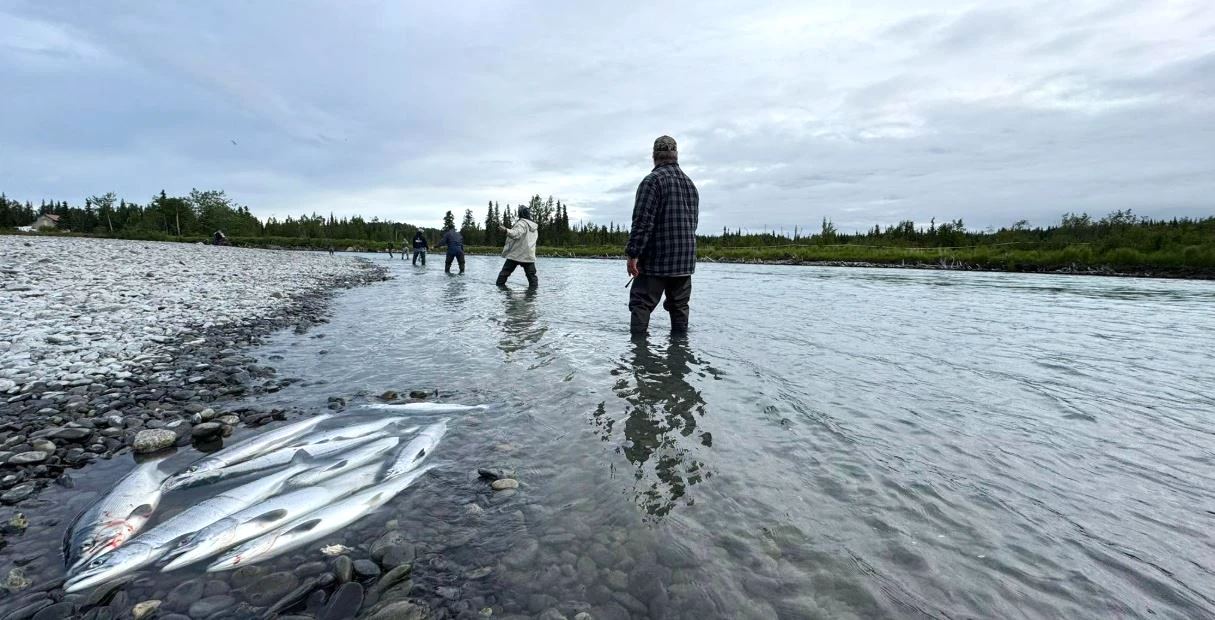 A stringer of bright Kasilof River sockeye, June 23, with Alaska Drift Away Fishing.
July 3, 2025
Sockeye fishing on the Kasilof River has been steady, with daily counts rising over the past week. On July 1 alone, 34,788 sockeye passed through. 22,614 on the North Bank and 12,174 on the South Bank. This brings the cumulative total to 290,672 as of July 1. Counts have climbed each day since June 26, when 15,900 fish entered the river. With the bag and possession limits increased on June 25, now’s a great time to get in on the action if you haven’t already.
Dipnetting Opens
Personal use dipnetting on the Kasilof River opened on Wednesday, June 25 this year, beginning at 12:01 a.m. and running 24 hours a day for Alaska residents through August 7. Anglers arrived early, with dozens of nets already in the water as the first high tide of the fishery rolled in just before sunrise. The opening morning saw “decent” but not fast fishing; fewer than a dozen sockeye were caught on the north shore between 4 and 5 a.m. Many early arrivals reported moderate success but anticipated action would improve as the run develops.
Kasilof River Sockeye Salmon Limits Increased as of June 24th.