


A week on the fly at Alaska West
Story by Troy Letherman
There is an ethereal quality to a morning submerged in fog. For one, it’s almost always unexpected, no matter how attuned one may be to the capricious moods of western Alaska weather. It moves in during the night when no one is looking, heavy and gray and silent as a wolf padding across the tundra floor. It softens the horizons of sight, hides landmarks, dampens sound. The otherworldly sensation is helped along by a lingering befuddlement concerning the day’s overall intentions; there could be a bright sun already at work burning through the mist, or there could simply be more gray, and rain. [emember_protected custom_msg=’This content is available for subscribers only.’]
But inside this gunmetal-colored cocoon the vagaries of climate hardly matter. In fact, I find myself pleased to be greeted by impenetrable fog on my first Kanektok River morning, and not only because it provides the uniquely Alaskan thrill of wearing fleece in July. I like it because I think context is important, and to me nothing says anadromous fish quite like empty casts, impossible expectations, and a muted, rather nebulous connection with reality.
From downstream I hear the whip of a D-loop setting up and then the protracted whoosh of line tearing free from the water’s surface. In these not-so-light conditions I can barely make out George Cook in his mid-river casting position and I can see nothing of where his fly may have landed. Probably right where he wanted, I decide with some amount of malice before returning to my own mechanics.
Keenly aware of an audience—the legendary Ed Ward stands just behind me, appropriately obscured by the fog—I rush the setup, jump the forward stroke, and launch an absurdly lame cast. Muttering something incoherent and probably profane, I dismiss for the moment thoughts of seppuku and instead settle uncomfortably into the swing. There won’t be a strike on this drift; I know that before my fly even has a chance to get wet.
Atlantic salmon, sea-run brown trout, steelhead, or Pacific-touring Chinook—there is very little variance in the feel of fishing for the great anadromous species, unless one can detect the difference between an eight-weight and a ten simply by touching the cork. It’s about persistence, consistency, virtues of presentation like depth control and the speed of the fly, and economy of effort. It’s not mindless, but there is a certain, seductive rhythm to the down-and-across tautology of fishing on the swing that suggests an indifference towards complexity. Cast a straight line, get the fly down to where the fish may hold as soon as possible, and once there, let it swim-out the drift, covering as much water as possible. Repeat.
Even after considering the tragicomedy that is my Spey casting on this morning, I’m beginning to embrace the effects of repetition. The cacophony of flowing water drowns the clamor of everyday life, and beyond the eighteen or so tips Ed has offered in an attempt to improve my chances for success, I don’t think of much. More to the point, I fail to notice the slowly clearing mist: One minute I’m knee-deep in the river, entombed in fog, and the next time I look around I’m twenty yards downstream, the sun is out, the sky a patchwork blue, and I can see thickets of willow and alder crowding the opposite bank. Near the bottom end of the run, Cook unwinds a long, graceful loop, tosses in an upstream mend, and almost immediately sets up on a solid fish. Despite the distance I can hear the whine of his reel as the king takes line.
Unlike my first hundred casts, things are starting to feel fishy. With increasing confidence then, I continue to work the outer bank, paying ever more attention to each pause, tick, or bump in the drift. Mid-swing after a cast that was no better or no worse than any of the rest, I have a grab. The fight is short and impossibly sweet, and I quickly beach a buck with flanks of quicksilver. It’s a jack, but that matters even less than the morning’s fog. Ed’s rigging up his own rod, and a short distance downstream, Cook’s howling critter and leaning into another fish. I pop the hook from the small king’s jaw and quickly return to my station in the current. It’s a rare sensation, but I can’t escape the feeling that a bonanza is finally at hand.
Throughout the better part of the 1970s and the early ’80s the Kanektok barely existed upon the radar of the Have Rod, Will Travel crowd, but that had more to do with the size of Alaska and the relative remoteness of Kuskokwim country than it did the river’s productivity. For centuries the Yup’ik people of Quinhagak have depended on the drainage for sustenance, utilizing it for everything from transportation into the mountains for caribou and firewood to a source of potable water. It’s copious fish stocks—runs of all five species of Alaska’s Pacific salmon, plus healthy populations of rainbows, grayling, and Dolly Varden char—are vital to the Natives’ way of life. Along with characteristics like clear water, even-tempered flows, and abundant gravel bars, the fish of the Kanektok made certain that sooner or later sport fishermen would take notice as well.
The river issues from the western end of Kagati Lake in the 4.7 million-acre Togiak National Wildlife Refuge and flows some ninety miles to its terminus in Kuskokwim Bay. In its upper reaches, the Kanektok zips through the storm-scoured Eek and Aklun mountains and contains a cornucopia of classic fly-fishing structure, with all the riffles, pools, and long seams that are expected of good trout water. After about forty miles, the river braids onto an ancient glacial flood plain and meanders through the taiga forest vegetation typical to western Alaska lowland streams. Here anglers will find some of Alaska’s most ideally constructed salmon fisheries.
With vigorous runs of king, chum, sockeye, pink, and coho salmon, coupled with the resident species the salmon help sustain, the Kanektok stands strong even when compared to the giant lake-river systems of the Bristol Bay region to the south. The fishing was so good, and the conditions so conducive to wilderness float trips, that when the river was first “discovered” by visiting sport fishermen most did what they could to prevent its name and location from being divulged. Even today, long after the river underwent an explosion of effort through the early to mid-1990s, you can happen along plenty of folks obsessed with keeping secrets that no longer exist; in this case, the Kanektok is usually referred to as the “Chosen River.”
However, the appellation is not without a whiff of the axiomatic, as few other systems can approach the Kanektok in terms of sheer fecundity. In 2004, for example, the overall drainage escapement for Chinook as estimated by the Alaska Department of Fish and Game was 42,908 fish, a number that may not reach the stratospheric return totals posted by rivers like the Nushagak and the mainstem Kuskokwim, but as far as waters friendly to the wading angler go, there might not be any better king fishery than that offered by the Kanektok—and for the fly angler, there probably isn’t.
“Consistency,” George Cook says, condensing the Kanektok king experience into a solitary word. “The health of the resource and the quality of the fishery has been consistently good in eight or nine out of the last ten years. It’s the place to go for the optimum chance of hookups, with an outside shot at a forty- to fifty-pound king.”
He would know. Though this is my initial encounter with the river’s Chinook, Cook has visited the Kanektok eleven consecutive years during king season and refers to the weeklong forays as “a seasonal must.” That’s worth noting because in his rampant ardor for anadromous fish, he also treks annually to such fabled locales as British Columbia’s Dean River and the wind-stricken pampas of Tierra del Fuego, where the world’s largest sea-run brown trout are welcomed into the waters of the Rio Grande.
We’re both guests of Alaska West, a deluxe tent-camp operation located on the lower river. They’ve been in business on the Kanektok for over a decade, though only recently the outfit was purchased by Deneki Outdoors. The company was started by Andrew Bennett, a Fairbanks native and Dartmouth grad who in 2004 abandoned the software industry to pursue his passion for fly water. For Bennett, like Cook and the guide staff at Alaska West, the principal allure of the Kanektok lies in the superiority of the king fishery it can provide. To facilitate anglers reaching these fish, Alaska West offers an innovative program throughout the Chinook season, teaching beginning to advanced anglers the art of the two-hander.
For a week at a time, Alaska West brings in a guest instructor who chases kings with the clients during the day and then offers gravel-bar clinics in the evening. It’s not only the presence of the kings that makes the program successful, but the very nature of the Kanektok as well.
“It’s a good-sized river,” explains Eric Neufeld, a manufacturer’s representative who got his start in the industry as a guide at Alaska West from 1999 through 2002. “But the fish are accessible to the fly. Depending on water conditions, you can fish at thirty to fifty feet and be in the game, which makes it a great river for the beginning to moderately-skilled angler. You don’t necessarily need to be a monster caster to find success on the Kanektok.”
Neufeld served as the guest guru two weeks before my trip to Alaska West and says the river’s abundance of long gravel bars help make it such an attractive destination for Spey-casting aficionados. “What I like about the Kanektok is that you can fish it most productively in the classic steelhead sense. Cast, swing, take a step; cast, swing, take another step, and so on.”
Still, the fish are the real draw, and on that score, the Kanektok is just as attractive. “I’m not sure about other places,” Neufeld continues, “but these fish eat the fly. When they commit, they commit; there’s no nips, no nibbles—they chew on flies like they’re bubble gum.”
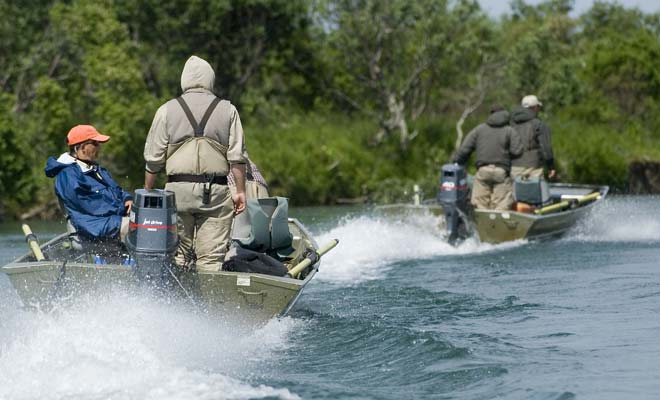
I could attest to the truth of that statement after only a few hours on the Kanektok. With the moment of high tide rapidly approaching, Ed Ward, Cook, and I load back into the boat and race for the lower end of the river, giving up our gravel bar for a chance to cast at the brightest of bright fish. This is Cook’s preferred methodology for fishing Kanektok kings—snag a piece of first water early in the morning and swing for the fish held-over from previous tides, then move to tidewater for the optimal shot at incoming cruisers, finally finishing out the afternoon by playing hopscotch from bar to bar in an effort to keep pace with the fish moving upriver. It’s a scheme that worked well throughout the week, and in our first trip down low, we were into fish directly. Like Neufeld said, they were grabbers.
Unlike the release of adrenaline that occurs upon a tarpon take, when you’ve had plenty of time to build ivory towers of anticipation while watching the fish stir to track the fly, move under it and open that great maw, and then finally explode through the offering, the exuberance of a Chinook strike is entirely more jarring. Minus the alarm bells of actually sighting the fish, I was simply minding my own business when the first tidewater taker nearly jerked the rod from my hands. The next set the hook all on its own, swimming right through the fly and continuing upstream at a pace that had me seriously questioning the sense of any operation that involved twelve-pound tippet. Cook was into fish just as steadily, and for a while, we were involved in abit of an angler’s circus: move to the bow, cast towards the reed-lined bank, hook a fish and scramble to the rear where Ed was waiting with the net. Step right up and do it all over again.
Not bad for a first day, and we still had an entire afternoon to go.
Back at camp that evening, and indeed, throughout the rest of the week, both the guides and the guests could be found loitering in the mix of emotions between the unadulterated excitement of a peaking Chinook run and the quiet reverence of anglers who understand the luck of bumping into such fish at all. Personally, I tend toward the latter, going so far as to refuse to speak of numbers at all when anadromous fish are at issue, having previously been hit with the mother of all jinxes.
Case in point: A few years ago, caused I’m sure by some minor indiscretion, I suddenly couldn’t buy a fish. The fall steelhead run was on and I’d lucked into plenty of time to spend on the water, only I may as well have been casting in the yard. Exhibiting increasingly sketchy behavior, I pushed it into December, nearly freezing to death as I eked out my 23,714th cast without an eat. Needless to say, the kind of long, cold winter that followed has led to an irrational hatred for the band Cinderella.
The next April I ended up on Prince of Wales with Fish Alaska publisher Marcus Weiner, arriving just in time to watch the streams island-wide swell to ridiculous levels. The only day offering decent conditions was the first and I predictably turned up the only goose egg of our initial outing. But determined to either pull out of the slump or go down trying, I kept at it, plowing into water that threatened to breach my waders, casting through sideways rain, swapping out flies with homicidal fury. Then, in the most unlikely of scenarios—fishing a run from the worst possible angle, my fly fluttering a scant few inches beneath the surface, slack line scattered across the river like an overturned bowl of spaghetti—my luck turned. A kamikaze steelhead rose from the depths, boiled on the fly, and subsequently held on to it long enough for me to get control of my senses and all that loose line.
It’s probably the most satisfying fish of my life.
Unwilling to risk such disaster again, I was more than happy to keep still and focus instead on the other obsessives gathered in camp. Sunburned, a little twitchy around the edges, and dependent on massive quantities of caffeine, the guides at Alaska West already showed signs of sleep-deprivation and appeared much too comfortable in Gore-Tex, which, of course, spoke volumes about their quality. I didn’t even have to wait to see what they did with their free time (scarf down dinner and return directly to the water for some personal fishing) to know they were a professional bunch. These are the kind of guys who have accepted the notion of guiding as a calling, and they spend the rest of the year filling up the time until they can come back. A few have joined the professional leisure circuit and head directly to a new season in Chilean Patagonia. Others have clients waiting for them in the Pacific Northwest or on the rivers flowing into the Great Lakes. Steve Apple has an annual excursion to Terrace, B.C., for steelhead that can’t be missed. Jeb Hall is a kayak and whitewater–not to mention fishing—guide in North Carolina. Ramsey Smith, edging near actual citizenship, is an assistant tennis coach at Duke University.
Ed Ward, of course, is just Ed Ward, iconoclastic angling phenomenon and part-time Jedi knight.
Among the guests is greater diversity. A father and son team, Larry and David Dingman, have saved for years to make the trip and are positively buoyant over the numbers of hefty salmon they’ve turned up by trolling plugs and tossing the occasional spinner. Gordon and Stacia Phillips are regular Alaska visitors and accomplished fly anglers, though this is the first time they’ve gone through the Spey program at Alaska West. The first night they attend George Cook’s river-left clinic, then two nights later, river-right. The crash-course is more than successful. One evening just before it’s time to head back to camp for dinner, Gordon puts it all together, drilling an impressive, chrome-bright Chinook; “the fish of the week,” according to Cook.
Lastly, there’s John Toker, the manager of Deneki Outdoors’ newest property, a bonefish camp named Andros South. Toker, to put it simply, defies description.
Once just a run-of-the-mill trout bum, he moved out West in his twenties, eventually landing in Pullman, WA, which as it turned out, was entirely too close to the Clearwater River. After just one steelhead season he gave up on any remaining notions of bourgeois comfort and soon found himself working during the day, fishing through last possible light, grabbing a few hours sleep in his truck, fishing again from dark to pre-dawn to actual morning, and then dragging himself back into work. Minus any degree of self-consciousness, he tells of a time he went nine days without ever removing his waders.
The Kanektok accommodates us all, the once-cursed, the passionate, the pleased, and yes, even the insane.
Certainly then there’s more to the river and its phenomenal fishing than just the kings. Every day someone in camp is heading upstream to search for the system’s famous leopard rainbows, and one group does nothing all week but fish the Arolik River, a prolific nearby trout stream where Alaska West has an exclusive concession. Each evening after dinner, guides and guests alike fill fish boxes bound for the freezers back home with sockeye picked up along the gravel bar that borders camp. One night we walk the side channel that veers in the other direction and find fresh bear tracks and scads of sea-run Dollies.
Playing a hunch, guide Steve Apple and I even convince Toker to abandon his two-hander and the lower-river Chinook for an afternoon trout mission. He agrees, although it’s clearly a painful proposition. Not long after we enter the braids, Apple pulls into a slow-moving back channel where he sights a beauty of a rainbow hanging under a rootwad, a fish Toker casts to, hooks, and lands.
Later that night, Cook recruited Ed Ward and I to accompany him for a few last casts in the hope of turning a solid king to end the day on a good note. Well, it sounds plausible anyway—I went because I needed the practice, and with the chance to fish in that company, only a fool would decline (as Cook later said, “Having Ed Ward in a steelhead or salmon camp is akin to going to a hitting clinic and having Albert Pujols show up that day”). Ed had the excuse of some prototype lines he needed to test. Cook—there’s really no way around it—is truly a junkie for sea-run fish and just couldn’t help himself (Toker, it should be noted, was already out fishing with another off-duty guide).
With a golden light falling across the river and the prospect of a gorgeous sunset beginning to throw pink and red stripes across the horizon, we picked out a long run where several happy salmon could be seen rolling in the current. At the bottom of the bar was a deep bucket that surely held a few kings. Cook and I headed there, while Ed stayed near the boat to work the big flat.
I found nothing but frustration in the bucket, where two kings seemed to roll for every failed swing I had to retrieve. Neither Cook nor I had experienced so much as a bump and I was beginning to think we never would. Out of the corner of my eye I’d watched Ed land about half a dozen salmon, so upriver I went. They were chums, newly minted and fresh from the salt and apparently dead-set on wrecking every fly we could dream up. This was not a surprise. While their cousins steal all of the notoriety, the Kanektok’s chum fishery is of absolute world-class quality. They arrive in the river at about the same time as the kings and in greater numbers, and when the bite turns on, it’s tough to produce a cast that ends without a take. Plus, like chum salmon everywhere, they come at you with the grit of a Clint Eastwood character and reserves of endurance that would leave a Kenyan marathoner gasping for air. For nearly an hour I hooked a fish for every three casts and Ed landed two or three to my one. Cook, stubborn as any mule in Christendom, refused to even consider joining us. He was casting only to kings, he insisted.
Just then, in the middle of a long drift, I felt an uncompromising jolt. My line shot upstream and water spun off the reel. I danced a little inside. With the same abruptness, and seemingly for no reason at all, the line simply went slack.
I stripped like crazy until finally giving in to the realization that the Titanic was indeed going down. With any perspective gained during my week of sea-run success sailing away like the last of the lifeboats, I could barely find the spirit to reel up the rest of my line.
For minutes afterward, I debated whether the whole episode hadn’t been a product of my imagination. Ed spoiled this tact by asking what had happened. I mumbled something or another designed to be declarative, unwilling to risk a question for fear the answer might somehow get back to the guy who had been running the rod. With a little shakiness, I proceeded to the beach, where I watched Ed stick his own evening king, which he of course hauled into the shallows and held up for a look-see I didn’t need.
Sea lice, too; what a treat.
If there were any positives to take from the outing, it was that Cook returned to the boat absent so much as a single strike, looking even more crittery than me. He produced some cockamamie theory to explain Ed’s king, and though it probably can’t be repeated here, I was involved and not in a flattering way. I kept the fish I’d lost a secret, though I replayed the incident endlessly, recalling the sudden surge of power, turning it over and over and upside down in my mind, hoping that if I shook the memory hard enough some existential truth might suddenly come free. By the time we arrived back at camp, where the guides had a horseshoe game going strong, all I knew was that I’d handle the take better next time.
Ghosting across the surface of the river not a hundred yards from Alaska West, I saw the first of the night’s fog moving in. Steve Apple clanged a ringer home. I heard Cook telling Toker about the Dean. Someone mentioned that today was the Fourth of July, Independence Day. That’s when I decided my next king would be the new most-satisfying fish of my life.
Troy Letherman is the editor of Fish Alaska magazine. [/emember_protected] [emember_protected scope=”not_logged_in_users_only”]
- Need to subscribe? Now’s a good time! Check out our current subscription specials!
- Already a subscriber? Login below to access all of our online articles and content!