


Prime Time for Southeast Kings
Story and photos by Terry W. Sheely
There may be better places to catch king salmon than Southeast, but not as consistently, not from May into September, and not in so many
diverse arenas.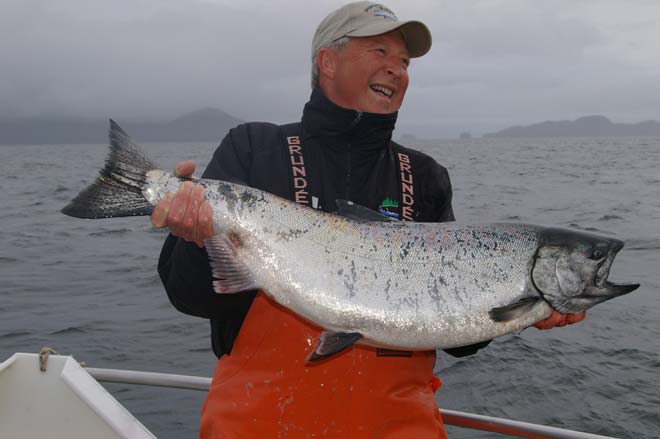
Evidence the king of Southeast Chinook, a 126 1/2-pound behemoth reigning from a humble display inside a Nordic museum in Petersburg, dusty proof that the good ol’ days were more than delusions and that hulking big salmon really do lurk in these quiet inside waters.
In 75 years no one has caught another behemoth to rival that Goliath and probably never will, considering the steady slip in the average weights of today’s king salmon. [emember_protected custom_msg=’This content is available for subscribers only.’]
But while I am watching the black rod throb in the holder, keeping time with the peculiarly cut herring that I’m trolling along the rock face of a uninhabited island west of Wrangell, I wonder about the monster’s pay-it-forward gene pool and if it survives in a distant cousin that perhaps right now is tracking the sweet sway of my bait.
Point Colpoys is where the 53 1/2-inch slab wound up in a commercial fish trap in 1939. From where we’re fishing, the celebrated point is on past Zarembo Island and a doable southwest run down Sumner Strait to the northern tip of Prince of Wales Island. Wouldn’t take long to run down there in his 35-footer, John says, pointing at the twin-250s on the transom. But, he adds, there’s just as good a chance that record fish would have arrived at this spot had it not been short-stopped in the commercial trap. And so might its cousins.
The king of kings was a six-year-old on a migration line that likely was pointed at the Stikine River mouth south of Petersburg and directly across the bay from Wrangell, dead on target with our trolling path.
Don’t hold your breath, John says, but it is possible that we could still hit a wall of fish right here, maybe a Colpoys cousin. And he was right. We didn’t. But we did nail a couple of stout kings in the mid-20s and in today’s salmon world those are righteously good kings.
In retrospect, I wonder if the king of kings was even headed to the Stikine. Maybe instead it had been sniffing out a right turn down Clarence Strait, south along the east side of Prince of Wales Island past Coffman Cove, Thorne Bay, Meyers Chuck and Kasaan. I lost a huge fish at Kasaan a couple of years ago, a king that inhaled a foot-long horse of a herring intended for halibut. It hit on the free-spool drop, spun my spool into a blowout tangle and snapped 100-pound-test. I wonder?
Or would it have continued past Ketchikan and Point Chacon to one of those powerful salmon rivers in neighboring British Columbia. The Nass, perhaps, or the Skeena or…
The reality is that migratory kings swimming through Southeast collect from all over the North Pacific, assemble in Southeast and then fan out in dozens of directions toward hundreds of spawning destinations. Reason enough for me to keep coming back to this complex riot of protected points and islands, rips and eddies, passages and reefs from Juneau south to the Canadian border.
For king salmon fishermen, Southeast has everything. Protected inside water, big fish potential, calendar scenery that is filled with glaciers and mountains, seascapes and wedges of Tongass National Forest, islands big and small, remote getaways and in-close honey holes, upscale destination lodges and rental kickers for do-it-yourselfers.
Sixty-pounders are rare, but caught, 50-pounders, too, and I’ve caught my share of 30- to 40-pounders and that’s plenty of king for me. The high average is between 20- and 25 pounds—a respectably sized salmon—and there are wads of three-year-olds swimming around in the high teens.
You’ll possibly find bigger average-weight kings homing in on Kenai Peninsula rivers, and certainly more big-fish concentrations off Kodiak Island if it’s not too far. But if you want respectable-to-ohmygawd-sized kings and maybe a lot of them, Southeast is the destination.
The plusses come in plethoras.
Most Southeast salmon fishing centers are either conveniently adjacent to international jetports, or remote and landlocked in wilderness isolated from outside road systems, boosting the esoterics and dumping fishing pressures. Every hotspot is on or near historic migration routes for hundreds of different runs, which extends the Chinook fishery across the best parts of summer. Mixed in are designed destination fisheries enhanced by hatcheries that release millions of smolts that morph into enviable spring and summer returns.
The persuasive bonus of targeting hatchery kings is that these fish are intended to be caught by sport anglers. In designated enhanced areas daily and possession limits are usually exceptionally generous for resident and non-resident anglers.
For non-residents the really big plus of fishing enhanced areas is that hatchery-produced Chinook are not counted against Alaska’s parsimonious annual king limit for out-of-staters. The confusing annual non-resident possession limit on kings varies from 1 to 2 depending on areas and time of the season, but in enhanced areas it can be up to 6 a year.
Where in Southeast anglers target kings will determine what month they should be fishing. In some parts May is the prime king time; the majority of regions are at full throttle in June, some early July, and a few spots are still producing decent king action into August and September.
If I had to pick a general prime-time for kings throughout the Southeast region, it would be early- to mid-June and I’d plan to fish every day until the Fourth of July.
Here are some of my favorite Southeast king zones.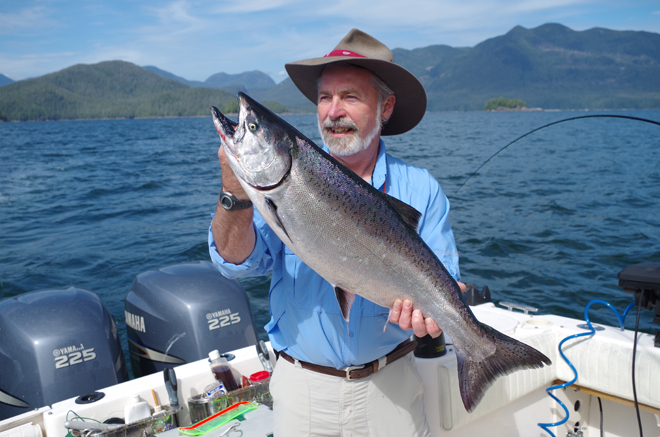
JUNEAU: The state capital has leaped into the forefront as a Southeast king fishery, led by a massive surge of hatchery Chinook from the Macaulay Salmon Hatchery on Gastineau Channel. Anglers nail kings virtually from the sidewalks in downtown, and small boat areas off the dock harbors, the mouth of Fish Creek and inside bay points to upper Taku Inlet. Rental kicker boats are available in the marinas and there is no lack of city-based charter boats for half-day and all-day trips.
Two runs of kings arrive here. The early hatchery run from the release of almost 6 million Chinook smolts peaks in late May and June followed by the Taku River wild fish, in late June to mid-July. During the early hatchery run from April through June, ADF&G has liberalized catch limits to two a day and non-residents are allowed to possess 5 kings, and none of those count against the state non-resident annual limit. Two-rod fishing is allowed in both charter and private boats.
The Taku fish of late June to mid-August do not share the liberalized limits of the early Macaulay hatchery fishery. There’s a bonus, though. Hatchery workers expect between 1.8- and 4.8 million chum salmon back to Macaulay and for a month both summer kings and big chums share the water around Juneau. The late run coincides with the popular Golden North Salmon Derby August 8-10.
SKAGWAY-HAINES: If there is a sleeper king fishery in Alaska, it’s this one at the head of glacier-walled Lynn Canal where ADF&G has quietly been working to build a quality king fishery.
Skagway is 13 miles northeast of Haines, across the water at the head of Lynn Canal. The gold-rush theme-town makes its summer money off tourism, and the king fishery that’s evolving here is an underrated, rarely publicized stepsister. Which means no commercial competition and light sport-fishing pressure just minutes off the dock. Two runs of king salmon slip into these calendar-perfect waters. The first run is wild fish that arrive in late May and peak in June for both towns.
That run is followed at Skagway by adults from a release of 90,000 Macaulay hatchery smolts that enhance the natural run and can be caught from June into August, with some still moving up in early September. This is one of the few places where spawner kings and silvers overlap in late August to September. Haines, 13 miles away on the other side of Lynn Canal, also chases the pass-by king fishing May through July then turns to silvers, chums and pinks in summer. Charter boats operate at both towns, which share the double bonus of being accessible by highway from the Lower 48. (Contact: http://skagway.com and http://www.haines.ak.us.)
SITKA: Sitka needs no build-up, as this historic Baranof Island tourist town on the outer coast under the volcanic dome of Mt. Edgecumbe is one of the best places in all of Alaska for king fishing. At times it is the best in Alaska, according to ADF&G catch figures, and it has the fishing pressure to prove it.
May and June are the hot months when kings are thickest, but July and August can also produce shots at pass-by Chinook and there is a high-action overlap in late summer with silvers and chums. Most fishing is in the ocean, but close-in. Limits are tight. The daily for non-residents is one king and the annual limit varies from 1 to 3 depending on when you fish.
Amenities include airline service, five lodges within shouting range of Sitka, plus 7 hotel/motels, another 15 B&Bs and a raft of day charters and guides out of one of the five small boat harbors around town. (Contact: sitka.org.) You can win a trip to Sitka this year by entering at Fish Alaska’s website.
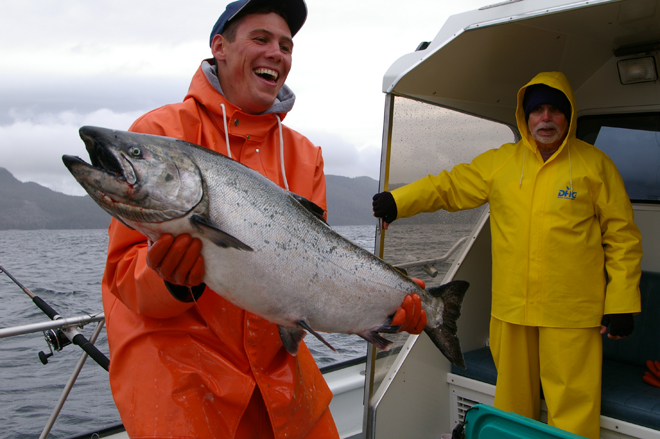 ELFIN COVE-PELICAN: Eighty- and 100 miles southwest of Juneau, Elfin Cove and Pelican are small, isolated towns that started as commercial salmon strongholds and now have quality sport-fishing operations. King action starts in May and can run into September but if you have to pick one month make it mid-May to mid-June.
Separated by miles of wilderness on the northwest corner of Chichagof Island, the towns are tucked into protected coves on the ocean end of Icy Strait, giving anglers the choice of fishing outside in Cross Sound on the edge of the Gulf of Alaska or inside in the protected waters of the strait. It’s great to have options when weather and wind are worries. Both harbors mix commercial and sport boats, are unique in their own ways and offer plenty of character. Access is by boat or floatplane from Juneau, and the fishing is mostly accomplished via lodge- and charter-boat operations, but a couple of outfits inside Icy Strait rent self-guided kickers if you prefer.
Pelican likes to brag that it’s “closest to the fish,” and the town motto nails it—most of the kings headed into Southeast land here first. Back in its commercial heyday, Pelican was credited with having the most king salmon landings in the world. Commercials are now tightly restricted on kings, leaving huge numbers available to the sport fishery. Half a dozen lodge and charter operations are in operation here.
Elfin Cove is a few miles farther inland than Pelican, but both fish the same areas of Cross Sound. Elfin boats tend to also fish farther east up Icy Strait and follow migrating schools inland past Glacier Bay National Park.
King fishing in Cross Sound runs all four of the warm months starting in May and peaking in June. Elfin anglers catch kings from runs to the Sacramento River in California, Taku at Juneau and south into Ketchikan. It’s a rare Southeast king that doesn’t first swim past Pelican and Elfin Cove.
Here where Cross Sound meets Icy Strait it is irresponsible to talk king fishing without paying homage to local halibut. King-and-hallie combo trips are standard and the halibut catches here are quality. (Contact: http://pelican.net and www.traveljuneau.com.)
WRANGELL: Mid-May to mid-June is when the big kings of the Stikine River wallow into the glacier-clouded Wrangell waters. Recent runs have been down but are still plentiful enough to target. Captain John Yeager tells me the kings last year averaged 22- to 26 pounds, the biggest pushing 40 and the earlier in June that he fished the better the Chinook action.
Wrangell is off the beaten track, more fish-town than tourist stop, with limited hotel/lodge accommodations but a bunch of B&Bs and a scattering of fishing guides and charters. This is a tough place for do-it-yourselfers and chartering a rail spot is a wise investment. The fishing grounds are widespread, the fish move around and local insight is money. On the plus side, the fishery is in wind-protected coves, near islands and points in the Inside Passage. I’d recommend Memorial Day as the best chance to whack a king. There is airline and ferry service. (Contact: http://wrangellalaska.org/visitors.)
PRINCE OF WALES ISLAND: You don’t just go fish POW—it’s too enormous. Around the third largest island in the U.S., anglers target either the east side in Clarence Strait, the west side out of Craig/Klawock or the north end at Point Baker. Unless you have a boat, the island is a 30-minute floatplane flight from Ketchikan.
In late spring through early summer POW is surrounded by kings migrating either south to British Columbia and Washington, east to mainland spawning rivers or to hatcheries including a couple of major ones on the island. Benefiting from a king salmon hatchery program and POW shoulder action can stretch Chinook catches from May into August, with a peak around the Fourth of July. The late king runs are sweetened with overlapping early coho and chum runs. POW kings average in the mid-20s with some in the 50s and a very, very few pushing 60.
Craig, population 1,200 with another 850 in neighboring Klawock, is the center of island sport fishing. Lodges, charters, motels and rental cars are centered here, but it’s also the king hub because the POW Hatchery Association’s Klawock River facility produces 300,000 Chinook annually. Hatchery officials claim it is the largest sport-producing hatchery in the state. On the east side of the island, across Clarence Strait, the Neets Bay Hatchery adds a few hundred thousand more kings. The hatchery impacts on both sides of the island coupled with major migrations south provide a near-constant stream of kings along both sides of POW into July, while strays continue to show into August.
Ninety-nine percent of west-side king fishing centers in Craig and Klawock, where there are multiple charter fishing operations ranging from bare DIY skiff rentals to day charters and full-service fishing lodges. By contrast, facilities on the east side are mostly independent operations scattered along Clarence Strait from Sportsman’s Cove north through Thorne Bay, Coffman Cove and Whale Pass to remote Point Baker on the far northern end at Sumner Strait. East-siders fish Clarence Strait and target kings in May and June, tapering into July when silvers and chums arrive. Stray kings are picked up throughout the summer. The May-June action zooms in on the east side of Clarence along Cleveland Peninsula, intercepting kings returning to the Neets Bay hatchery in Behm Canal. (Contact: http://www.princeofwalescoc.org.)
KETCHIKAN: When the fifth-most populous city in the state bills itself as the salmon fishing capital of everywhere, boasts an international airport, has cruise ships stacked five deep and three dozen charter and guide boat operations—don’t expect salmon secrets.
The city built its salmon reputation on cruise-ship pinks and silvers, but it also hides a surprisingly good early king fishery starting in May, peaking between June 1-24 and tapering into the first week in July. Another plus is that some of the best fishing is near town; north in Clover Pass, off Ward Cove and especially Knudson Cove. Eight miles south of town there’s a king return that packs into Herring Cove. It’s not aesthetically pleasing, but Herring Cove is close, accessible by road and productive. On the long-run side, some Ketchikan charter captains may be persuaded to run as far south as Cape Chacon, within sight of the B.C. border. It’s a long ride but there are kings here well into summer after the close-in bites fade and fishing pressure is rare. I’ve caught Chacon kings in July, and there’s some huge fish passing through here.
Closer to town at Survey Point, within sight of the docks at Knudson, is where I’ve had my best luck in early June. The Knudson marina office is a solid source of information on what’s hot and what’s not. There are some DIY skiffs at Knudson and Clover Pass but unless you’re plugged into the local fish talk, a guide or day-charter trip will cut days off the learning curve for Ketchikan kings. Prime time is the first two weeks in June. (Contact: http://visit-ketchikan.com.)
CHATHAM STRAIT: South of Juneau along both sides of Chatham Strait, the ABC Islands (Admiralty, Baranof and Chichagof) hold dozens if not hundreds of remote and prime king fisheries. Angoon on Admiralty Island is centered in the ABC complex and is a good base for fishing all three islands. Remote lodges targeting king areas are located on each of the ABCs facing the strait.
Kings arrive in mid-Chatham in mid-May and catches hold up well into mid-July; then they taper quickly. This vast area has huge king potential but it can be overwhelming for private boaters unless based at one of the sport-fishing communities — Angoon, Tenakee Springs, Hoonah, or Baranof Warm Springs Bay.
You rarely have to run far to find kings. One of the best June ambushes is Danger Point within sight of the houses in Angoon. With little concentrated fishing pressure and respectable numbers of kings, Chatham Strait is one of the Southeast’s most remote wilderness Chinook options. Plenty of sheltered anchorages for private boats and day fishing charter trips can be arranged in the community centers. (Contact: www.traveljuneau.com.)
###
Terry W. Sheely is a contributing editor for Fish Alaska magazine and writes from his home in Black Diamond, WA. [/emember_protected] [emember_protected scope=”not_logged_in_users_only”]
- Need to subscribe? Now’s a good time! Check out our current subscription specials!
- Already a subscriber? Login below to access all of our online articles and content!