


Prince of Wales Island’s Waterfall Resort
By Marcus Weiner
As one happy angler bobbed up and down—in rhythm with both the gentle rocking of the seas and the rod pulsing in his hands—the next hooked his own Chinook chromer. “Could it be?” I voiced internally, just as a third rod slammed down under the mighty strike of another king.
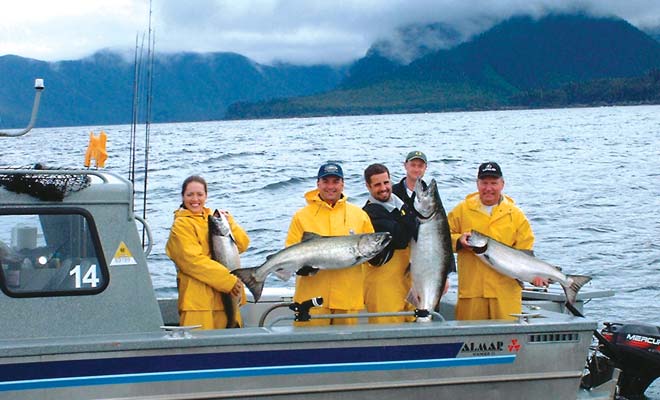
With open-mouthed amazement, I watched as the whirl of activity increased, our companion boat initiating the complex dance of fishermen otherwise known as the quad hookup. Four anglers, four simultaneous king salmon. A pair of these sea lice-laden freight trains broke the 35-pound barrier, while the other two each eclipsed the 40-pound mark.
Only smiles were left once the action had abated, leaving one thing abundantly clear—on this June day, beneath this perfect Alaska sky, there was no place any of us would have rather been than fishing from Waterfall Resort on Prince of Wales Island. [emember_protected custom_msg=’This content is available for subscribers only.’]
Hors d’oeuvres
The trip had gotten off to an extremely promising start. Our party, consisting of my co-publisher Melissa Norris and her husband Wayne, my mom Sue Weiner, our family friend Sue Watson, and myself, headed for Ketchikan from Anchorage on June 1. Upon arrival in Ketchikan, we promptly spent two half-days and another full day fishing for king salmon with Ray Chaikin, owner of Eagle Creek Lodge, and Kevin Beck, the captain of the lodge’s boat, the Frieda Mae.
In our short time on the water, we landed a total of 25 fish, with the largest a 30-pound-plus buck that nailed the spoon so hard the rod butt struck me in the head as I moved to retrieve it from the holder. For 30 seconds or more, that supercharged chinook stripped line from the reel, leading to visions of a 40 or 50-pound behemoth. Thusly warmed up and perhaps a little spoiled by the kings of Ketchikan, did we stand a chance of finding even more success once we’d arrived on Prince of Wales Island? You bet.
The Main Course
As soon as you step off the floatplane at the Waterfall Seaplane Base, expect to be greeted by the lodge’s staff. You’ll be helped off the plane while someone grabs your gear and moves it to your cabin. At the lodge’s general store area you’ll be assigned quarters and a boat, and then there’s only a quick stop to be outfitted with rain gear and pick up any licenses and stamps you may need before you’re off to your first half-day on the water.
Thirty minutes at the lodge, and it’s already time to go fishing? Now that’s my kind of place!
After our flight from Ketchikan, Melissa and I joined Chuck Baird, the marketing director for Waterfall Resort, and Peter Ottsen for our first excursion. We were scheduled to fish for a few hours before dinner—a strategically planned warm-up designed to get your blood pumping over the area’s outstanding fishing possibilities. “We had one day last year when we brought in 12 kings over 40 pounds and four were over 50,” Chuck told me on the boat ride out. He needn’t have said another word.
Scott McKelvey, Waterfall’s head guide, was our captain. Upon arrival at our fishing hole, we were introduced to a technique called power mooching, where we simply mooched with cut-plug herring while Scott slowly moved the boat across good water with the kicker motor. It proved to be quite effective, as Melissa and I each quickly hooked and landed a salty king. Both were in the 20-pound class, average fish for the area, but great to see within the first hour of fishing. Before we returned to Waterfall resort that evening, we had boated our limits of halibut and caught-and-released a lingcod on the high end of the 30 to 39-inch slot limit set for their retention in these southeast Alaska waters.
Prince of Wales Island is part of the Alexander Archipelago in the southernmost portion of the Alaska panhandle. The region is dotted with a multitude of smaller islands, and the many bays, points, passages, and channels combine with extreme tides and the surging ocean currents to create phenomenal habitat for millions of baitfish. The baitfish in turn lure an abundance of trophy-sized salmon, halibut, yelloweye rockfish, and lingcod, which have made the area a world-class angling destination.
We soon discovered the basis of that legendary reputation for ourselves, as our first full day of fishing set the bar for a Fish Alaska saltwater trip. Not only did Wayne, Melissa, Chuck, and Peter experience a quad hookup on king salmon, but they were hooked-up times-four on halibut and yelloweye rockfish as well. They also boated a limit of lingcod. Did I neglect to mention they did all that and still returned to the resort by 2:30 p.m.? What an awesome day of fishing. While nowhere near maintaining the blistering pace set on Scott’s boat, we too experienced our share of good luck. Fishing with our own Waterfall captain, Colin McCrossin, my mom, Sue, and I returned with a handsome catch of three kings, six halibut, and one lingcod.
The typical day of fishing at Waterfall Resort begins with king salmon, since the other species of targeted fish are usually pretty willing to bite. Year-round populations of feeder chinook are available in the waters surrounding the island, but it’s the pre-spawners of spring and early summer that are truly prized. There are virtually no king salmon spawning streams on Prince of Wales, however. The vast majority of these mature fish are caught while feeding heavily along the surf-swept coast as they continue towards mainland Alaska and their natal streams.
King gear at the resort is currently comprised of G•Loomis GL-2 rods and Daiwa SG27LC Sealine reels with line counters. The line counters were an extremely helpful feature, as after the captain had targeted the position of the fish in the water column, you could maximize the chance of hooking a hungry king by ensuring your bait stayed in the mooching zone (typically from 60 to 140 feet). To complete our mooching rig, we used red colored four-ounce banana weights in cooperation with a unique double-hook setup, which is designed to maximize the spin on the cut-plug herring.
After mooching for kings, we shifted our efforts to the ocean floor and the bottomfish that lurk down there. While some of the waters around Bucareli Bay are known to occasionally produce a 200-pound barn door, the Waterfall skippers usually target the smaller or “chicken” halibut (10 to 30-pound class) in 120 to 200 feet of water. These smaller halibut make for great eating and can actually be quite a fight on the salmon gear. And they’re abundant—not a day went by without us boating our limit. Waterfall Resort encourages the release of 100+ pound halibut in an effort to conserve the resource.
The fishing for yelloweye rockfish and lingcod was done on offshore pinnacles that dropped to as much as 300 feet. Since the limit of lingcod is one per day, the Waterfall strategy is to catch your limit of two yelloweye first and then drop to the lower portion of the pinnacle for lingcod. We didn’t want to take the chance of killing a lingcod if we already had a limit of them, so it was important to get the rockfish first.
The fishing is fast and furious for these species. Within 30 seconds on many drops, we were fighting a lingcod or yelloweye. We jigged a 16-ounce leadhead grub using Seeker Classic Series rods and Penn Senator reels. The stiffer rods are necessary for a 16-ounce jig and were also useful in fighting the large bottomfish. One of the highlights of the trip occurred on day four while Scott guided Wayne and I on a hunt for these species. I ended up hooking a fish while jigging that I thought was a decent lingcod, but to my amazement, it turned out to be a very large yelloweye. Waterfall Resort posts a big-fish board for all the species they target, and the rockfish, at 20 pounds, 2 ounces, was the biggest yelloweye caught so far that season.
Once the coho arrive in numbers, the salmon focus at Waterfall Resort immediately turns to silver. While we didn’t get to experience the resort’s silver fishing firsthand, their season does extend through August, and we’d have to guess the coho angling there is as outstanding as it is throughout the rest of the region.
Side Dishes and Dessert
A rugged, yet breathtaking landscape characterizes America’s third-largest island. Several freshwater streams amble through deep U-shaped valleys carved by glacial ice and offer their own bit of angling opportunity, some of it among the best to be found anywhere. Numerous peaks tower above the scene, looking down on a terrain blanketed in Sitka spruce and western hemlock, with some red and Alaska yellow cedar, red alder, and shore pine interspersed as well. A muskeg carpet covers the ground, consisting of sphagnum moss, ferns, blueberry and huckleberry bushes, young evergreens, devil’s club, and lichens. And bordering Ulloa Channel on the western coast of this scenic marvel lays a finely honed fishing machine, Waterfall Resort. Each vacation at this resort may indeed be tailored around catching fish, but the thrills certainly don’t end there.
At Waterfall, a scenic hour-long boat ride to the fishing grounds begins each day. Your transportation is currently a 25-foot Almar with a 225 HP Volvo Penta diesel inboard/outboard and a Mercury 9.9 HP, four-stroke kicker motor. The boats are equipped with heated cabins, suspension seats, and the full compliment of fish finding and navigational equipment. After cruising through some truly spectacular scenery, you’ll find yourself fishing at spots with names like “Pineapple,” “Big Roller,” and “Shaft Rock,” where the action can be every bit as satisfying with a camera as with a rod and reel.
At any time on the waters near Prince of Wales Island, you might spot puffins, sea lion rookeries, porpoises, and many types of whales, including Orcas, the most widely distributed of all cetaceans. The world’s only remaining population of gray whales is located off the coast of western North America, as well, where they undertake a 13,000-mile round trip journey from Alaska to Baja California, the longest migration of any mammal. Though they’re another species considered rare throughout the world (it’s estimated there are no more than 5,000 left), the humpback whale can also be regularly seen in these bountiful Southeast Alaska waters. On our trip, we were treated to the sight of a humpback in nearly full breach, an outstanding display that still has us talking.
On land one can occasionally see Sitka blacktailed deer, wolves, mink, and martens, as well as the black bears making their way to the island’s salmon streams. Birds common to the area include loons, herons, kingfishers, Stellar Jays, terns, and especially, the majestic bald eagle. More bald eagles are concentrated in southeast Alaska than anywhere else in the world. In the latter part of the season, you can even hear the call of migrating Canadian geese splitting the air. The waterfall that gives the resort its name is no more distant than a leisurely hour’s walk by beach and boardwalk. It’s the main water source for the resort, and some of the original pipes, running parallel to the boardwalk, can still be see on the way to the falls.
As far as history goes, Waterfall Resort is chock full of it. In the early 1900s (back when each boat would be sent out with a carrier pigeon onboard, to be released only as emergency communication), Waterfall was the site of one of the most productive salmon canneries in Alaska. Many of the present buildings that stand now were constructed in the 1930s as a part of a major expansion; then in 1973 the old cannery and surrounding 34 acres were sold to the Des Moore family and converted into the Waterfall Cannery Resort. In 1980 Waterfall Group, Ltd. purchased the operation and all of the buildings were renovated.
Now, in addition to the 24 guest cabins, 10 lodge rooms, and four condos, there is a fish processing facility, a general store, a dining facility, and the “Lagoon Saloon,” where guests can relax and enjoy some first-rate views of Tongass National Forest. If the day’s trophy fish have been particularly feisty and further relaxation is needed, a masseuse can be scheduled through the resort’s hospitality staff.
A nightly buffet offers choices spanning the spectrum of culinary possibility. From fresh halibut dishes and homemade soups to New York strip steak, we’d routinely eat well after a good day’s fishing. Fish processing is included at the resort as well, and your catch will be cleaned, vacuum packed, frozen, and then boxed to make the return trip with you. Waterfall’s onsite Alaska Airlines agent can even tag the fish boxes for you, after reconfirming your flights and providing seat assignments. It all adds up to a convenient, and almost luxurious, fishing destination.
Our After-dinner Report
All told, we landed 12 king salmon, 30 halibut (while releasing many small fish), 13 rockfish, and eight lingcod on our trip. On day three of our stay, a man from New Jersey landed a 49.9-pound king salmon, setting the new high-water mark for the largest fish of the month. When we left, Wayne’s 41-pound king was the seventh largest of the month.
I was pleased with the variety of fish available, the excellent king salmon opportunities, and the ability to catch halibut within five miles of land in reasonably shallow water. I was also very impressed by the professionalism the Waterfall team displayed in all areas of their operation, and with the punctuality of the fishing fleet.
The experience was especially unique for my mom and Sue, who had traveled from Virginia Beach, Virginia, to fish with us in Alaska. Afterwards, Sue’s favorite memory remained the humpback whale. “The sea lions were incredible,” she said, “with hundreds of them laying out on the rocks, but I just can’t get over the whale. It had a head larger than a Volkswagen!”
Apparently, my mom never did get her sea legs, as she later told me. “The rooms are always moving,” she confided, speaking of Waterfall’s white clapboard guest accommodations, “but the resort is still great. And of course, halibut fishing rocks.” [/emember_protected] [emember_protected scope=”not_logged_in_users_only”]
- Need to subscribe? Now’s a good time! Check out our current subscription specials!
- Already a subscriber? Login below to access all of our online articles and content!