


The Bounty of Sitka
Story and photo by Kathy Anderson
Trip after trip, year after year, the Sitka experience finds new ways to impress.
Sitka is a personal treasure-box of memories for me and has been ever since our first trip as tourists from Atlanta many years ago. My husband, Patrick, and I experienced the thrill of catching king salmon and halibut for the first time, dipped ourselves into secluded hot springs in the ruins of a seemingly ancient resort, and caught our first-ever grayling in a mountaintop lake from a leaky rowboat under the stern view of dozens of bald eagles. [emember_protected custom_msg=’This content is available for subscribers only.’]
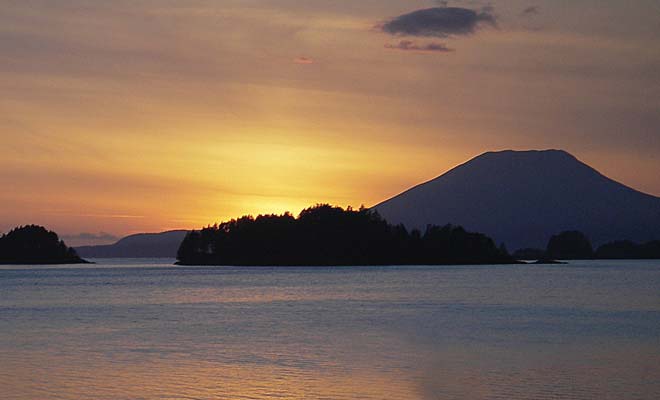
We’ve been Alaska residents for several years now, and the magic of Sitka has only grown for us. This enchanted mid-southeast Alaska town is captivating for its rich and diverse history, its lush rainforests, and the unbearably beautiful Mt. Edgecumbe, a picture-perfect dormant volcano that dominates the western horizon and can bring you to tears on a clear day.
Arrival last fall for silver fishing took place on just such a day. My cousin, Phil Kline, and I took advantage of the sun and warmth and explored the city with Dove Island Lodge manager and tour guide, Nicole Bilinski. Traveling by foot, we wandered from an old Russian church to the hilltop site of the 1867 ceremonial transfer of Alaska from Russia to the United States and then on to a long trail of Tlingit totem poles at the national historical park. We bypassed the waterfront McDonald’s, which undoubtedly has the best fast-food view in America. Sitka, it seems, floats on a time horizon different from others, with deep roots into the past existing side-by-side with modern life.
The mystery writer John Straley described Sitka as ” . . . an island town where people feel crowded by the land and spread out on the sea.” We felt that – both in the compactness of downtown and in the breadth of view looking towards the ocean-going vessels at ease in the harbor. Trollers, trawlers, and seiners alike were docked at the marina, along with a goodly assortment of pleasure boats large and small, power and sail. We were met by a Jack Sparrow-style pirate by the name of Doc, a friendly jack-of-all-trades from the lodge. We skimmed the short distance across the water to the lodge’s private island and the hearty welcome of owners Duane and Tracy Lambeth (see “Steelhead Saga,” Fish Alaska April 2006). Dinner was a remarkable assortment of brightly colored seafood and vegetables served on heaping platters family-style, a sign of the bounty to come.
After Sitka’s glorious welcome, most of our days were gray, each threatening and most delivering the relentless light rain that is southeast Alaska’s signature. But the truth was, we didn’t much care – there was a silver lining, literally and figuratively, in those clouds, as we experienced incredible coho fishing in secluded, secrets spots known to Duane and his head guide, Eric Morisky. Our transit was made easy by the lodge’s DeHaviland Beaver floatplane and Duane’s superb piloting skills, and the weather was kind enough to break most mornings so that we could fly out – and each evening so we could fly back. On days when the weather was less kind, we were able to reach some splendid destinations with a short ride in one of the lodge’s 27 1/2-foot SeaSport boats.
You probably know the feeling – the one that tells you that everything is just right: this is theplace, this is the time, and I’m the lucky angler who’s going to take the prize. We’d flown, on day one, to a place that Duane calls “Crabby Bay,” and we hiked in a short way past the bogs at the mouth of the stream. Phil had an immediate strike on a pink Vibrax and landed a nice silver. I caught a small jack, and Eric was thinking about moving us upriver. I asked him to give me more time, though, because that feeling came over me. I was on a mission to land a silver on a Santa Clouser, a red and green saltwater fly adapted by my husband, who had to miss this trip because of work. I wanted to be able to E-mail him a close-up of a silver with his special fly in its mouth.
The casting was easy, with plenty of beach behind me, but the overhang on the far side was dicey. I managed to finesse the fly right under the branches and was rewarded almost immediately with that “glug” that means a fish has been fooled. I felt no pressure, no panic, and kept him under control and out of the logs. When I beached him, I felt the singular pleasure of achievement, of landing a meaningful silver on a hand-tied fly with a hand-made fly rod, using my own private strategy. After that, I thought, it didn’t matter what happened the rest of the day.
Heading upriver, we passed dark, swirling holes with logs half-hidden. To say that this place was deserted or desolate isn’t quite right – it was just quiet, and all ours. The sounds of the rushing water, the random drip of the rain through the forest canopy, and the ripples of wind through autumn’s last leaves accompanied us on our shortcut through the woods. There was an air of mystery, an uncertainty about what would be around the next bend. The huge trunks and stumps of old-growth forest enveloped us, and the ubiquitous moss softened the echo of our footsteps.
We approached a deadfall tree lying across the stream and decided that the hole just downstream of it looked promising. We both went to spinning gear and were rewarded quickly with unmistakable strikes. Phil landed a shimmering Dolly Varden, with huge, bright spots, after a short but exciting fight. I switched back to fly after I caught my Dolly, and promptly lost one of my casts to distraction when a pair of Stellar jays catapulted out of the deadfall. Phil landed a large, slightly blush silver, the first sign of spawn that we’d seen. She put up a remarkable fight, and that, indeed, is the thing – not the catch, but the chance to exercise one’s skills, to use all those lessons we learn the hard way over the years, and to prevail in the end. Phil remarked that what we were doing would be fun even if we weren’t fishing, and we knew he was right but were nevertheless glad for the chance to cast a line.
Eric noted that we were due back at the mouth for our pickup, but The Feeling came over me again, and I sensed that there was a fish for me, in front of the log just below where Phil had caught his silver. I dropped the fly in, unfurling the leader in semi-slow motion. There it was, the take, the run, the jump, then another run and jump, then another. There was the bend in my rod, there was the zing as the line stripped out, there was the splash. Just like I’d known, like it was supposed to be. I thanked my tired, shiny silver as I gently released her. I was ready now, and we waded back to the waiting plane.
There was a day of abundance, later in the week, the only time we fished in the sun. We returned to our day-one spot, having traded our Gore-Tex for our sunglasses and wide-brimmed hats. It was as if we were in a different place altogether – two days of ensuing rain had brought the river up considerably, and there were new sloughs and wholly different challenges. Setting up shop at the mouth of the river, Phil set the pace again by landing the day’s first silver on a pink Blue Fox spinner. After that, we settled into a rhythmic pattern, landing fish every third cast or so. I had great luck on the Santa Clouser again, and my largest silver treated me to a circus-like performance,including both acrobatics and high intensity “sulking” on the bottom in between jumps. I landed him, to no audience but myself, as Phil and Eric were both more than occupied with their own successes. After one hour, we’d landed 16 coho and lost countless recalcitrant fish that had spit the hook or overstressed our knots. Tying good knots in Spectra is definitely tricky.
We tore ourselves away and criss-crossed upstream towards where we’d fished a few days earlier. It was remarkable to note the change in the course of the river. Logs we’d fished downstream from weren’t even visible, and places we’d crossed were now well over my wader tops. We hit one tough hole with a snaggy, felled log upstream and two equally treacherous logs below. Luckily, these coho were a little smaller than our earlier ones, and we were able to guide them around the minefield and land all but one. It was as if we were on a magical journey, going through small twisty passages and picking up treasures along the way – each fishing hole presenting its own challenge. By the time we were done here, our treasure count had reached 24, two dozen silvers landed by three anglers.
We crossed over to our next destination through the woods. This time, we were deeper into it, and there was no beaten path. Eric told us that bears make most of the trails there, and there was something thrilling but disquieting about the half-eaten fish remains we stepped over on our way. We followed our ears to the other branch of the river, but found we’d come too far up for the silver. We saw a few shaggy pinks but decided to pass.
Farther downstream, we came to about 150 feet of river frontage, with blessedly wide grassy areas for back-casting and plenty of room for three anglers. At about 3:30, halfway to high tide, a pulse of chromers came through, and we were about to understand why Eric had invented the phrase “lightning rocket ride.” What happened next was a bit of a blur. We were each in our own mechanical world, casting about halfway out, setting our hooks when the take came, and holding on for the crazed, frenetic runs and jumps of our irritated prey. We helped each other when a big one came in, as the bank was six feet high in places, but for the most part, we were on our own for catch-and-release. It lasted thirty minutes, but it felt like we were in a warp zone, that time and space where you really are in the moment, each moment.
When it was over, we could only fall to the grass and laugh. Eric had counted 27 more silvers landed, for an incredible total of 51! None of us were really there for the numbers, but it provided some sort of perspective on just how extraordinary our day had been. We took down our rods, loaded up our packs, and crossed the river. Two great blue heron stood watch as we hiked across the bogs to meet our plane.
On our last day, Duane was able to join us for the fishing and not just be our drop-off pilot. I was interested in cutthroat, and he was pleased to accommodate me. We’d experienced more extremely rainy days, and the remote islands had apparently gotten even more precipitation than we did at the lodge. We landed on a lake that was so high, his usual docking spot was underwater. We couldn’t approach the head of the river directly on foot because its exit from the lake was, by Duane’s estimate, 15 feet higher than normal. Eric and Duane marveled at how changed the landscape was: There were cascades over rounded rocks that were usually exposed, slow eddies over grassy stretches that were once banks, and wide expanses over previously easy casting waters. It was as if nature was spilling over, subsuming what she could, taking what was hers.
We hiked over a small crest to reach a streamside fishing spot and stood in 18 inches of water where there was usually none. Once again, Phil got the first strike and brought in a 14-inch cutthroat, a nice size for this river. The rest of us followed suit, and I was delighted to land my first-ever of this remarkably beautiful species. Their black spots were prominent against their highly-colored sides, and the namesake slash of red on the underside of their jaw was unmistakable.
The trick to catching these cutthroat was to use a very slow retrieve with a slight twitch. They stayed fairly close in, just past the underwater drop-off that had been the riverbank just a few days ago. We pulled at least 20 more out, then sat on a log and ate our sandwiches. Phil, who is a dedicated birder, noted that we’d seen and heard red crossbills, song sparrows, ruby-crowned kinglets, and juncos, all in the space of a few hours. We couldn’t help but think that we were among the very few humans that these birds would come in contact with that fall, and we appreciated the privilege.
Duane wanted to try a second spot, so we headed out in the Beaver to another swollen lake and river system. Here, though, we could see coho jumping in the lake, so we began to anticipate the stream before we even landed. We fished there for two hours, hiking through dense tangles from hole to hole. Roll casts were my friend, in fact were the only possible approach to the water with my fly rod. The Dolly Varden were intrigued by the guys’ #2 Black Fury Mepps, though, so I joined them with my ultralight and delighted in bringing pretty, vibrant Dollies to shore. They were quite aggressive, snatching the lures with abandon. They seemed fat and well fed, so we assumed they were in it for the variety.
At the second pool, Duane got into something else entirely, a huge coho that spun and danced and flirted with the tangled roots at his feet. Duane won, though, and proudly displayed the largest silver of our trip. On the last cast of the day, when the rest of us were urging him to quit and head back to the plane, Eric landed a stunning 16-inch cutthroat. This beauty was golden, glowing in the late afternoon sun, and it seemed to be patient while Eric posed with it for our cameras.
Duane headed the Beaver back home. I tried to work on my notes, and found myself reluctant to write down the facts and the numbers of the trip. Below, the scenery worked more magic on me. Ribbons of water cascaded from cliffs and myriad lakes shimmered in the sun. Confused braids of water competed with stubborn strands of sand at the mouths of strong rivers, dissipating across grass yellow from saltwater incursions. Just as we came back into view of Mt. Edgecumbe, a humpback whale breached as if to say goodbye. I turned back to my notebook, vowing to capture the feeling of the day, one that would be carefully placed in my Sitka treasure box.
Kathy Anderson is an associate publisher of Fish Alaska magazine. [/emember_protected] [emember_protected scope=”not_logged_in_users_only”]
- Need to subscribe? Now’s a good time! Check out our current subscription specials!
- Already a subscriber? Login below to access all of our online articles and content!