


We’d found silver salmon nirvana. Hiking several miles up a remote stream in Southeast, we rounded a bend and there it was. A 7-foot waterfall . . . below it a hole the size of an Olympic swimming pool literally teeming with coho. The sun poked out from behind a cloud and the green moss and trees looked as if they were glowing. It was the kind of scene you dream about and I swear I could almost hear angels singing. Jig fishing silvers is great fun and highly productive.
Story and photos by JD Richey
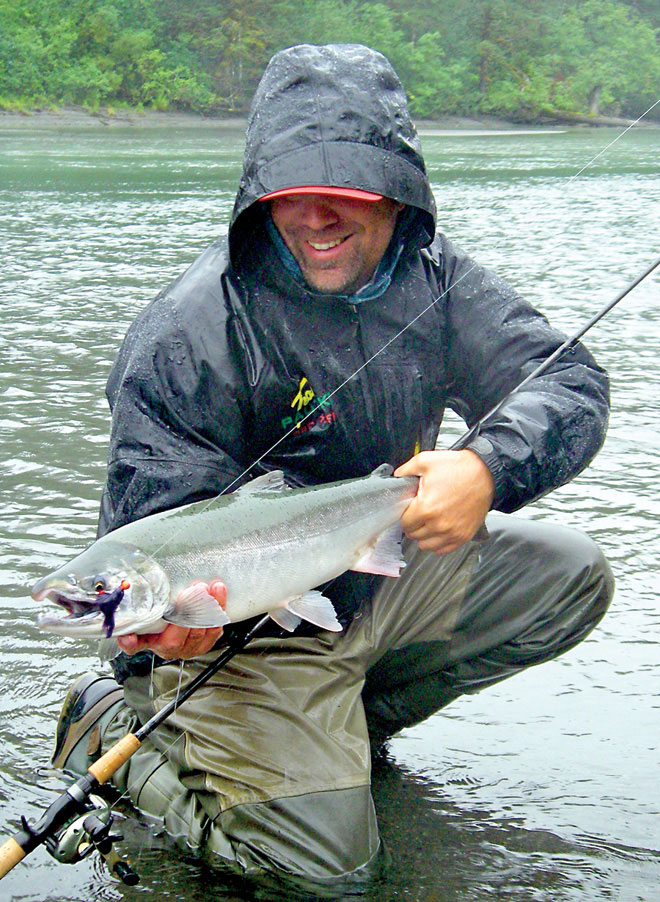
Our casts arced high over the pool and plopped down in unison. With reel handles turning and heart rates racing, the spinners didn’t get devoured on the first revolution as we had anticipated. Nor the second or the third. In fact, the lures both made the journey through what could only be described as shark infested waters without so much as a pause. Uh-oh! The clouds suddenly darkened . . . [emember_protected custom_msg=’This content is available for subscribers only.’]
After landing only two fish in the first 35 minutes, we started cycling through all of our gear, looking for something those kegged-up coho would bite. Every spoon, spinner and plug was met with the same tepid response. As a last gasp, I threw out an old 1/8-ounce black marabou jig I’d used years ago on some smallmouth bass trip in the Lower 48. Well, you can probably see where this is going: the salmon loved the thing and I caught fish until I was too tired to make another cast. Thus my infatuation with jigs for silvers was born.
Since that fateful day, I’ve taken jigs with me every time I’ve gone silver fishing and have yet to be disappointed. I’ve done extremely well on upriver coho that have gotten stale, caught tons of chrome-bright fish on jigs in the lower sections of rivers and even whacked them in the salt. In short, jigs will work wherever you find silvers.
I wish I could tell you why the fish like little tufts of marabou or rabbit fur, but the bottom line is they do. It may have to do with the fact that jigs have a nice, natural look to them as they pulsate through the water—the perfect balance of action and attraction without being overwhelming. Maybe jigs look like some sort of aquatic invertebrate that the fish keyed in on as juveniles or an ocean food that silvers like out in the big salt. Who knows…let’s just accept it as a fact and move on!
Jigology 101
As far as jigs go, I’ve done best on ones built on 1/8-ounce leadheads. In extremely deep water, ¼-ouncers will sometimes produce and I’ve also caught a few on 1/16-ounce models in extremely low, clear water. That eighth-of-an-ounce size, however, seems to best cover most situations. It’s also heavy enough to cast and sinks down to the fish but also light enough to give the lure a lively action. Just be sure to purchase jigs with stout hooks as the thin wire varieties will straighten out pretty quickly.
As far as colors go, the sky’s the limit but I like to keep things really, really simple. My best all-around jig color is purple with an orange or pinkleadhead (think Egg-sucking Leech), followed closely by black fur/orange head and all pink with an orange head. Generally, I use the darker colors on bright days and in clear water and the bright pink on cloudy days and in off-colored streams. You can also get into two-tone patterns like pink/purple for the dark days when you need a little extra contrast.
I build my own coho jigs and primarily use rabbit strips for the body (you can find them at any fly shop) because they’re so easy to work with. Marabou is also a great body material and it really gets down to personal preference because the fish don’t seem to mind either way.
If you’re not into making your own, there are several companies that now manufacture salmon and steelhead jigs. A quick search through the ads of this magazine and then a trip to Google should get you what you’re looking for.
Technique
Ah, here’s where fishing silvers with jigs really starts getting appealing. Not only do all the lures you need for a day of fishing fit into a pocket, the basic technique is really pretty easy to master.
In the soft-water pools and edges that silvers seem to prefer, cast upstream of where you think the fish are holding and allow the jig to sink towards the bottom. At that point, with the rod tip held up at about a 45-degree angle, twitch the lure with a sharp upward snap of your wrist. Be careful not to use your whole arm or you’ll impart too much movement into the jig.
Immediately after the upswing, pause and then drop the rod tip back to its original position and crank one to two turns on the reel as the lure’s falling. Snap upwards again once or twice and let the lure fall again . . . and keep that routine going until the lure’s all the way back to you. What you’re trying to accomplish here is a hop-hop-hop type of action. On the lift, the feathers or fur of the jig will tuck tight against its body and then will flare back out on the pause, giving the offering a very lifelike pulsating movement.
Pay close attention to your rod tip for any light “tick” or “thump” as the lure falls. That’s when coho are most likely to grab a jig and the bites are often on the faint side. Of course, there are also days when they completely mollyhock your lure and about rip the rod right out of your hand. In either case, set the hook! The good news is the single hook of a jig typically holds very well and you won’t lose a whole lot of fish with these things. Clip the barb and you’ve also got one of the easiest lures to retrieve from a fish’s mouth . . . another bonus!
Float Fishing
When flows drop, the water clears and the coho get into one of their moods and won’t even take a twitched jig (rare), you’re going to have to go stealth on ’em. Often, lock-jawed silvers will sit in a pool, suspended off the bottom and won’t give the time of day to anything that moves. In that scenario, the best way to present a jig in a non-intrusive fashion to stale salmon is under a float.
Rig up with a small balsa float that’s rated for the size lure you’re going to use—again, 1/8 is best, but 1/16-ounce sometimes works for moody fish—and use as light a line as you can get away with. Fluorocarbon is the best leader material in these conditions. Unless you can see the fish, you’re going to have to guess about the depth to run your jig. Start with it just under the surface and then slowly increase the distance between the jig and the bobber until you get bit. Cast well upstream of the fish to avoid spooking the fish and allow the jig to drift, drag-free through them. Though it may not seem all that appealing just hanging there, the jig will lightly pulse as the float bobs along on the surface, giving it just enough attraction power to light up grumpy coho.
Saltwater
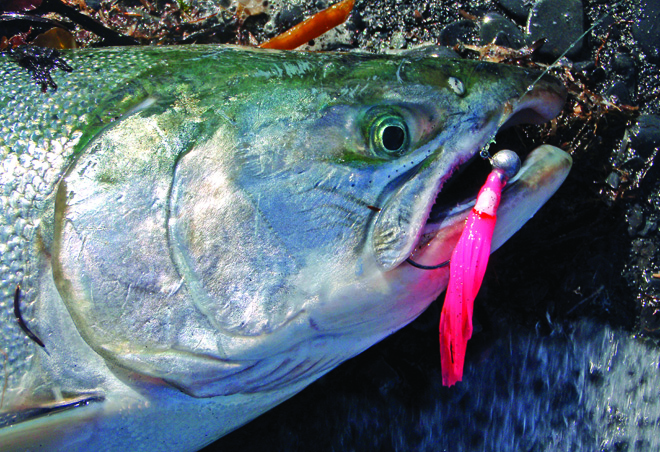
Jigs are also super deadly as silvers start to stage in saltwater near spawning streams. I’ve had some unbelievably good days in the salt throwing pink marabou jigs while anglers casting traditional hardware fared considerably worse. Even better are the “squid jigs” I make up with a lead head and a pink hootchie skirt. Coho slurp those things up like candy.
The concept here is basically the same as in freshwater—cast the jig out and retrieve it with the same hopping motion, though you can often let it fall longer if you’re working in deep water. Let it fall to the bottom and who knows what you’ll pick up—I’ve caught all sorts of bottomfish from rockfish to halibut on light jigs.
Other Species
And that leads me to the next attractive attribute of throwing jigs for river silvers, which is these things will catch anything that swims! Big rainbows and Dollies often whack my jigs when I’m silver fishing and humpies and chum go really crazy for the pink models. I’ve also had my share of big kings smash, oddly enough, the all black models. Be careful when using these things anywhere pike live, too! In the streams of Southwest, I’ve lost many a silver jig to northerns when working slow water.
Rigging Up
When fishing jigs, you’ll need a 7 ½- to 8 ½-foot rod rated in the 8- to 15-pound range that has a soft tip to cast light lures but also features enough backbone to work big fish out of cover (silvers love wood). With a quality baitcaster and the right rod, you can cast small jigs a long distance. However, you can also go with a similar rod in a spinning model.
For jig fishing, braided line is the way to go. Thirty-pound braid has the diameter of 8-pound mono and casts like a dream. It also has superior sensitivity, which will help you detect the sometimes subtle take of a coho. Just run a 6-foot section of 15-pound fluorocarbon to the end of your braid with a double Uni Knot and you’re in business.
Give jigs a try for coho this summer and fall . . . just in case you stumble on your own salmon paradise.
###
Contributing editor JD Richey writes regularly in Fish Alaska magazine. [/emember_protected] [emember_protected scope=”not_logged_in_users_only”]
- Need to subscribe? Now’s a good time! Check out our current subscription specials!
- Already a subscriber? Login below to access all of our online articles and content!