

Alaska Anadromous Waters Catalog listings are what give fish habitat legal protection under Alaska state law, and the more streams that get added, the better protected Alaska’s fisheries become. That is exactly the work Mark Hieronymus has been doing for the past seven years through Trout Unlimited’s Fish Habitat Mapping project. This year, Mark hit an incredible milestone, and we sat down with him to hear some highlights from his time in the field.

The prize Mark is constantly searching for: a wild steelhead in undocumented waters.
© Mark Hieronymus
Story by Marian Giannulis
For the past seven years, Mark Hieronymus has been on a mission to explore and document previously unknown anadromous waters in southeast Alaska for Trout Unlimited’s Fish Habitat Mapping project.
Waters listed in the Alaska Department of Fish and Game’s (ADF&G’s) Anadromous Waters Catalog (AWC) are protected under Alaska law. Once streams are included in the catalog, anyone looking to develop in that waterway must adhere to conservation measures, such as timing activities to avoid spawning and migration, so fish resources aren’t harmed in the construction process.
In southeast Alaska there are over 7,900 cataloged anadromous streams and lakes, but this likely only represents about 50% of the habitat that anadromous species use. With the average length of a cataloged stream being just over a mile, that means there may be thousands of miles of anadromous fish habitat in the region without the conservation measures they deserve.
That’s why Mark has spent the last seven years documenting habitat and getting critical habitat protections, stream by stream. This year he hit an incredible milestone of over 100 miles added to the AWC. That’s 100+ miles of habitat supporting steelhead and salmon that now have their habitat officially recognized and conserved. This work is especially important as proposed changes threaten high-value fish habitat across the Tongass National Forest.
In celebration of those 100 miles, we sat down with Mark to hear highlights from his time in the field.
Fish Show Up in the Most Unexpected Places
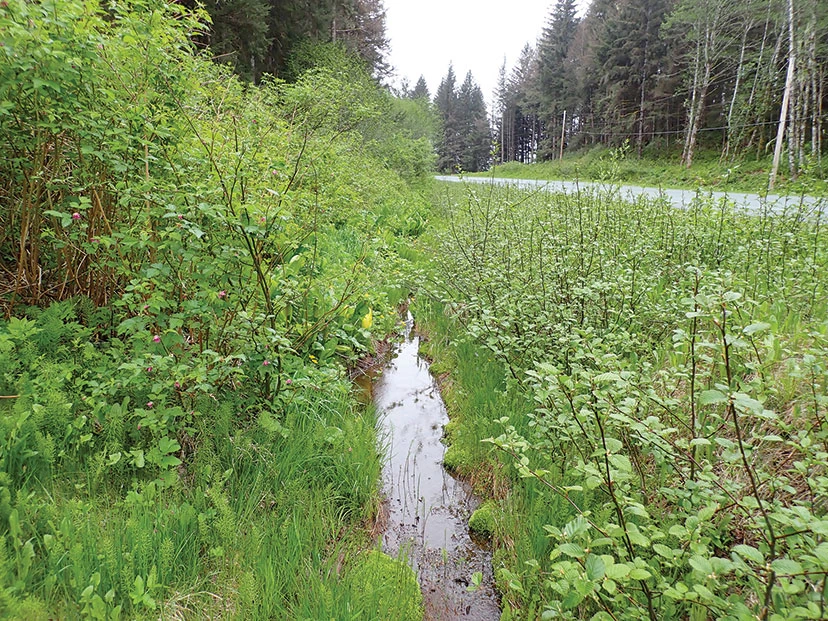
This ditch is home to coho fry. © Mark Hieronymus

Coho fry like this one need their habitat documented so they can receive critical habitat protections. © Mark Hieronymus
Q: Where was the most surprising place you documented habitat?
A: In a roadside relief ditch. Seriously.
I was assisting ADF&G with a steelhead survey on a road-accessible stream in Juneau when I noticed some juvenile fish in what appeared to be a relief ditch. I proceeded to document coho young-of-year (YoY), little fellas around 1.4 inches long in about 660 feet of ditch.
The super-interesting thing about that particular nomination is the flow eventually ends up in a mainstem stream about a half mile away and through two culverts, only one of which is a “fish-pass” culvert. The other is a relief culvert, about a foot in diameter and not really installed to pass aquatic organisms, just excess water. The presence of YoY coho in May means that at least two adult coho made it all the way up to that relief ditch the previous fall and decided that’s where they were gonna spawn. Fish are awesome.
Suffering in the Name of Science
Q: What was your most challenging day in the field?
A: In May 2021, I conducted a pair of steelhead surveys on back-to-back days. I was accompanied by a donor and a “super-volunteer” friend with lots of woods experience. I surveyed two mainland streams in far-less-than-ideal conditions—mid-30s air temps, slushy “rain” coming down by the bucketload, and snowmelt-swollen rivers making upstream travel rather difficult.
Long story short, we were successful in establishing steelhead presence in both streams, but the surveys themselves were physically and mentally challenging. The upstream travel and “fish-detection potential” on the first stream was complicated by a recent windstorm which left timber scattered in the channel for much of the surveyed length, so much so it took us the better part of half an hour to travel 100 yards. Water levels and the addition of many drowning hazards made snorkeling an unwise choice, but we managed to locate four steelhead on that day, including three I photographed by belly-crawling out on a spanning log so I could get close enough for an underwater photo.
The very next day, under similar conditions on a stream in close proximity, we pretty much repeated the grueling march up a brush- and timber-choked stream corridor while gallons of near-freezing water cascaded from the sky. I elected to snorkel this stream as its size was slightly more manageable than the first, but the water temperature was 35.6ºF. Brrr! To make matters worse, I managed to tear not one, but BOTH wrist-seals on my drysuit while navigating logjams early on in the snorkel, so I spent the better part of four hours in an ice-water bath inside my drysuit while getting Maytag’d around in the stream…But in all that excitement, I managed to locate and document two adult steelhead, making that particular exercise in Type II fun a success.
And yeah, even after that experience, I still love it. I’m kinda goofy that way.

Mark isn’t afraid to suffer in the name of science. © Sam Roche
Valleys Worth Fighting For
Q: Is there a specific stream that you’ve documented that means the most to you?
A: There is a mainstem stream and tributary that I have fished and guided anglers on for decades; both lie within an obscenely beautiful valley. I first surveyed the mainstem stream in 2022 and successfully documented adult steelhead use as well as juvenile coho rearing and the presence of anadromous cutthroat.
My next visit to that stream was in 2024 to map out a tributary that, by all metrics, should have been included in the AWC but was somehow overlooked. On that long and productive day, we documented anadromous fish in not only the main tributary, but four other small but productive rearing streams and eight ponds as well. My records show there were over 600 fish either visually observed or captured by fish trap or hand net. The bulk of those were rearing juvenile coho salmon, but I also documented juvenile chum salmon and anadromous cutthroat trout.
So yeah, that tiny little valley holds a special place for me. When we started, the catalog had one stream which measured about three miles long with pink and chum presence, and when we finished the pair of surveys, there were an additional six streams with five miles and eight lakes with 6.25 acres (that’s nearly five full football fields!) of demonstrated anadromous use by pink salmon and chum salmon as well as steelhead, anadromous cutthroat trout, and coho salmon. Not a bad couple of days at the office.
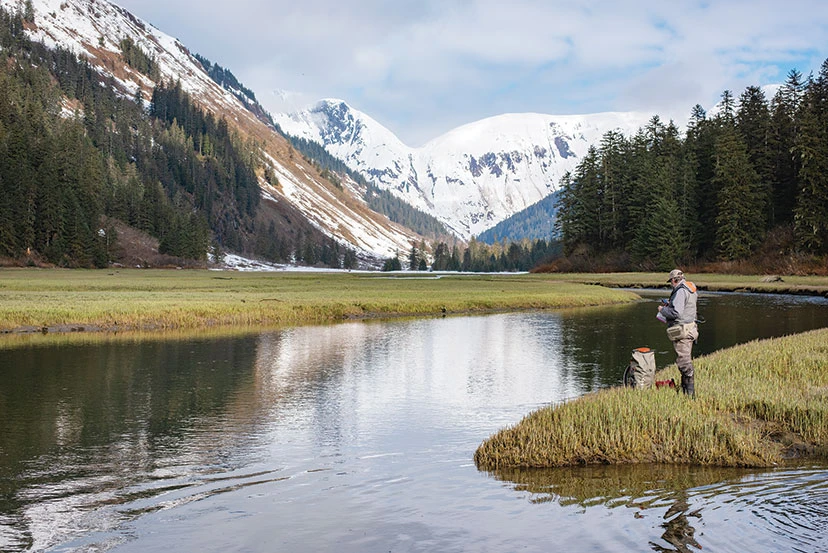
Mark’s favorite valley. © Sam Roche
Increasing Steelhead Streams in Alaska Anadromous Waters Catalog
Q: What is the highest number of steelhead you’ve found in a previously undocumented stream?
A: With the help of a friend with a jetboat, we made an overnight excursion to a remote stream in which I had previously caught steelhead, but knew they weren’t listed in the AWC. The stream is typically difficult to access during May, as the lake where one would normally land a floatplane usually doesn’t ice out until June, but the jetboat worked like a charm to get us to the mouth of the stream. From there we were able to hike about two miles of water, in which we observed over 20 steelhead.
To be clear, every place where the Alaska Fish Habitat Mapping Project has documented steelhead has been previously listed in the AWC; they were just absent from the official species assemblage. As steelhead (and cutthroat, the other true Pacific trout) spawning, rearing, and migration timing is very different from the rest of the Pacific salmon species, this omission leads to gaps in habitat conservation measures—not only does the stream need to be listed in the AWC, but the species does as well.
What’s at Stake If We Don’t Map What We Don’t Know
Q: Why is documented fish habitat so important to the Tongass and to Alaska?
A: The Anadromous Waters Catalog specifies which water bodies are important to anadromous fish species and therefore afforded habitat protections under Alaska state law; water bodies that are not listed in the AWC are not afforded that protection.
The AWC currently lists about 20,000 streams, rivers, and lakes around the state which have been specified as being important for anadromous fish. However, based upon thorough surveys of a few drainages, it is believed that this number represents a fraction of the waters used by anadromous species. In addition to gaps in actual habitat listing, many of the water bodies currently listed in the AWC have incomplete species assemblages meaning not all the species that use the habitat have been documented. Until these habitats are inventoried and assemblages fully accounted for, they are not afforded protection under State of Alaska law.
To put a nice tidy bow on it, these are the three big takeaways about the AWC:
No Listing = No protection. Fish habitat in undocumented water bodies is not afforded protection under state law.
Less than 50% of the freshwater anadromous habitat in Alaska is currently listed in the AWC.
And the more we know about fish distributions, the better informed we are when it comes to planning and decision-making.
For more info on the AWC, including an interactive map of all currently listed waters, visit adfg.alaska.gov.
Trout Unlimited’s mission is to protect, reconnect, and restore North America’s cold-water fisheries and their watersheds. Learn about our work in Alaska at prioritywaters.tu.org/alaska. Marian Giannulis is the Alaska Communications & Engagement Director for Trout Unlimited.
For more conservation reading, check out Fish Alaska’s Conservation Blog for more.