

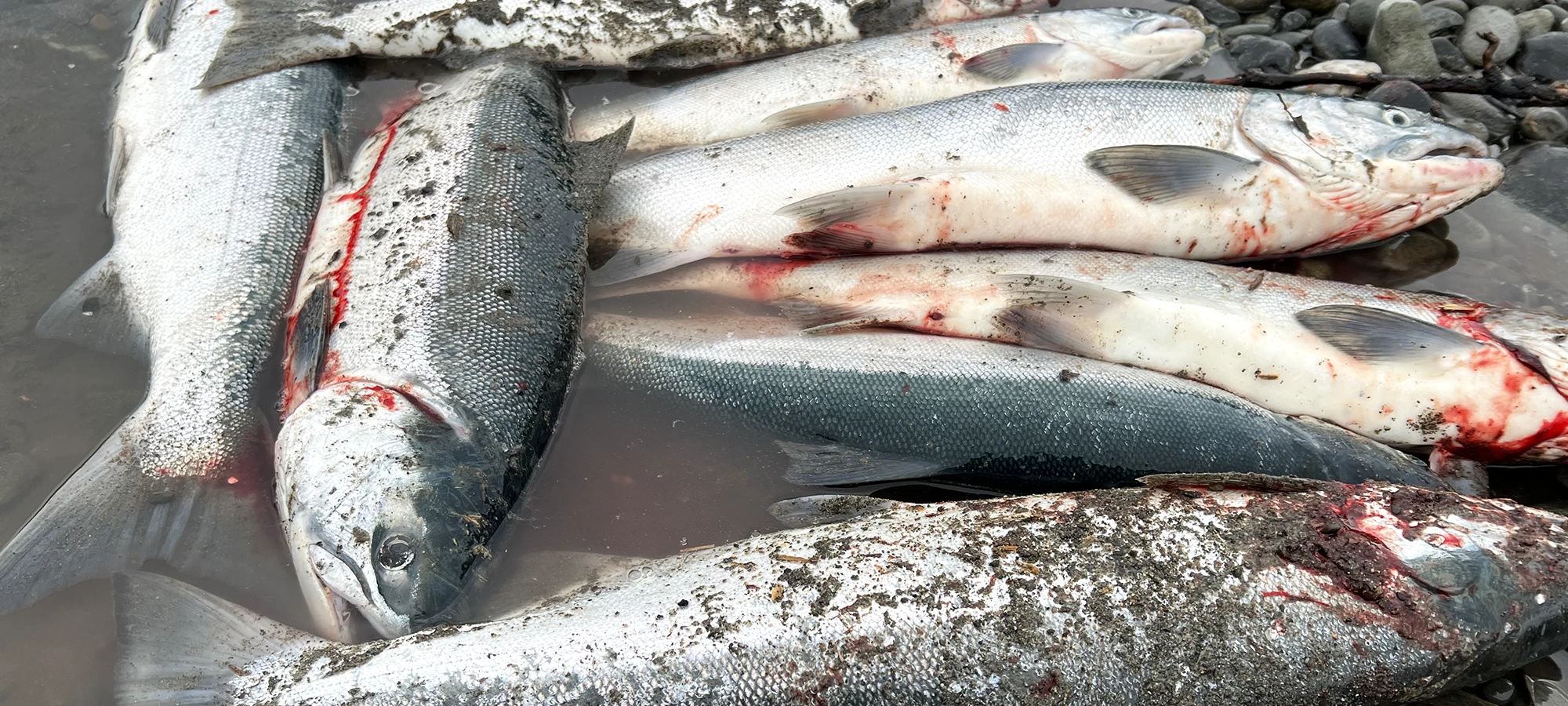
Kenai salmon management has long revolved around the fear of over-escapement, a concept suggesting too many returning fish can harm future runs. Yet decades of data from the Kenai River tell a different story.
Story by George Krumm
For many years—really, since the early 1990s, many people have thought the dreaded “over-escapement” as it pertains to Kenai sockeyes, was not valid. I am one of those melodramatic fools. Today, I believe it more than ever. I think it is simply not valid for the Kenai watershed’s sockeye population. The Alaska Department of Fish and Game (ADF&G) on the other hand, has always used the fear of over-escapement as rationale to fish on large sockeye runs (regardless of what might happen to the rare, far fewer, Chinook salmon, and coho and chum salmon bound for northern Cook Inlet rivers). ADF&G is mandated to manage sockeye salmon (and other species) for Maximum Sustained Yield (MSY), and they have claimed for decades that over-escapement of sockeyes results in poorer returns in future years. Intentionally or unintentionally, they have been lying to us.
That’s a bold statement but let me back it up. Between 2000 and 2025, Kenai late-run sockeyes have over-escaped 14 of those years: ’03 through ’06; ’12, ’14, ’15, and every year from 2019 through 2025. The river keeps over-escaping, but the runs don’t crash or falter. In fact, for all these years of over-escaping, the Kenai late-run sockeye have never failed to replace themselves. This year’s massive return is primarily the result of broods from 2019, 2020, and 2021. All three of those years over-escaped, yet those years produced this year’s huge return—one of the largest ever. Yes, over-escapement, at least for Kenai late-run sockeyes, seems to be a big fat lie we’ve been fed for decades.
A Convenient Construct for Harvest Justification
Over-escapement is a construct. No doubt, when the commercial fishermen first heard of it, they probably jumped for joy because they knew they’d get wide-open fishing if fish managers feared the dreaded sockeye over-escapement might happen. Over-escapement has always been used as justification to keep fishing for sockeyes, start fishing for sockeyes, or fish more to harvest all those sockeyes. ADF&G did this to manage in accordance with the MSY (which is mandated in the Alaska Administrative Code). The concept of over-escapement is tied to MSY. As such, MSY should be called into question, too. It ain’t working, at least not for some of our species. But MSY is a topic for another day.
ADF&G’s management of the Kenai has always been very sockeye-centric. But what about the other species? Look at the entire Cook Inlet Chinook salmon situation. ADF&G is supposed to manage for MSY, but there is currently ZERO yield for Chinook for any wild population in Cook Inlet. Total failure. The same can be said for the languishing Chinook runs in other parts of the state. Perhaps all this focus on Kenai River sockeye over-escapement (and sockeye over-escapement in other rivers like the Nushagak, etc.) is misguided. We have a massive under-escapement Chinook problem that desperately needs fixing.
Why Over-Escapement Doesn’t Hold Water
What defines sockeye over-escapement on the Kenai? The in-river goal for Kenai late-run sockeyes is 1,100,000 to 1,400,000 sockeyes. More than this is considered over-escapement. So, why does the over-escapement construct not work for the Kenai, or probably any other large river with multiple species?
The concept is too simple, and the Kenai watershed is too complex and dynamic, and the volume of water probably prevents some of the problems over-escapement proponents expected. The ocean, too, is complex and dynamic and contributes to the return. Over-escapement might work in a lab where you have rather static, limited, and predictable conditions. But the Kenai watershed is not like that. As a result, the over-escapement model has been wrong over and over again. There are other things happening that cause the over-escapement model to not work.

Photo from ADF&G’s website
This year’s massive over-escapement (it will probably wind up at over 4 million in-river late-run sockeyes) came primarily from the spawners in 2019, 2020, and 2021. All three of those years over-escaped, too. The red and purple lines represent the boundaries of the in-river goal. If the concept of over-escapement was valid, then we should be getting a weak sockeye run this year, not the biggest return most of us have ever seen.
I have heard that Kenai Lake and Skilak Lake are a little warmer, and a little clearer, than they once were. This bodes well for plankton, upon which juvenile sockeye feed. If plankton populations increase, sockeye survival to smolthood increases. It is likely the carrying capacity of the system has been slowly increasing. What’s more, the original baseline for what biologists thought was the Kenai’s carrying capacity for sockeyes was probably inaccurate to begin with. If it was accurate, and if the concept of over-escapement was valid, then we should have seen some population decreases because of all the over-escapement we’ve seen through the decades. But we haven’t.
The Evidence Keeps Piling Up
This year will be the acid test regarding over-escapement. As of today, August 6th, 2025, the in-river return so far is 3,670,633 late-run sockeyes—a tremendous over-escapement. With seven consecutive years of over-escapement, topped by this year’s massive over-escapement, if we don’t see a big decline in sockeye returns in the coming years, it will be irrefutable that over-escapement, as it pertains to the Kenai watershed, is nothing more than an invalid construct. This year’s massive over-escapement is probably the final nail in the coffin if future returns continue to be robust.
Many people have believed for a very long time that over-escapement is a construct, and a lie, and that it is not valid for the Kenai watershed’s sockeye population. It seems it is time the fear of sockeye over-escapement, and use of the concept, should be abandoned. Perhaps ADF&G fish managers should instead focus their attention, time, and resources on stocks that really need help. Chinook throughout Cook Inlet, which currently have a yield of ZERO, come to mind. Perhaps ADF&G should use the MSY framework to prioritize managing for the most constrained stocks…Chinook! The State Fish! Regardless of what direction ADF&G takes, one thing is certain: If this year’s gigantic over-escapement of sockeyes effectively replaces itself, then it will be impossible to argue that the construct of over-escapement is valid as far as the Kenai watershed is concerned.
For more insight into Kenai salmon management and other fisheries conservation efforts around the state, check out Fish Alaska’s Conservation Blog for additional reading.

George Krumm
About the Author George Krumm
George Krumm is the Editor of both Fish Alaska and Hunt Alaska magazines. He is also a freelance writer/photographer. George has fished and hunted from Patagonia to Alaska and has been writing professionally since 2003. George writes several feature articles per year for various publications, plus he writes the “Editor’s Creel” and “Flyfishing” columns for Fish Alaska magazine, and he wrote the “Stillwater” (flyfishing) column in Fish Alaska for more than nine years. His specialties include single- and two-handed flyfishing, fly tying, and conventional gear fishing for everything from trout to salmon to halibut to white sturgeon. George lived in Alaska for 20 years and now makes his home in the Pacific Northwest.