

Plants for Salmon events are bringing Alaskans together in a big way, with volunteers from Talkeetna to Hope rolling up their sleeves to replant native vegetation along some of the state’s most beloved waterways. These community-driven restoration projects are making a real difference for the fish we all love.
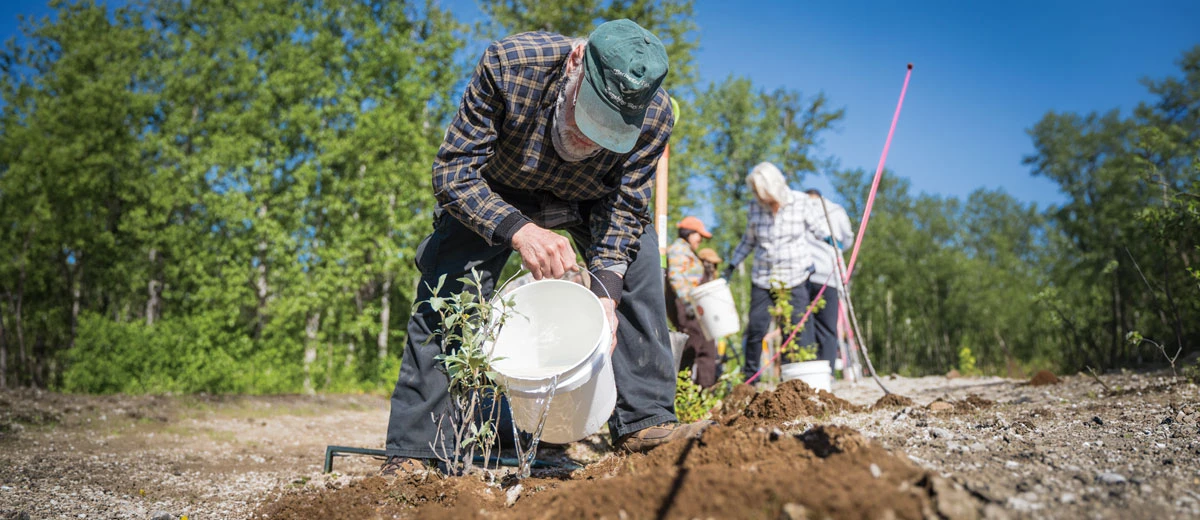
A volunteer waters a newly planted shrub on Montana Creek in 2025. © Jeff Fisher, Alaska Department of Environmental Conservation
Written by Chennery Fife
Communities Coming Together to Care for Fish Habitat
Salmon have a special way of bringing Alaskans together. When they’re running, friends gather together to share a boat or stretch of riverbank. Fresh fillets gifted to family, friends, and neighbors strengthen social connections. Eighty percent of Alaskans get out to fish annually. A love for salmon is something almost all of us can agree on.
Over the past several years, salmon have brought people together in a different way. Volunteer-supported restoration projects in Talkeetna, Soldotna, and Hope brought together diverse groups of salmon lovers to fix degraded habitat, benefitting the fish we all love and building community along the way.
These “Plants for Salmon” events restored habitat on very different streams, from the smaller Montana and Resurrection creeks to the major river system and most popular Alaskan sportfishing destination, the Kenai River, but each one had a very similar feel.
Each event had dozens of Alaskans excitedly planting and watering native vegetation. Hungry volunteers shared meals and fishing stories. Kids crafted salmon hats, tried their hands at flycasting, and learned about healthy fish habitat. “Plants for Salmon” are powerful acts of community where volunteers get their hands dirty and make hands-on contributions to help their local waters and fisheries.
My husband and I participated in the Montana Creek planting day because we wanted to “walk the talk,” so to speak. The actual physical work to improve fisheries and stream-bank habitats was very satisfying. The program was set up in a thorough way for volunteers to easily participate. Here’s to more such work!
Becky Long, Talkeetna community member
Montana Creek
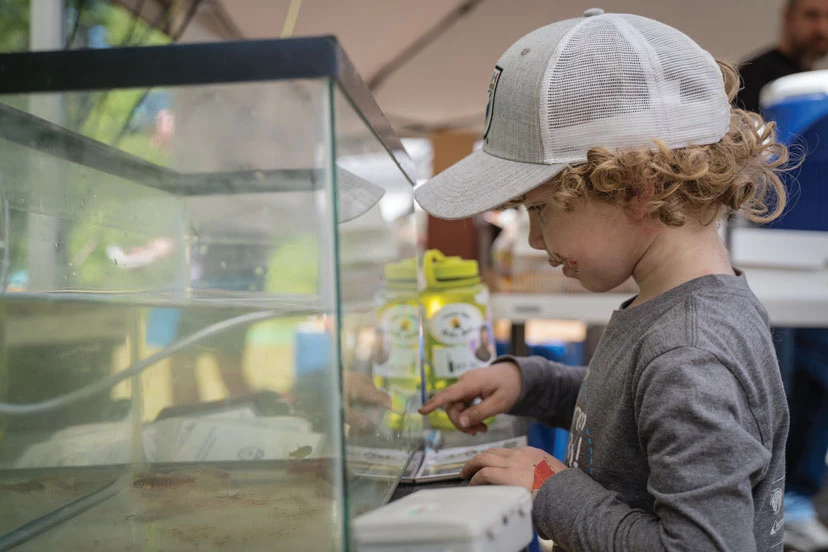
The US Fish and Wildlife Service and the Alaska Department of Fish & Game had Montana Creek juvenile fish on display for kids to see at the 4th Annual Mat-Su Plants for Salmon in Talkeetna in 2025. © Jeff Fisher, Alaska Department of Environmental Conservation
Montana Creek near Talkeetna is a clear-water tributary of the Susitna River and a popular destination for anglers. In 2012, following a major flooding event, the Mat-Su Borough applied stone riprap armor on the streambank near Yoder Road to protect downstream infrastructure. This new rocky shoreline is not ideal habitat for fish. In 2023, several partners joined forces for a multi-year effort to improve fish habitat in the area. After contractors laid topsoil and hydroseeded the area, the community came together for three annual planting events. From 2023-2025, these events brought over 150 volunteers who planted over 400 native trees and shrubs on 450 feet of shoreline.
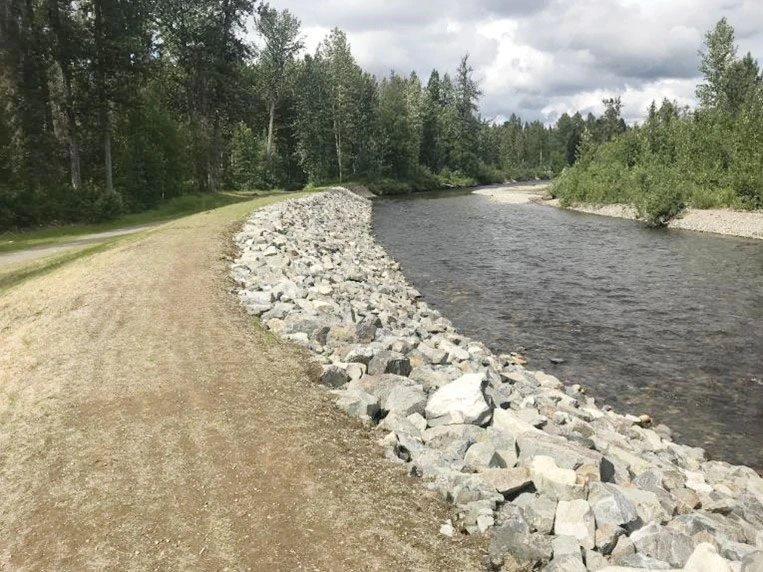
The bare riprap along Montana Creek before the first planting day in 2023. © Jessica Speed, Mat-Su Salmon Habitat Partnership
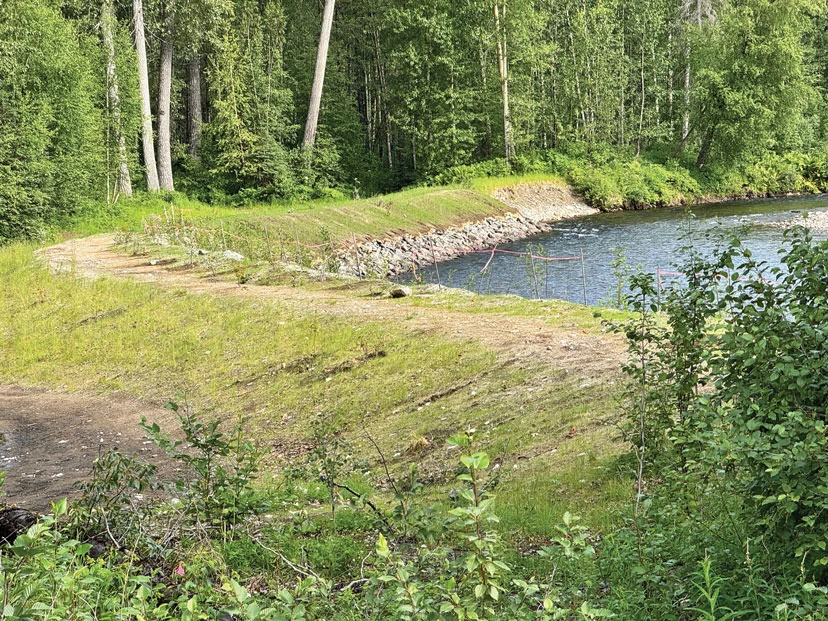
After three successful planting days over three years, the shoreline along Montana Creek is vegetated with grass, trees, and shrubs. © Mike Campfield, Mat-Su Borough
“MontanaCreek is a heavily used, well-loved place which is exactly why this project mattered. It was exciting to see people of all ages working together and to watch partners bring such different perspectives to the day, from sharing stories about Indigenous history, to helping kids identify juvenile salmon. For the Susitna River Coalition, this is what place-based advocacy looks like: local people taking action in places they know and care about, and those efforts adding up to meaningful, lasting change. It’s work we’ll carry forward each time we return to Montana Creek, whether for stewardship or for time on the water during fishing season.”
Margaret Stern, Susitna River Coalition program and communications director
Kenai River
Soldotna’s Centennial Park is usually packed with anglers looking to fill their freezers during the sockeye- and coho runs. High angler traffic killed many of the streamside plants and eroded the stream bank along this popular section of the Kenai River. In June 2024, 50 community members gathered in Centennial Park and planted 175 native shrubs, trees, and flowers on 124 feet of damaged riverbank.
“Being part of the Soldotna planting day was one of the highlights of my season and truly one of the best community events I have been a part of in my almost 10 years on the Kenai Peninsula. Watching all demographics of the community, young and old, fishing and non-fishing, come together to revamp a struggling piece of land was amazing. All the smiling faces of a community joined together, working hard, sharing shovels, wheelbarrows, fish stories, and enjoying a great burger in the meantime was something I won’t soon forget.”
Jack Mister, Sterling resident and owner of Mister Kenai Sportfishing
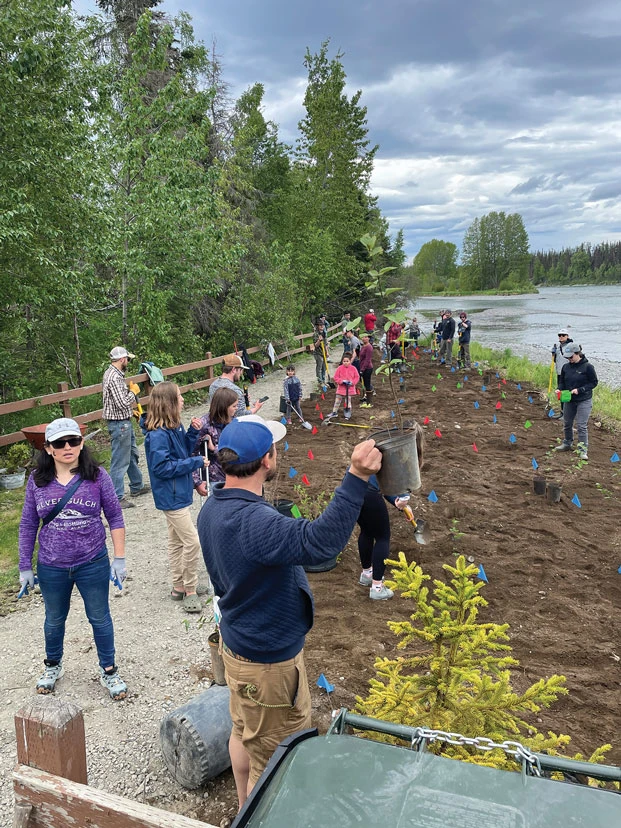
Many volunteers make light work at the Kenai “Plants for Salmon” in 2024. © Trout Unlimited
Resurrection Creek
Resurrection Creek in Hope was the site of one of Alaska’s first gold rushes more than a century ago. The mining methods of the day removed the soil and significantly altered the stream channels and wetlands of Resurrection Creek. Now, many partners are executing a major restoration project to restore over 2.2 miles of creek and 74 acres of streamside habitat. Heavy equipment is used to bring back the natural curves and bends to the stream. Tons of topsoil were trucked to support revegetation efforts. In June 2025, 60 volunteers planted over 700 native shrubs, grasses, and wetland sedges along 500 feet of Resurrection Creek’s shoreline.
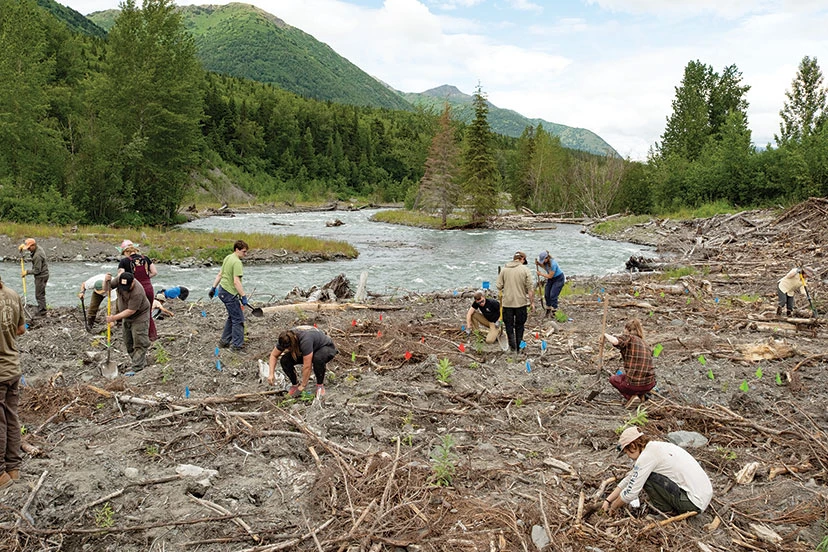
Volunteers planting native vegetation along a new bend in Resurrection Creek in Hope in 2025. © US Forest Service
Why Plants Matter
Riparian areas are the lands along the edges of water bodies. Healthy riparian areas full of native vegetation help fish thrive in many ways. Shade from native plants provides habitat for fish to hide from predators and keeps the water temperature cooler, which is important for cold-water species like salmon and trout.
These plants provide nutrients and organic matter that support the insects which are vital food sources for fish. Roots of trees and shrubs hold soil together and help prevent erosion during floods, reducing the amount of sediment entering the water. Well-vegetated riparian areas serve as natural filters that reduce pollutants like fertilizers, heavy metals, and pesticides from entering the water.
Vegetation creates a rough surface that slows water during flooding, which reduces potential damage to structures downstream. Healthy riparian areas are essential habitats that fish need to thrive. These community-driven restoration projects improve habitat for the benefit of water, fish, and people.
“When people of every background unite for the sake of the natural world, conservation becomes a force of hope—proof that our shared love for the cold, clean water is stronger than anything that divides us.”
Jason Amaro, Trout Unlimited Southcentral Alaska Chapter membership coordinator
Partners Make It Possible
The success of each of these events is due to the dedication of the many volunteers and partner organizations who came together to make them happen.
The Montana Creek “Plants for Salmon” was made possible by the following partners: Susitna River Coalition, US Fish and Wildlife Service, Mat-Su Basin Salmon Habitat Partnership, Knik Tribe, Mat-Su Borough, Trout Unlimited, Alaska Department of Fish & Game, NOAA Fisheries, Mat-Su Health Foundation, Jessica Stevens Community Foundation, and Trout Unlimited Southcentral Chapter.
The Kenai River “Plants for Salmon” was made possible by the following partners: Trout Unlimited, NOAA Fisheries, City of Soldotna, Alaska Department of Fish & Game, US Fish and Wildlife Service, Kenai Watershed Forum, Kenai Peninsula Stream Watch, Cook Inletkeeper, Trout Unlimited Kenai Peninsula Chapter, Kenai Peninsula Fish Habitat Partnership, and Kenai Soil and Water Conservation District.
The Resurrection Creek “Plants for Salmon” was made possible by the following partners: Trout Unlimited, the U.S. Forest Service, the National Forest Foundation, NOAA Fisheries, Kinross Alaska, the Student Conservation Association, and Allen Family Philanthropies.
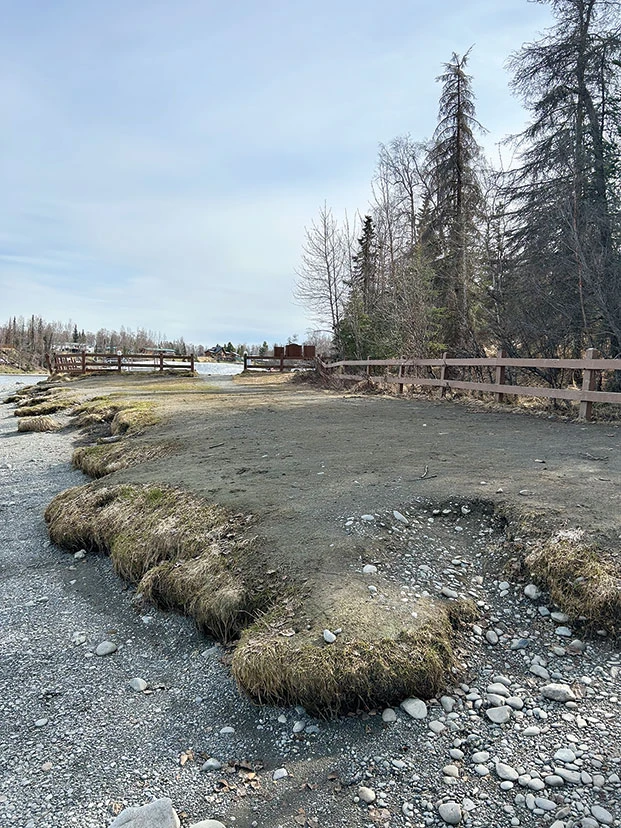
Angler traffic had been eroding this site in Centennial Park in Soldotna for many years. © Trout Unlimited
“The success of these events wasn’t just in the work done, but in the spirit of the people doing it. It was incredibly impressive to see community members of all ages—from children to elders—so eager to roll up their sleeves and do something tangible for a place they love. It’s one thing to care for a place, but it’s another to steward it with the real dedication and collaboration I saw between our diverse partners and community. It’s a powerful reminder that while we can do good work alone, we can only achieve real scale together.”
Jessica Speed, Mat-Su Salmon Habitat partnership coordinator
Trout Unlimited’s mission is to protect, reconnect, and restore North America’s cold-water fisheries and their watersheds. Learn about our work in Alaska at prioritywaters.tu.org/alaska.
For more conservation reading, check out Fish Alaska’s Conservation Blog for more.