Tullis Wiggle Bug: The Fly That Swims

Tying Instructions

By Larry Tullis – Wiggle Bug originator

Note: The Tullis Wiggle Bug is a style of tying rather than a specific pattern and there are hundreds of variations possible. This basic version is relatively easy to tie but it is difficult for many to get the proportions and balance right. It may take practice to get it swim in a serpentine motion at fast and slow speeds. [emember_protected custom_msg=’This content is available for subscribers only.’]

Foam Body Preparation

Buy pre-cut bodies or cut rectangular foam strips approximately 7/8 times the hook’s gape width, 1/3 times the hook’s gape thickness and 1.5 times the hook-shank’s length. The underside of the diving lip should be tapered with a razorblade or sandpaper. Craft foam sheets can be used for smaller flies but stouter EVA foam cut from popper blocks is better for medium and large flies. Use a metal straight edge and razor knife to cut slabs and strips. The strips can be straight or wider at the front and narrower at the rear.

Materials

Hook: Long shank, straight-eye streamer/nymph hook.

Over-body: EVA foam rectangle strip.

Thread: heavy (140 denier or larger).

Body: Chenille (regular, metallic or pearlescent).

Hackle: Optional-saddle hackle.

Adhesive: Zap-A-Gap.

Tail: Marabou or alternative, w/flash.

Eyes: Paint or glue-on.

Tullis_Wiggle_Bug_3_thumb.jpg

Tying Instructions

1. Secure the hook in the vise. Attach heavy thread at hook-eye and cover hook-shank. Wind thread back to the hook-eye. Unlike other flies, we tie the Wiggle Bug body backwards, from eye to hook bend. Tie-in chenille and optional saddle hackle at the hook eye, leaving a 1/8-inch pad of thread behind the hook-eye for the foam to be glued to.

2. Wrap chenille backwards to the hook bend, over the thread underbody. Secure chenille at rear of hook-shank. Palmer optional hackle backwards to same point and secure it well. Leave thread at rear of hook-shank. This 1/8-inch pad of thread will be the securing point for the foam back.

3. Measure the gape of the hook with a thick needle or a skinny nail. Add 1/16-inch to that measurement and puncture the foam lip that distance from the lip, not straight in, but backward at a 45-degree angle. This is the hole that the hook-eye will go through. Make sure the hole is centered, with even amounts of foam on either side of the needle.

4. Add a drop of Zap-A-Gap to the thread pads on both ends of the body. Quickly push the hole in the foam body onto the hook eye until the eye just protrudes from the foam. Make small adjustments to insure the hook eye is centered in the foam body before the glue has a chance to set up. Then bend down the back of the foam body, center it and secure it over the rear thread wraps with multiple wraps of the strong thread. Trim back the extra foam sticking out, leaving ¼-inch or less extending back. Press the “V” of your scissors on top of the foam tag and snip out a divot or channel for the tail material to nest into to avoid the tail fouling often while fishing. Tie-in the marabou or other tail material out the back and add some flash on top of that, both about a shank-length long. Avoid a real long or heavy tail, which impedes the wiggling action. Whip finish by hand at the rear of the hook-shank, snip thread off and add a drop of head cement to the wraps. Add paint-on or glue-on eyes and other markings if desired.Tullis_Wiggle_Bug_2_thumb.jpg

5. Balancing the fly: You are not done yet! Take the hook out of the vise and check again that the foam body is centered where the hook-eye protrudes and that the lip and back are not twisted to one side or another. Everything must be balanced and lined up with the book bend, which acts as a keel for the fly.

Check the balance of the fly by tying on a piece of monofilament to the hook eye using a loop knot. Always use a loop knot. Pull the fly through some water slowly and briskly. The fly should dive and wiggle back and forth in a distinct swimming motion at both speeds.

If it tends to spin up to one side, it means that it needs more foam on that side of the hook eye. Hook a pointer fingernail on the hook eye and push the foam that direction with your thumb. The foam is slightly moldable and this should balance out the fly. If not, repeat the last step or check for other unbalanced features. If it wiggles too much for your taste, trim a small strip off the very tip of the lip, to shorten it.

The Wiggle Bug will get out of balance periodically because of fish chewing it up and from improper fly storage so learning how to balance the fly is important whether you tie the flies yourself or get them from another source.

Please contact me, Larry Tullis, if you need a source for finished flies or Wiggle Bug bodies, E-mail me at flyfishxprt@aol.com .

Variations:

-Glue a weed-guard into the foam lip

-Rib body with wire or monofilament

-Add adhesive flash to sides

-Body markings with paint or felt pens

-Thread rubber-legs through body

-Add weight to underside of hook near eye

-Drill hole in body for glass rattles

-Stainless hook for saltwater

-Articulated versions

-Use flashy dubbing or Mylar tubing for body

-Vary size from under 1-inch to snake length

-Shallow swimmer or deep diver

-Round, tapered, square or rectangle bodies

-Imitate: minnows, leeches, fry, sculpin, lamprey, crayfish, shrimp, crab, damselfly nymph, salamander, snake etc.

 Tullis_Wiggle_Bug_5.jpg

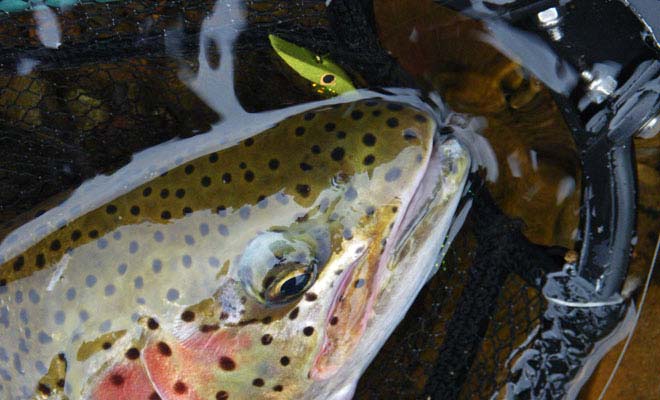
Click on thumbnails below to see some of the fish caught with the incredible, edible Wiggle Bug. [/emember_protected] [emember_protected scope=”not_logged_in_users_only”]

[/emember_protected] [emember_protected scope=”not_logged_in_users_only”]
[wp_eMember_login]
[/emember_protected]