


A fish finder is an instrument used to locate fish underwater by detecting reflected pulses of sound energy. Today’s standards use a graphical display to locate schools of fish, temperature, debris and the bottom of a body of water, which can be integrated between a marine radar, compass and navigation systems. They are used in rivers, lakes and the ocean by anglers and commercial fisherman alike. You can get them with a high-resolution display or GPS and the list goes on, but its main function is to be a tool in finding fish. Anglers, however, can still misinterpret what a fish-finder is used for and how versatile it can be.
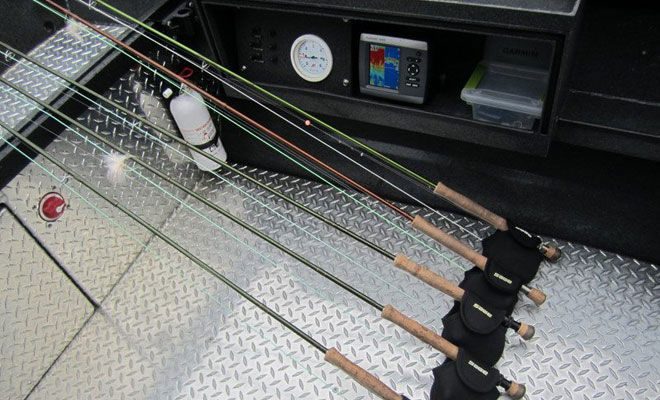
Story & Photo by Nigel Fox
[emember_protected custom_msg=’This content is available for subscribers only.’]
The Furuno brothers from Japan developed the fish-finder in 1948; it was created because an experienced Japanese fisherman told the brothers he knew how to find the fish and the quantity from the air bubbles. The sound waves reflect when it hits against a bubble. After the talk, the Furuno brothers were inspired to create a machine that would detect the air bubbles in order to find the fish. That was a primitive piece of equipment compared to the technology we have nowadays.
Since most of my time is spent on the Kenai River fishing for trout, I use a fish-finder as an essential piece of equipment on a daily basis. Sure, you need to know how to rig, what gear (rods and reels) to use and the proper technique to use for whatever species you are targeting, but anything you can utilize is an advantage, especially when it is your job to catch fish.
For instance, if I am targeting trout for the day Iwould use my fish-finder for temperature, depth and structure. Temperature is essential when fishing for trout; they are very picky eaters when it is too cold or warm. The most ideal temperature for actively feeding trout on average is around 50 degrees, but that can change if the temps are consistently cold or warm and that is why I like having that feature on my fish-finder.
Depending on the weather, the depth of the river can change; it can quickly go up or down. Knowing depth helps you determine how shallow or deep to fish, as if you are not down where the fish are you can’t catch them.
Structure has a different meaning to me on the Kenai River. When I am looking at bottom structure I look for holding salmon or areas where salmon would spawn. If I can find that I generally can find the trout and lots of them. This is just one method or use that can be applied with a fish-finder.
On the other hand, there are many other guides and private anglers on the water that don’t have fish-finders. Many of them are still catching fish and frankly, they can be as successful as myself and many other guides that use fish-finders.
There are days when the fishing is tough and I wonder what could be wrong? Then I take a look at my fish-finder and I notice the temperature is too cold or too warm or the depth has changed; automatically I think that is the reason why fishing is slow. Sometimes anglers can’t accept the simple fact that fishing is slow. Maybe what was working yesterday is not working today and sometimes the fish-finder gives us an answer.
Fish-finders are an incredible piece of equipment for angling and should be used as one of your many tools to be successful on the water. But don’t make it a crutch for you when the fishing isn’t good. Knowledge is your ally when fishing, and that is what a fish-finder does: it gives you knowledge so you can apply it to catching fish.
Once you know where the fish are, all you have to do is use the best method to fish them. Just remember to always go in prepared so you can be successful.
Nigel Fox has been partners with Jeremy Anderson and Nick Ohlrich at Alaska Drift Away Fishing (www.guidekenairiver.com) for more than 12 years. He is a lifelong Alaskan and has been fishing on the Kenai River since he was a young boy. Fifteen years have passed since his first guided trip, and each year he learns more about the intricate world of catching trophy fish on the Kenai and Kasilof rivers.
[/emember_protected] [emember_protected scope=”not_logged_in_users_only”]
- Need to subscribe? Now’s a good time! Check out our current subscription specials!
- Already a subscriber? Login below to access all of our online articles and content!