


Article and photos by Paul D. Atkins
As during so many springs in the past, I fueled and oiled my snowmachine the night before. My wooden sled, made by one of my Native friends many years ago, was hitched to the J-hook and looked as if we were going hunting instead of fishing.
The blue plastic tub that was bungeed to the sled waspacked with all the necessities for the day, our niksiks (fishing jigs), line, lures, pliers, extra gloves, fillet knives and the all-important thermos of coffee. I also had my auger with the big 10-inch blade, a tonk (ice breaker), a plastic bucket and a dipper that also doubles as a spaghetti strainer.
As we made our way across the sound the snow shimmered along the well-beaten trail towards the mouth of the river. The Baird Mountains, beautiful as ever in the clear Arctic air, lay visible in the distance, serving as our signpost in anticipation of what lay under the pack ice. It was going to be a great day, especially for catching sheefish. [emember_protected custom_msg=’This content is available for subscribers only.’]
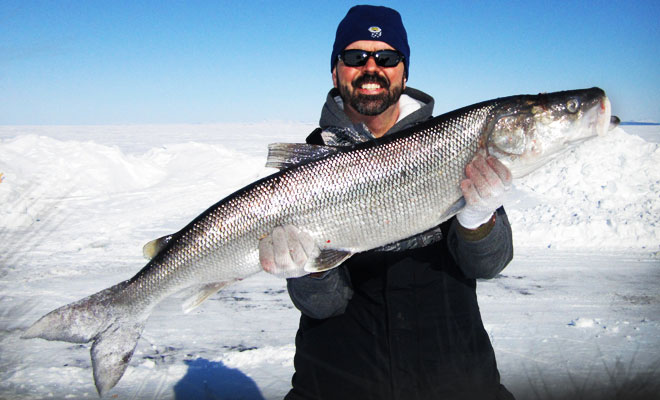
Sheefish, or inconnu, sometimes called the “tarpon of the north,” can be found only in the Arctic and subarctic areas of Alaska. They are silver in color with a darker bluish sheen along the top of their back. They remind me of the big stripers we would catch back in Oklahoma and Arkansas. Here in the northwest Arctic they are most commonly found in the Selawik and Kobuk river drainages of Kotzebue Sound. These fish can get big, weighing up to 60 pounds, and are commonly found in the deep, cold water where the current is the swiftest. Their tremendous size and eating qualities make them one of the most unique freshwater fish in North America.
When it comes to ice fishing for these monsters it’s a pretty simple process. You first must find where the current is leaving one of the river channels and cut your holes. Unless you are lucky enough to find a hole that has already been cut/fished, this will be the toughest part. The ice gets pretty thick during the winter months in and around the Kotzebue Sound, as much as 10 feet in some places, but usually between six and eight. Most people will usually start in one place, cut holes, fish it and then move to another. It has been my experience that sheefish will move after a few days and it is usually
closer to town.
For digging holes you will need to have an ice auger. For many years I used a handheld auger, and if it wasn’t for the promise of catching a big fish that would provide a great meal, I would have chosen to do something else. It was hard work, and getting through 8- to 10 feet of ice was a backbreaking affair. Gas-operated augers, such as those made by the Eskimo brand, make drilling through ice a piece of cake and can have you fishing in a matter of minutes. Most augers come with extensions for the really thick stuff and can cut either 8- or 10-inch diameter holes. I prefer the 10-inch model, which will allow a little more room for the big boys that don’t watch their waistline. I’ve actually hooked fish that would not come through the hole. The only solution was to wait and let them breathe and when they do pull a little at a time. Eventually, but not always, they’ll pull through. In other words, a bigger hole allows for a bigger fish.
Niksiks (Inuit word for fishing jig) are simple tools, most commonly made out of willow branches with a slight half-moon shape. I’ve also seen them made out of caribou horn, moose rib and some as simple as a small board with a hole drilled through the end. The line is attached to one end with a strong knot. The line needs to be tough. I use Dacron string that is braided and comes in 50-pound test. Simple fishing line can also be used, but I don’t recommend it. Nothing is worse than getting a big boy to the top of the hole only to have him break the line and slide away. The amount of line needed depends on the depth you will be fishing. I usually attach 20- to 22 feet, but I don’t fish more than 15 feet, depending on water depth. The area in and near Kotzebue Sound is quite shallow in places and the amount of line you use will vary. My technique is to let the line out until it hits the ocean floor and then come up 3- to 4 feet from the bottom. Sheefish like to hold in the deep part of the water where the current will carry your lure.
Many lures can be used to catch these whitefish. Some people use imitation lures and others use live bait. Sheefish are said to eat about anything and can open their mouths to the same diameter as their body. Personally, I prefer to use a big, heavy spoon, either silver or gold in color. Sheefish are attracted to bright objects and the bigger the spoon the better. A heavy spoon will also stay deeper and ride the current a lot better.
Sheefishing through the ice is as simple as it gets. You simply auger out your hole, dip out the excess ice and then drop your lure in. A simple jerk with an up and down motion is all it takes. These fish will hit instantly, the line will get tight and you’re set. You pull the line up expecting a fight of lifetime, but not so much (meaning the “tarpon of the north” moniker has more to do with the look of the fish than it does to the quality of combat). With a little muscle they will come up and out of the salty slush with ease. It’s actually an amazing thing to see a fish three feet-long lying there on
the ice.
Here in the Arctic, April and May are special times of the year. The days get longer and the deep, dark cold of January and February are becoming a distant memory. Hunting is good, with the bears leaving their dens, plus the snowshoe hare and ptarmigan are also plentiful. However if you want to try something unique, something different, where you can truly catch a monster, then head north to the pack ice in search of sheefish.
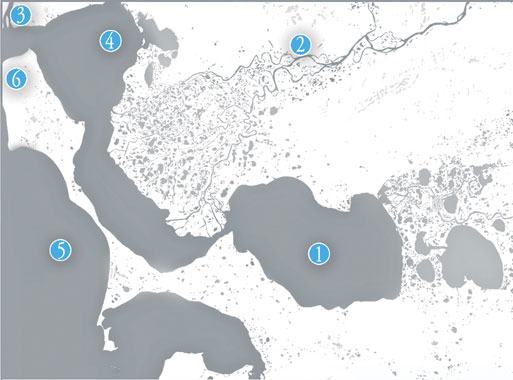
Map of the Far North of Alaska
1. Selawik Lake
2. Kobuk River
3. Noatak River
4. Hottham Inlet
5. Kotzebue Sound
6. Kotzebue
Here in the Arctic ice fishing is very popular for both the subsistence user and sport fishermen alike. Hooking a big sheefish and bringing it through the hole will provide about as much excitement as that offered by any ice-fishing destination on earth. However, opportunity is limited to a few places, but the areas available are vast. Selawik Lake is a prime location. The lake is huge and measures close to 31 miles long, with a little over 400 square miles of area to choose from. The Kobuk River drainages, which run several hundred miles to the east, also provide some great fishing along their narrow channels and deep-water runs. The Noatak River, running north, is another popular spot and provides some excellent fishing, especially at the mouth of the river. All these areas lead into Hotham Inlet and eventually into Kotzebue Sound, where fish, at a times, can be found close to town. Wherever you decide to drill, if they’re hitting the spoon, the fishing will be good. If not grab your auger and move to a different area. If you do plan to come you need to arrive sometime in late April to early May. Your point of destination will be the village of Kotzebue. Alaska Airlines has three flights arriving each day and the Nullagvik Hotel can provide all the comforts of home. Most people that ice fish use snowmachines to get from point A to point B. Sleds are also used to haul gear, augers and any of these big fish that you happen to land. Sheefish are the major species for both sport fisherman and subsistence users. However, in these waters you can also catch the occasional burbot and small flounder.
###
While this is his first story for Fish Alaska, Paul D. Atkins is a regular contributor to Hunt Alaska magazine. He lives and writes from his home in Kotzebue. [/emember_protected] [emember_protected scope=”not_logged_in_users_only”]
- Need to subscribe? Now’s a good time! Check out our current subscription specials!
- Already a subscriber? Login below to access all of our online articles and content!