


Kiss the Kelp and Tickle The Rocks and You’ll Nail Braggin’ Salmon Others Miss
Story and Photos by Terry W. Sheely
This time I’ve got it dialed in, the push from roller waves surging up and folding back off the bald black boulder, the slight drift of a near-slack tide, gentle side breeze, heaving kelp fronds, the angle of the underwater rock slab dropping into the hole, herring freefall and a righteous spin – all coming together precisely in the spot where every bit of salmon sense in my body says a big king is holding.
I aim the bow of the kicker boat at the shoreline, bearing directly at a truck-size boulder and ease forward, rod rigged on the port side, the inside, plug-cut spinning and sliding crescent sinker flashing just under the surface, not yet fishing but ready. I’m glued to the depth sounder, watching it sketch the bottom, mark the depths, reveal the rocks, ping on bait and outline the drops. [emember_protected custom_msg=’This content is available for subscribers only.’]
It’s about the strategy now; the approach, the stalk, the irrestible in-your-face presentation. Nothing serendipitous about this, it’s all premeditated calculation based on experience and two devastating defeats.
Two earlier hookups and two heartbreaking losses.
The first fish, somewhere in the mid-30s nearly as I could tell, powered into the kelp jungle, zigged, zagged, wrapped and ripped off. The second I honestly think was pushing the upper-40s and it simply ran to open water, ran so fast the line cut a welt in the glassy saltwater. At 80 yards it was still moving with too much speed to thumb the spool, at 100 yards it angled to the surface and continued running like a scalded porpoise, belly in the water, back in the air, tail churning like a propeller. At maybe 175 yards, judging by the thinning spool, it thrashed a splattering distant blowup and the barbless unbuttoned. Gone! I actually slammed my weightless rod against the water and I never do that, not any more.
This pass feels different, better, like I may finally have it dialed in.
When the bow of the boat is almost touching the boulder I swing the kicker motor hard, goose the throttle and the boat swings to starboard, lining up parallel with the shore and just a rod length off the heaving kelp jungle. Underwater, the smooth face of a monstrous slab rock shows up on the electronics. The side I’m moving over looks like a sliding board on a steep descent into a hole on the bottom 40 feet down. The bottom is flat, gravel and sand probably, and less than three rod lengths across. The flat spot ends abruptly at the base of another rock wall. Small balls of small fish light up the fish-finder halfway down the slide. Herring, probably.
Slowly line slips off the spool, skitters the mooching lead down the face of the rock, pulling the spinning herring into the abyss.
I’m search-fishing tight against the shore alonebut no more than a hundred yards from other lodge boats. Within sight but as alone as I can get. No one cares to share the risk and why should they. They’re fishing good, proven water, safely away from rocks and kelp tangles, trolling flashers and motor-mooching along a foam-flecked tide line that consistently produces keeper Chinook. The foamy rip marks a migration path that is a couple of hundred yards offshore, in 175- to 200 feet of water, parallel to the bank and at times, according to the lodge fish-master, it’s a path that can be loaded with moving Chinook. Earlier my wife and I caught several salmon from that rip motor-mooching cut-plug herring – all in the high teens, low 20s, and all released.
That was a warm-up.
Now it’s the challenge, a one-rod, one-angler maneuver into strange places and I’m no longer after just any Chinook; I’m after big Chinook, lazy kings, plodders, gluttons, sag-belly wall fish. My wife, pleased with her 18-pounder, is back at the lodge, feet up, in dry clothes, sipping hot soup and feeling good, so now it’s just me in the drizzle and fading light kissing the rocks, looking for a maybe-fish.
For reasons I no longer bother to dissect it’s been my experience that big kings tend, like poet Robert Frost, to take “the road less traveled” and that road is almost always in the near-shore rubble parallel to established open-water migration paths. Bigger kings, I’ve found, are often as tight to the shoreline as it is safe to boat, lurking in brown kelp fronds, monolithic rocks, broken bottoms and topographic indents, all of which blunt the incessant tidal flow and stack bait foods into protected pockets where the pickings are easy.
I’ve caught 40-pound kings from as little as 15 feet of water, and a few times hooked up in that narrowest of open-water slivers between land and the inside edge of kelp carpets.
Any near-shore areas along a migration rip that shows boulders on the bottom in 30- to 100 feet of water are always worth prospecting. If you can add lines of brown kelp and scallops of mini-bays where Chinook can hunker down out of the current you’ve got a perfect slab king hole. It’s rare that such places are not also alive with Chinook prey; herring balls, poggies, squid, shrimp, crab, and if the salmon are still a fair distance from natal streams, the presence of food is as important as finding cover and quiet water.
These inshore hidey-holes may be as small as a few yards or as long as rolling kelp forests but invariably the big kings will be holding as tight to the cover as they can wiggle. The challenge of fishing such small and possibly hazardous zones requires skillful boat handling and sharp weather eyes.
Allow me a second of pulpit time here. Probing hidey-holes can be dangerous work. When a boat is maneuvering within inches of clutter and tangle as often required, a heartbeat of distraction can position the distracted atop rocks, twisted into the kelp or swamped by rogue waves. My standing concession to safety here is to never – never – shut off the motor. I have on a couple of occasions been prop-wrapped in weeds but I’ve always been able to nurse the stuttering outboard into safer offshore water before shutting down to untangle the prop. For kelp ticklers and rock kissers the ability to move “now!” is the difference between unforgettable bad memory and forgotten safe skedaddle.
Finding big kings in small spots is not a quest fitted to trollers. Inshore salmon lies are often just a few yards across, sometimes less, pressed into tight quarters with plenty of obstructions. This is the domain of finesse techniques, of constricted targets that can only be hit by moochers and jiggers with the ability to drop their offerings directly into the face of a languid glutton belly-down on the bottom.
Because this is shallow work and I need to feel everything, I prefer to stalk the strange places with light, two- or three-ounce crescent sinkers rigged to free-slide on the mainline. Agreed, braid for mainline provides better sensitivity, more “feel,” but because strikes are often close, powerful, explosive and always on the edge of tangles I go with the extra stretch and forgiveness of monofilament. Strong monofilament to be sure, something in the 30-pound range, tied into an invisible leader, 20 feet of 40-pound fluorocarbon. Hard to see, tough enough to cut kelp and scratch over barnacles.
The offering, whether it’s a plug-cut herring or chromed jig, needs to have built-in action. There’s no room to pull lures or bait that need water resistance to activate, to flash and roll, entice and infuriate.
Rather than cutting my herring at the standard king angle to produce that wide rolling presentation that works so well in open water, I cut pocket-picking herring with a fast coho spin to create instant bait flash that darts on the fall if pulled by no more than the weight of the little crescent sinker. Kings hanging tight to cover and out of the current rarely move to chase bait, but also rarely seem to pass up a suicidal morsel that dances straight into gulp.
One hand on the rod, the other on the tiller, I thumb the spool spilling line, feeling the sinker bounce and slide down the rock face. When the sinker hits the flat bottom at the base of the slide, I drop the motor into neutral and wait. Five seconds, 10, 12. Current pulls at the boat, pushes the bow. I drop the kicker into gear, take up slack and lift the sinker off the bottom, drop it, lift it, drop it, talk him into it, beg a bite and then he’s on!
There was no tentative nibble, no gentle pull, no line strip necessary. The king just opened its mouth and sucked in the spinning herring. The salmon is well-hooked and doing something crazy against the bottom. I can’t tell what but it feels like somersaults. I pull the bend in the rod toward the bad news, toward the kelp and encrusted rocks and the king reacts – as expected – bulling against the pressure and running the opposite direction, to open water.
I turn the boat and follow, slow enough to keep tension on the tight line and resistance on the rocketing king, yet fast enough to clear the rocks and clutter in the hidey-hole.
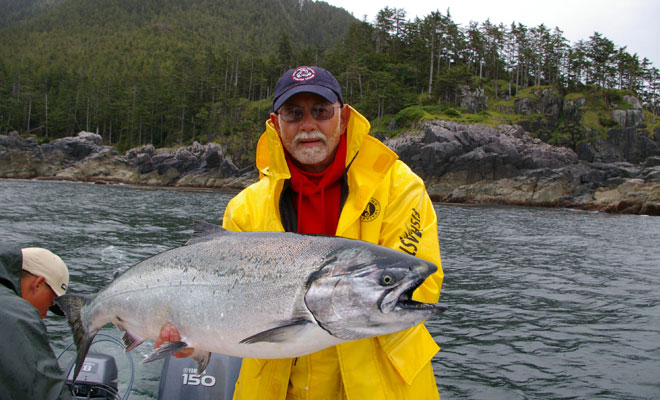
Short version: the king is a player, makes four long runs, twice circles the boat forcing me to bury the rod tip under the keel and prop and follow. After it has made the standard king boat run, is truly played out, and on its side, only then do I reach for the net. I turn on the reel clicker as a guard against backlash should the big fish dive, flip the clutch into free-spool and with thumb on the spool I pull the fish close, drop the rod and reel to the floor behind my legs and with both hands shove the big net under the king’s head and shoulders and hold on as it thrashes deep into the mesh.
Two-ounces under 40 pounds on the lodge’s electronic scale.
Kiss the kelp and tickle rocks. Big kings live in strange places.
###
Terry W. Sheely is a contributing editor for Fish Alaska magazine and can be reached through his website. [/emember_protected] [emember_protected scope=”not_logged_in_users_only”]
- Need to subscribe? Now’s a good time! Check out our current subscription specials!
- Already a subscriber? Login below to access all of our online articles and content!