

by Troy Letherman
“This land of bounty has provided for our families, our culture and our traditional way of life for tens of thousands of years,” says Lydia Olympic, a Yupik/Sugpiaq from the village of Igiugig, which is located on the shores of Lake Iliamna in the Bristol Bay region of southwest Alaska.
These days, a good bit of Olympic’s time is spent organizing and educating people on the development proposals that could threaten Bristol Bay’s fisheries resources, but she still finds time every summer to return home to help her family harvest and dry salmon at their fish camp. Of course, the fisheries represented in this small slice of Alaska are second to none, so there’s definitely a need for extra hands once the salmon start to return. [emember_protected custom_msg=’This content is available for subscribers only.’]
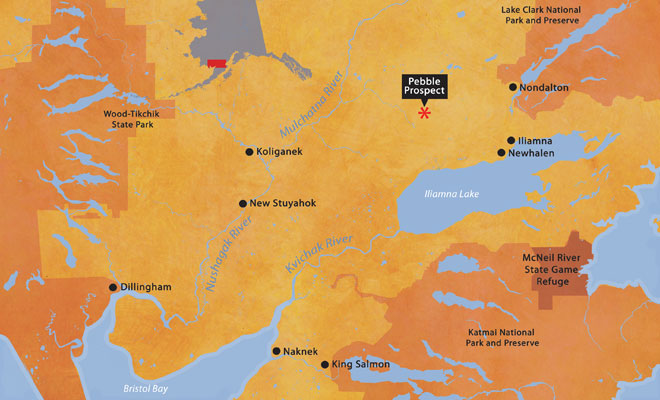
The area around Olympic’s ancestral home supports a flourishing riparian habitat, and in turn, the world’s largest sockeye salmon runs – about 37.5 million fish return annually to Bristol Bay drainages, with the Kvichak River sustaining the planet’s largest single-river return. The area is also home to one of the heftiest Chinook salmon runs in North America (the Nushagak River hosts the fourth largest, in fact) and Alaska’s first designated trophy trout area, which attracts more wilderness recreation than any other spot in the state.
In all, each of Alaska’s five species of Pacific salmon return to nearby drainages, providing the foundation for thriving lodge, guide, outfitter and transporter services. Also of note: the Bristol Bay commercial fishery is the most productive on Earth, accounting for 46 percent of the world’s wild sockeye salmon and an annual commercial harvest of 27.5 million fish (1990-2010). The region’s bounty continues through 35 different fish species, more than 190 bird species and 40 animal species, including the Mulchatna caribou herd.
However, nearly 800 square miles of contiguous mining claims are now staked on the watershed divide of two of Bristol Bay’s largest salmon producers – the aforementioned Nushagak and Kvichak river drainages. By far the largest of the proposed developments, the Pebble Mine also represents one of the most significant deposits of its kind in the world. Based on information provided by Canadian-based Northern Dynasty Minerals, Ltd., which is developing the prospect with London-based Anglo American, Pebble has the potential to produce more than 80 billion pounds of copper, more than 107 million ounces of gold and 5.6 billion pounds of molybdenum. The companies also say the mine could provide an estimated 1,000 full-time jobs.
Many, such as Olympic, worry about both the direct and indirect impacts on fish habitat and ecosystem function that would result from industrial mining of the scale necessary to develop Pebble.
“This land is what we call home,” she continued. “We need our lands and waters to stay pristine to continue living healthy lifestyles.”
Having served seven years on the Igiugig Village Tribal Council, as well as being the Vice-Chairman of the National Tribal Operations Committee for the U.S. Environmental Protection Agency, Olympic is well-positioned to comment on the potential effects the mine could have for the people of Iliamna country. But hers is by no means a solitary voice.
Bobby Andrew, a lifelong subsistence hunter and fisherman who lives in Dillingham and who strongly opposes the proposed mine, fears the impact Pebble could have on the area’s subsistence resources. “I find myself fighting for the future of our renewable fish and wildlife resources,” he stated. “They are the central part of my culture.”
Also a spokesman for Nunamta Aulukestai (Caretakers of the Land), an association of eight Alaska Native village corporations in Bristol Bay, Andrew’s views are shared by a majority in the region, according to a poll conducted by Dittman Research & Communications earlier this year. The survey of Bristol Bay Native Corporation shareholders showed that a significant number – 38 percent – supported mining in general, though 57 percent of those remained opposed to the Pebble project. By region, 93% of the people in the Nushagak sub-region oppose the mine, while 90% are against it in the Togiak sub-region. Eighty-six percent are opposed in the Ugashik region, with Chignik, Naknek and Iliamna reporting Pebble-opposition numbers of 75-, 74- and 68 percent respectively.
In a release, corporation President and CEO Jason Metrokin explained further. “BBNC supports responsible resource development, but opposes the Pebble project due to the risks it poses to our fisheries and our Native way of life. Like our shareholders,” Metrokin continued, “we believe there are other projects that could be developed in our region that would provide jobs and other economic benefits that would not present unacceptable environmental risks to our people and our land.”
This comes at the same time as the U.S. Environmental Protection Agency has released a new study initiated at the request of a nine Alaska Native tribes, two commercial fishing organizations, the Bristol Bay Native Corporation and others, asking the EPA for a restriction on permits that would allow for the disposal of dredge and fill material (mine waste) into waters within the Bristol Bay watershed. The draft report, presented as a look at the impacts of the type of mining necessary to successfully develop the deposit, concluded that large-scale mining would indeed have significant impacts on fish habitat, even without a major problem such as the failure of a dam holding mine tailings. This, according to the study, is due to the fact that development of the needed scale would require the elimination or blocking of streams, removal of wetlands and a reduction in the amount and quality of fish habitat as freshwater is used for mine operations.
Like much concerning Pebble, the report has only added more fuel to the debate, with proponents and even some state officials quick to suggest that the federal agency was reaching beyond its authority, while those who oppose the potential mine lauded the effort as well-timed and necessary.
“We welcome EPA’s science-based look at the potential threat of large scale mining in the Bristol Bay watershed,” said Tim Bristol, Alaska Program Manager for Trout Unlimited. “The agency’s actions are based on the requests of multiple stakeholders from the Bristol Bay region and provide decision-makers the information they need to determine its future.”
The EPA study reiterated that the Pebble prospect’s low-grade ore means a mine will be economic only if conducted over a large area, and therefore, a large amount of waste material will be produced. The entirety of the proposed project actually entails two mines, Pebble East and Pebble West. In the former, the minerals are of higher quality but deeper in the ground, thus most likely requiring an underground mine. If Pebble West were to be developed, it would almost certainly require an open pit mine, with the potential to become North America’s largest, producing up to 10 billion tons of mine waste. Some of that waste would become toxic and would need to be treated and stored in perpetuity.
While noting that the Bristol Bay watershed ecosystem is intact, with clean water and very large salmon stocks, the EPA also examined the importance of the region’s salmon in sustaining the traditional subsistence lifestyle of Native villages in the watershed. The assessment included detailed reports on Bristol Bay indigenous culture, wildlife and economics, as well as salmon and other fish species. It did not, however, offer a verdict on whether the Pebble Mine project should move forward.
But for many, such as Trout Unlimited’s Alaska Commercial Fishing/Outreach Director, Lindsey Bloom, it’s a great start.
“I think the EPA’s Watershed Assessment is awesome,” she said. “This is the first government agency or voice of decision-making authority who’s really listened. Before it always felt like our concerns were falling on deaf ears.”
A lifelong Alaskan, Bloom started commercial fishing with her father at the age of 16 and now owns the gillnet boat Rainy Dawn. “As a longtime participant in the Bristol Bay fishery, this is a personal issue,” she continued. “For me it’s all about the fish habitat, as we’re all just incredibly dependent upon these fish coming back year after year.”
Having worked on theissue for the past seven years, Bloom says it’s been a pleasure to find commercial and sport fisherman “totally on the same page” when it comes to Pebble.
“It’s a clear and total consensus,” she explained. “I feel privileged to work, lobby and stand hand-in-hand with not only the other commercial fishermen who own businesses in Bristol Bay, but also sport fishermen from across Alaska and beyond, as well as tribal leaders and subsistence users from the region. The bottom line for all of us is that the fish are the priority resource for Bristol Bay. They need to be protected.”
Since the release of the assessment, the EPA has been conducting public hearings across the state, gathering information and gauging opinions from citizens and various stakeholders. Under section 404(c) of the Clean Water Act, the agency can prohibit the use of an area as a disposal site for fill material, even before a company applies for a permit, if it’s determined that discharge will present unacceptable adverse effects on wildlife or fish. To date the EPA has made no judgments about the use of its regulatory authority under the Clean Water Act (since 1972, when the act became law, such authority has only been used 13 times).
Pebble proponents, meanwhile, caution that there isn’t even a complete proposal yet, and that Alaskans should let the process play out. But as Bloom and others have noted, once the permitting process has begun, the State of Alaska has never before rejected a large mining project. For many, that’s just too big a risk to take.
“This region provides thousands of local, renewable commercial- and sport-fishing jobs, and generates over $300 million of annual in-state revenue,” finished Trout Unlimited’s Tim Bristol. “To risk all of that so we can satisfy far away mining company shareholders is both short-sighted and irresponsible.”
In Bristol Bay, over 40 million salmon returned to their pristine natal waters last summer. Commercial fishermen set their nets for the 127th consecutive year, harvesting over 30 million fish. Sport anglers from across the country and even the world made the long haul to the region’s numerous rivers and streams, angling for the abundant salmon, trout, char and grayling. And as they’ve done for thousands of years, Alaska Natives harvested tens of thousands of salmon, smoking, salting, canning and storing for winter.
A thousand more is the goal, for as Lydia Olympic notes, “We will still be here long after the mining companies have left.”
###
Troy Letherman is editor of Fish Alaska magazine.
If you feel that the development of Pebble is an unacceptable risk to the largest wild salmon fishery on earth, urge your representatives and Alaska Governor Sean Parnell to stop the Pebble Mine. Your voice can make a difference right now – make the Pebble Pledge at www.pebblepledge.com.
For more information, please visit:
www.renewableresourcescoalition.org [/emember_protected] [emember_protected scope=”not_logged_in_users_only”]
- Need to subscribe? Now’s a good time! Check out our current subscription specials!
- Already a subscriber? Login below to access all of our online articles and content!