


Story and photo by Scott Haugen
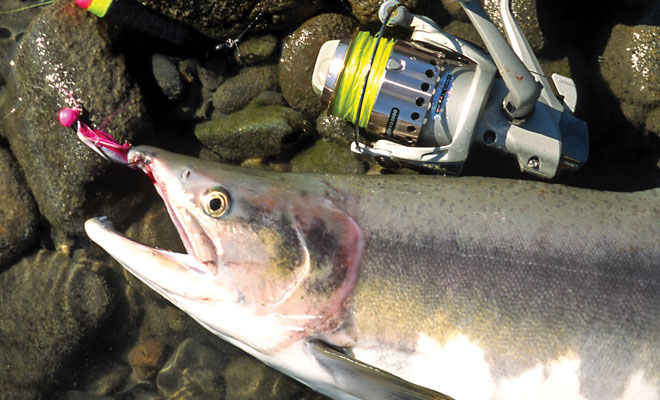
For many anglers around the world, their dream trip consists of nothing more than landing high numbers of salmon in a single day. If this is your goal, pink salmon are a worthy target.
The river was loaded with pink salmon, or humpies, as they are often called. The question wasn’t a matter of if we were going to catch fish, but how many. Starting off with bobber and jig, the action began on the first cast. Nearly every cast produced a fish, and if one wasn’t landed and released, one was at least hooked and lost.
Swapping out the jig for a spinner setup, the scrappy salmon continued to pound our offerings. Then came time for the fly rod, where bright streamer patterns proved to be the ticket, followed by micro-jigs nymphed along current seams. [emember_protected custom_msg=’This content is available for subscribers only.’]
Over the course of the morning and into mid-afternoon, we’d try numerous setups and terminal gear presentations. My buddy and I would end up landing and releasing over 130 pink salmon. Then we relocated to another river and repeated the process, with nearly the same results. By day’s end, we’d land and release over 100 pink salmon each, something longtime anglers and Alaskan residents know is not an unrealistic figure when you find yourself in the right situation.
If you’re looking for high-catch action, and perhaps the best species to hone your fishing skills on, the pink salmon is tough to beat. Some king and coho purists scoff at the thought of targeting pink salmon, but if your desire is to head to Alaska and experience what big-number salmon catching is all about, pinks are tough to beat.
I’ve been blessed to catch and release upwards of 60 silvers a day, as well as 50-plus kings, but when it comes to breaking the century mark on a daily basis, pinks are where it’s at, save for bursts of red salmon up select rivers. Though they are not as big or as strong as kings or coho, pinks are aggressive, hard-fighting fish for their size, and their tenacious behavior results in their attacking a wide range of tackle.
Meet The Pink Salmon
Pink, or humpback salmon as they are named due to the large, sharp hump that develops on the back of spawning bucks, are found in most inter-tidal regions across Alaska. Humpies average three to four pounds at adulthood, measuring 20 to 25 inches. Seven and eight-pound pinks are not uncommon, but the state record of 12 pounds, 9 ounces has stood since 1974, and came from the famed Kenai River.
Pinks spend only one year at sea before reentering rivers, thus explaining why the bulk of Alaska’s wild runs make their way into rivers on even numbered years, such as this. However, in some drainages, there may be cyclical shifts of dominant runs, meaning a previously weak, odd-year run, may become plentiful.
Upon entering rivers, pink salmon are silver-bright with a blue back and pronounced black spots, making them difficult to distinguish from other anadromous species. In the males, or bucks, the silvery appearance gives way to yellowish-brown, sometimes even black skin, above a white belly. Hens, or females, turn olive green with obscure patches or bars running above their pale belly.
Alaska’s pink salmon enter streams from late June into mid-October and travel short distances prior to commencing the act of spawning. Spawning in the inter-tidal zones and mouths of streams is common, which explains why fishing them in bays, estuaries, and river mouths can be so productive.
Within a couple weeks of spawning, both the males and females perish. Life, however, carries on, with the hatching of eggs in early- to mid-winter. In spring they emerge from the gravel and move to sea. Once in saltwater, juvenile pink salmon congregate in large schools, hugging beach lines near the surface where they feed on plankton, larval fishes, and even insects. The following year, at age two, pinks begin their death swim into rivers, where the circle of life continues.
To gain a better understanding of how important the pink salmon is to Alaska, in 1991 a commercial harvest in the state accounted for 96% of the entire North American harvest. From 1983 to 1992, an annual average of 77.4 million pink salmon were harvested in Alaska, and this not including subsistence- and sport-caught fish. At some point in an angler’s career, pinks are a salmon you’ll want to make a conscious effort to pursue.
Mastering a Technique
Be it a technique or form of gear, one of the toughest things for anglers to do is to try something new. Building confidence in the ability to master an unfamiliar form of fishing is tough, for it requires time as well as a certain degree of trial and error.
For instance, perhaps you’re interested in mastering the art of jig fishing for steelhead but are hesitant to apply the method for fear of losing valuable fishing time, or question whether or not you’re even doing it right. Using a bobber and jig for steelhead and coho, in particular, is very effective, and what better place to learn this approach than on pink salmon?
Personally, I’ve found a 10- to 10H-foot, 2-piece float rod such as the G. Loomis STR1265S, to be an ideal choice. Pair this with a Shimano Symetre SY2500 reel spooled with 14- or 20-pound FireLine, in flame green, and you’re almost there. Next comes the float, and there are many on the market today. I’ve been very pleased with the foam West Coast Floats as they are particularly sensitive and easy to read. As for the jig, there are also many forms of these available to anglers today, with my personal favorite being the Stuart Steelhead Bullet, due to its durable construction and effective color combinations.
The setup is simple. First, thread a bobber stop on to the mainline, followed by a 3mm bead and the float. The bobber stop serves as the depth regulator, as it can be freely moved up and down the line. Tie the mainline to a size 7 barrel swivel, then a two foot leader topped with the jig of choice. Match the weight of the jig with the weight of the float and you’ll get a true read on what’s happening beneath the water.
The beauty of jig fishing, especially for a bank angler, is there’s no better way to cover water from one place. The line can be cast high upstream and then fished downstream to the point where it disappears from sight. Continual mending of the line is critical, keeping the slack on the upstream side of the float. This ensures the presentation is at the natural rate of the river, which is perhaps the most critical element of effective jig fishing.
This is where pink salmon prove a valuable teaching tool. Pink salmon thrive on pink or pink/white jig combinations, which eliminates the guesswork. From that point, experiment with depths and leader length. One of my most valuable jig fishing lessons came while pink fishing. The water was shallow, forcing me to peg the float tight to the swivel and shorten my leader to about four inches. It worked, as the fish hit it very aggressively. Since discovering this shallow-water presentation, I’ve used it very effectively on silvers and steelhead, which were not shy of the float or the floating line, even in clear water.
In deeper slots, vary your fishing depth to find out where the strike zone is. This is where having polarized sunglasses such as those from Smith Action Optics can help, for they allow you to spot fish prior to casting. Work the jig high above them and gradually lengthen it to find out how far the fish will travel to strike. Once the strike zone is learned, carry that knowledge over to other fish species. At this point, it’s just a matter putting in the time, reading water, and getting on the river to further perfect your jig fishing skills.
High Numbers
Not only can one specific technique be mastered on pinks, but various approaches can be applied. Maybe you want to try out new reels and rods; there’s no better place to do it than on fish, and lots of them. Perhaps the intent is to hone your spinner or wobble lure fishingskills, or learn how to nymph fish or swing flies. Maybe effectively fishing a micro-jig beneath a strike indicator is what you want to accomplish. There’s much to learn, and the best classroom is a river full of salmon.
Many of the how-to articles you read in Fish Alaska magazine, even though they focus on other salmon species, can be applied and learned on pinks. Once mastered on pinks, they can then be applied on your more elusive target species, be they salmon, steelhead, or trout.
As pink salmon enter a river, they often congregate in large schools. Find those schools and fish them with everything you’ve got, or in every way you yearn to learn. Mind you, schools are not the same as spawning grounds, though these fish often do construct redds in very close proximity to one another, giving illusion to the schooling effect. As in all salmon fishing, avoid pulling pinks from their shallow-habitat beds, instead focusing efforts on fresh fish concentrating in holding zones.
Once you find a big school of fish, pick a method and fish it until you feel confident; then switch to another method. Once that approach is dialed-in, shift to another, and then another. Not only will offering these fish something different result in more fish being caught, but the change in presentation allows you to raise your skill level on each one. When the fish quit biting in that hole, on all you can throw at them, move on to another setting and try it all over again.
As you change locations, factors such as stream gradient, rate of flow, water clarity, water temperature, barometric pressure, and fishing pressure are some of the components that play-in to how cooperative fish will be. The key to successfully increasing your fishing repertoire—or at least deeming a specific approach or piece of terminal gear effective or not effective—comes with practice on actual fish. From there, it’s a matter of putting in the time to becoming proficient with a specified technique and confident enough to apply them in more challenging rivers and on more finicky fish.
For fly anglers, don’t overlook bays and estuaries to help build casting skills or learn a new technique. Maybe Spey casting is something you wish to take up, or maybe you would like to enhance your long-range casting with various-type lines. These waters are wide open and offer the perfect setting to learn such styles. Take the Valdez area, for instance. This is likely the best pink salmon fishery on the planet, and fly anglers and hardware tossers can not only catch numerous fish in habitats like this, but learn a lot at the same time. Personally, I’ve learned a great deal by fishing pink salmon scattered throughout Alaska’s many bays and estuaries.
The Initiation
No matter an angler’s age, catching fish, and lots of them, is a thrill. I know of numerous anglers of retirement age and beyond, who plan their Alaska fishing adventure around pink salmon, and travel to the Great Land every other year just for these fish.
Then there are the families who plan a vacation later in the summer, once the king and red salmon crowds have moved on. Such timing is not by chance, rather precisely thought out to coincide with pink runs in order to maximize the fishing experience for the youngsters in the family.
Looking to get a newcomer hooked on fishing? There are few opportunities which allow anglers to catch as many fish at one time as pink salmon. The best part, these fish are readily available on many roadside fisheries, making for easy access and instant success.
When the family is traveling together, especially with young kids, short attention spans are the norm and must not be ignored. It only takes one negative experience to turn a kid away from fishing. Get kids on fish, quick, keep their spirits high, and leave when it’s time, no later. To be able to offer these lessons on actual, hard-fighting fish is invaluable, and can make the difference between getting someone hooked on sport fishing for life, or losing them to other interests.
Alaska’s pink salmon are worth the investment; the investment in time, money, gear, and more. No matter your level of expertise, what can be learned from pursuing these hard-fighting fish only enhances fishing skills which can be applied elsewhere. Not to mention, if you’re looking to land more than 100 salmon in a day, there’s no better choice. The fish will be there, it’s a simple matter of taking that dream vacation to Alaska and discovering all this great fish has to offer.
Scott Haugen is a contributing editor for Fish Alaska magazine. [/emember_protected] [emember_protected scope=”not_logged_in_users_only”]
- Need to subscribe? Now’s a good time! Check out our current subscription specials!
- Already a subscriber? Login below to access all of our online articles and content!