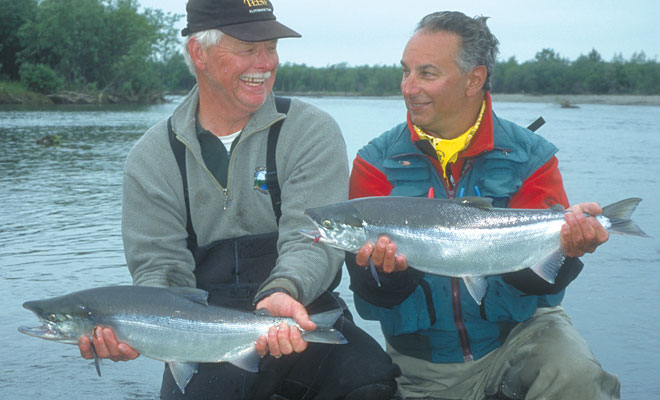
Non-Biters or Great Gamefish?
by Jim Teeny
The year 1975 marked my first trip to Alaska. We went in July and I traveled and fished with Dr. Jim Hodson and his son Kip from Redmond, Oregon. Bob and Linda Morton at that time ran a very comfortable Alaskan operation for traveling fishermen. They were based out of the village of Iliamna, a very famous area for trophy trout.
Ahead of us was the unknown, concerning both the fishing and the terrain.
Once we arrived at our destination the first plan was to purchase a license so we could go fishing. We asked many questions about angling prospects and one of them was in regards to the type of salmon running at that particular time. The answer was sockeye. It was explained that they don’t bite, but that we would probably snag them because of the sheer numbers of fish in the river. Both Jim Hodson and I let it be known we did not come to Alaska to snag fish. [emember_protected custom_msg=’This content is available for subscribers only.’]
We got our gear ready, and because the days are so long in July, Bob asked us if we would like to fish for a while. He suggested the very big and beautiful Newhalen River, which is a major tributary into Lake Iliamna and holds rainbow trout, sockeye, grayling, and even northern pike in selected areas. Taking our guide’s advice, we got in his truck and basically drove to the end of the road where Alexy Creek empties into the Newhalen River. It didn’t take long for our flies and fly lines to hit the water. As we worked our way upriver, I looked into the water with my polarized glasses and saw so many fish it was truly hard to believe.
At that time I was fishing a sink-tip line and had our Teeny Nymphs in burgundy and Blue Dunn colors (which we no longer offer). I made a couple of casts to the fish, with no strikes. I then put on a #4 burgundy Teeny Nymph and the action began. What happened that afternoon and the next day, I truly believe, changed sockeye salmon fishing in Alaska.
That first evening when we got back to the lodge we could not stop talking about the great fishing. An Alaska Department of Fish and Game officer got wind of how many fish we had landed and wanted to know if it would be okay to follow us the next day.
The next morning we drove up to our spot on the Newhalen, while he followed with his floatplane and landed just below us. He cast lures while we fished our Teeny Nymphs. At the end of the day he had not taken one fair-hooked salmon, while he watched us catch-and-release somewhere between 65 and 70 fair-hooked sockeye. The game warden told us he had never seen such fishing for sockeye salmon, and he felt this could be the start of a new sport fishery for the state of Alaska. It was!
What I learned in 1975 has helped me with a lot of other delicate-type fishing situations. For several years we would submit sockeye salmon to the IGFA for world records, and they would never accept them because they did not feel sockeye were a gamefish. With the addition of kokanee salmon to the IGFA record books in 1977, my friends and I again submitted our big sockeye, since they are basically the same fish (kokanee are land-locked sockeye salmon). We asked that they either be recognized as kokanee or a sockeye category be started. The largest I sent in certified at 14.6 pounds two days after I caught it but was denied like all of the others. The following year, 1978, they finally added sockeye salmon to the list, recognizing them as a gamefish.
It is my opinion sockeye started getting their bad reputation for not biting from impatient anglers. If you want to fair-hook sockeye salmon and you are willing to try, you can do it.
There are a few important aspects of sockeye fishing that cannot be overlooked when searching for more consistent success. In my opinion, most anglers that fish for sockeye have a tendency to do a few things wrong. Number one is over-wading a river or stream. By this I mean standing in the water too deep. What I’ve learned about sockeye is that when given the choice, they will swim in shallow water close to the shoreline. They also like to travel more rocky, gravel-type areas if available. If you step into the water and wade out, the fish will swim around you, forced into deeper water.
They are much easier to see when they are traveling in shallow water, and thus, they are much easier to hook as well. When sockeye first enter freshwater they are silvery bright and shimmer like ghosts in the current. I often look for V’s in the water as they are slowly moving upstream. Once they start to lose their silver color and pick up their spawning colors, they are much easier to see. Still, not every place you find sockeye will be good to fish from. That is one of the more difficult tasks you will need to overcome. It may mean moving until everything comes together just right, as water speed and depth are important in making the proper presentation. If I can find a nice place to stand, I will roll cast and make my presentation. This means the fish will normally be less than 50 feet in front of me or downstream, moving up towards me. Sometimes they can be as close as 20 or 30 feet. What is very important is to dead drift your fly drag-free to and by the fish. If they are traveling fish you will not get all of them to take your fly. If your fly picks up speed and moves faster than the current, your action will again decrease.
How you make your fly travel with the speed of the current can be a bit tricky at times. I found out the importance of a dead drift, drag-free presentation the hard way, and now I will make mends in my line to release tension so that the fly is drifting very naturally and not swinging through the current.
I have also found that for the most part sockeye are soft biters. You need to pay attention to your line while it is drifting and follow it with your rod tip so you will be more direct to the fly when fish strike. You will feel more takes and be in a much better position to set the hook or strip-strike.
There will also be times when the sockeye are holding above the angler’s position and an upstream cast will be necessary. As the fly line is drifting, you will need to pick up the slack very gently, so as to not disturb the drift of the fly. A lot of fish take flies on an upstream presentation, and these are the ones we usually miss the most. The more you pay attention and line-watch, the better you will do.
As far as equipment goes, choosing the right sockeye gear is a fairly straightforward proposition. Of all the fly lines I have ever fished for sockeye, there is none better than our Teeny Mini-Tip line. It is a weight-forward floating line with a five-foot sinking tip. This line allows you excellent control for better presentations of your fly at the proper level. In slower water, shallow riffles, and runs where fish are traveling, this is by far the best choice of fly line. When currents are stronger and where water may be deeper, you might need to put on a T-200 or T-300 line just to get your fly down to the fish. I use a shorter leader of about four feet when fishing our T-Series lines. Clear leaders seem to work the best, and I do not fish anything weaker than eight-pound test. Normally eight to 12-pound test is best. It is also a wise choice to have 30-pound backing on your spools when fishing for salmon. When your backing knot is visible, you don’t want to feel like you’re about to lose your fly line.
It has always been my policy to change colors and sizes until I find the perfect fly. As for our Teeny flies, the colors that consistently produce best are hot pink, ginger, black, chili, and hot green. Basically, these are in the nymph style, but there are a couple of exceptions. The Teeny Flash Fly combo of hot pink and ginger, in sizes of #4 and #6, are also deadly on sockeye. Last year we fished the Kenai River for sockeye and did very well on a #4 hot green egg-sucking leech.
For fly rods, I believe anywhere from a 7-weight to a 9-weight would be a good choice. My personal preference is an 8-weight Jim Teeny Signature Rod made by Lamiglas, which I’ve been fishing with excellent results. They are all 9-foot/four-piece fast action rods with a sensitive tip and strong butt section.
Every year when I head north to Alaska for some world-class fishing, sockeye rate very high for both challenge and excitement. The next time you go sockeye fishing, remember a few of these suggestions and I am sure you will be pleased with your results. Not all of the places you fish will produce tons of sockeye, so pick your spots carefully. Stay close to shore and do not over-wade. You will know when you’ve found a good spot! Also, remember that traveling lanes and channels play an important role when sockeye fishing. Don’t be afraid to experiment, as all river systems and watersheds seem to be a bit different when it comes to sockeye. And finally, please don’t believe the myth that sockeye won’t bite. How do you think they grew up? [/emember_protected] [emember_protected scope=”not_logged_in_users_only”]
- Need to subscribe? Now’s a good time! Check out our current subscription specials!
- Already a subscriber? Login below to access all of our online articles and content!

